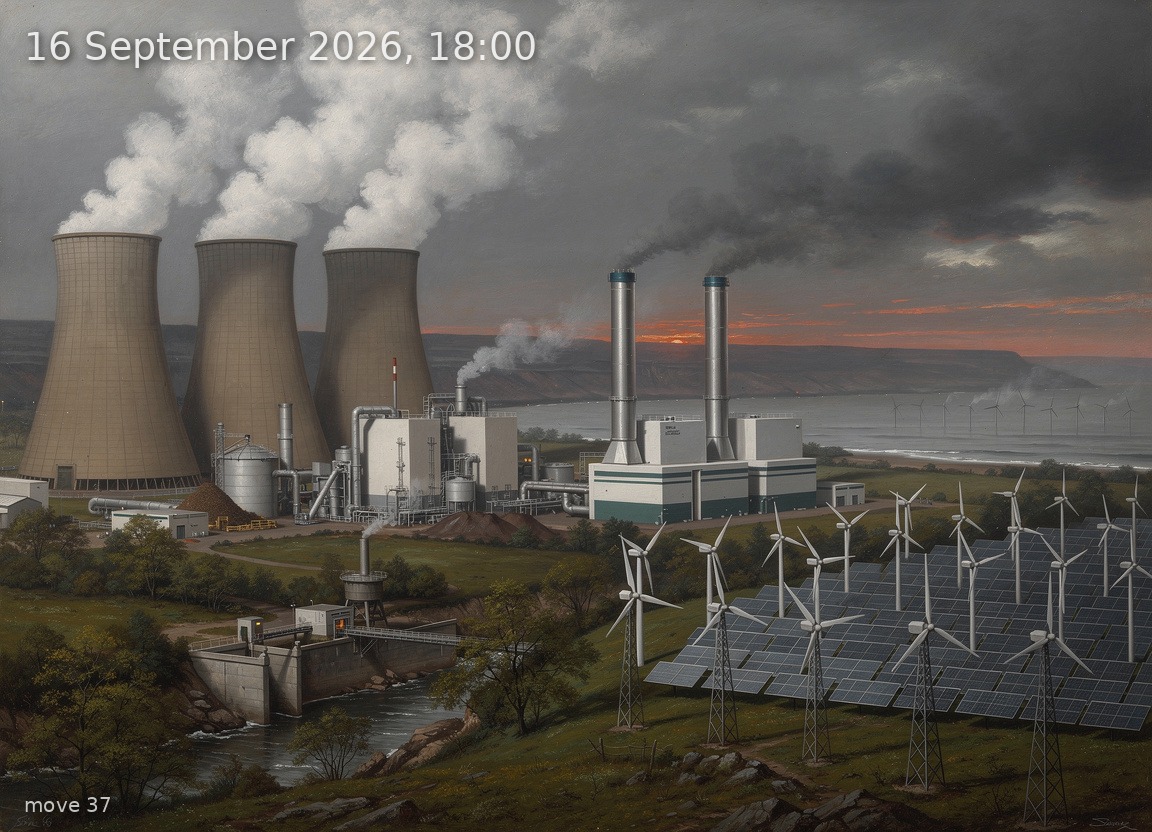
Brown coal, wind, and gas anchor generation while 13.5 GW net imports fill the evening demand gap.
Generation mix
Wind onshore 23%
Wind offshore 8%
Solar 8%
Biomass 9%
Hydro 2%
Natural gas 13%
Hard coal 12%
Brown coal 25%
50%
Renewable share
14.0 GW
Wind (on + offshore)
3.7 GW
Solar
45.4 GW
Total generation
13.4 GW
Net import
231.1 EUR/MWh
Day-ahead price
17.8°C / 21 km/h
Temp / Wind speed
Open-Meteo, Kassel (51.3°N 9.5°E) · surface estimate from 100 m wind
100.0% / 50.0 W/m²
Cloud cover / Radiation
359
gCO₂/kWh
Image prompt
Brown coal 11.2 GW dominates the left third of the scene as a massive lignite power station with four hyperbolic cooling towers emitting thick white steam plumes into the overcast sky; hard coal 5.6 GW appears just right of centre as two rectangular coal-fired boiler houses with tall chimneys trailing dark exhaust; natural gas 6.0 GW sits centre-right as two sleek CCGT combined-cycle units with single polished exhaust stacks venting thin heat shimmer; wind onshore 10.3 GW spans the right third as a deep field of dozens of three-blade turbines on lattice and tubular towers, blades visibly turning in moderate wind; wind offshore 3.7 GW is suggested in the far-right background as a row of turbines standing in a hazy grey sea along the horizon; solar 3.7 GW appears as a modest array of aluminium-framed crystalline silicon panels on a gentle slope in the mid-ground, their surfaces reflecting only flat grey sky with no direct sunlight; biomass 4.0 GW is rendered as a medium-sized industrial facility with a wood-chip silo and single exhaust stack near the coal plants; hydro 1.0 GW appears as a small concrete dam and powerhouse nestled beside a river in the lower foreground. The time is 18:00 in mid-September — dusk lighting with a fading orange-red glow barely visible on the low western horizon, the sky above completely overcast in heavy grey-pewter clouds with no blue visible, the upper sky already darkening toward deep slate. The atmosphere feels heavy and oppressive, reflecting the very high electricity price. Vegetation is late-summer green beginning to show early autumn yellowing. Wind bends grasses and ruffles trees at moderate strength. Rendered as a highly detailed oil painting in the tradition of 19th-century German Romantic landscape painters — rich, sombre colour palette of umber, slate grey, warm orange at the horizon, deep greens; visible confident brushwork; atmospheric depth with industrial haze softening distant turbines; meticulous engineering accuracy on every turbine nacelle, cooling tower profile, and panel frame. The composition evokes the grandeur and unease of Caspar David Friedrich meeting industrial reality. No text, no labels.