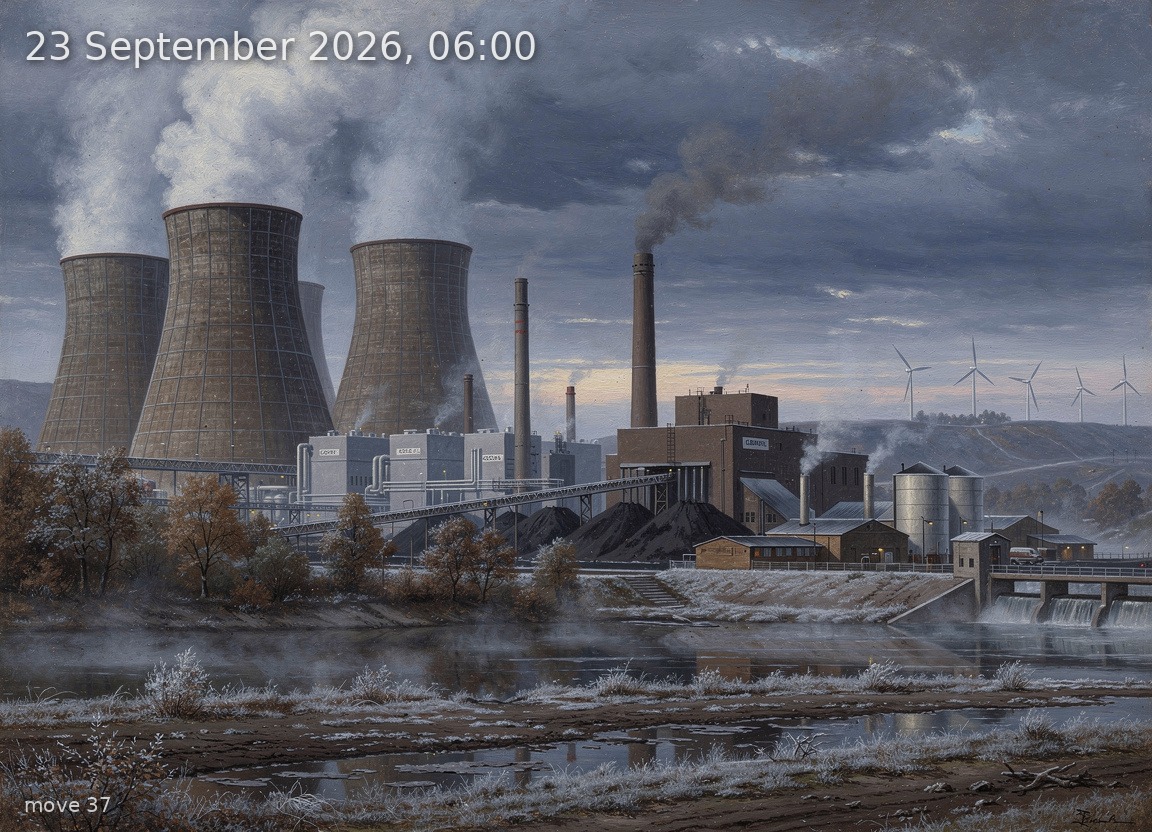
Brown coal, gas, and hard coal dominate as calm, overcast conditions eliminate wind and solar, driving heavy imports and high prices.
Generation mix
Wind onshore 4%
Wind offshore 1%
Solar 0%
Biomass 12%
Hydro 3%
Natural gas 26%
Hard coal 16%
Brown coal 37%
20%
Renewable share
1.7 GW
Wind (on + offshore)
0.0 GW
Solar
31.4 GW
Total generation
21.3 GW
Net import
300.0 EUR/MWh
Day-ahead price
5.3°C / 2 km/h
Temp / Wind speed
Open-Meteo, Kassel (51.3°N 9.5°E) · surface estimate from 100 m wind
100.0% / 0.0 W/m²
Cloud cover / Radiation
554
gCO₂/kWh
Image prompt
Brown coal 11.7 GW dominates the left third of the scene as a vast complex of hyperbolic cooling towers with thick white-grey steam plumes merging into the overcast sky; natural gas 8.3 GW fills the center-left as a row of compact CCGT plants with tall single exhaust stacks emitting thin heat shimmer; hard coal 5.0 GW appears center-right as a blocky power station with conveyor belts and a single large chimney trailing dark smoke; biomass 3.7 GW sits to the right as a cluster of smaller industrial buildings with wood-chip silos and modest stacks; wind onshore 1.3 GW is visible as a handful of distant three-blade turbines on a ridge, their rotors barely turning; hydro 1.0 GW appears as a small concrete dam and penstock structure at the far right edge near a river; wind offshore 0.4 GW is faintly suggested by two or three turbines on the far horizon line. Time is 6:00 AM late September dawn: the sky is a deep blue-grey with the faintest pale luminescence along the eastern horizon, no direct sunlight, no warm tones — only cold pre-dawn half-light. Overcast is total, a low blanket of stratus clouds pressing down oppressively. Temperature is near freezing: frost rims the grass and bare patches of mud in the foreground, autumn trees show thinning brown-gold foliage, breath-like mist hangs low over the river. Wind is essentially nil — smoke and steam rise vertically, no flags fluttering, dead-calm atmosphere. The mood is heavy and oppressive, reflecting extreme electricity prices: the air feels thick, the industrial infrastructure looms large and monumental against the suffocating cloud ceiling. Painted in the style of a highly detailed 19th-century German Romantic oil painting — rich impasto brushwork, deep chiaroscuro, atmospheric perspective with haze softening distant cooling towers, meticulous engineering accuracy on every turbine nacelle, lattice tower, conveyor belt, and cooling tower shell. No text, no labels, no solar panels visible anywhere.