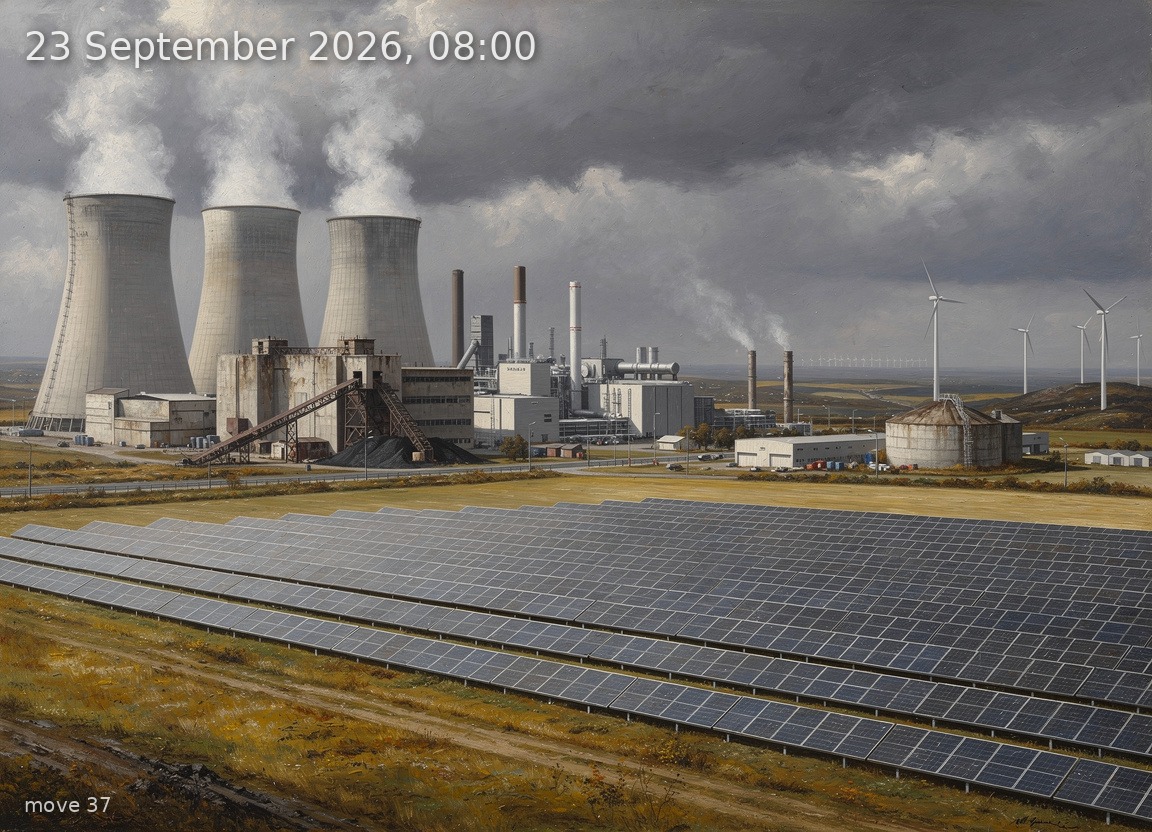
Brown coal, gas, and hard coal dominate as calm, overcast conditions suppress wind and limit solar to diffuse output.
Generation mix
Wind onshore 3%
Wind offshore 1%
Solar 27%
Biomass 9%
Hydro 2%
Natural gas 20%
Hard coal 11%
Brown coal 26%
43%
Renewable share
2.0 GW
Wind (on + offshore)
12.3 GW
Solar
44.9 GW
Total generation
15.0 GW
Net import
232.1 EUR/MWh
Day-ahead price
5.1°C / 2 km/h
Temp / Wind speed
Open-Meteo, Kassel (51.3°N 9.5°E) · surface estimate from 100 m wind
100.0% / 0.0 W/m²
Cloud cover / Radiation
397
gCO₂/kWh
Image prompt
Brown coal 11.9 GW occupies the left third of the scene as a massive lignite power complex with four hyperbolic cooling towers billowing thick white-grey steam plumes into a heavy overcast sky; solar 12.3 GW fills the centre-right foreground as vast fields of aluminium-framed crystalline silicon PV panels stretching across flat agricultural land, their surfaces dull and matte under diffuse grey light with no sun reflections; natural gas 8.8 GW appears as a cluster of modern CCGT plants with slender exhaust stacks and smaller rectangular cooling units, positioned centre-left behind the coal complex; hard coal 5.0 GW is rendered as a pair of older coal-fired plants with tall square chimneys and conveyor belts feeding dark fuel, placed between the lignite towers and gas units; biomass 4.0 GW appears as two medium-sized combined heat-and-power plants with wood-chip storage domes and modest stacks, set in the middle distance; wind onshore 1.5 GW is depicted as a handful of three-blade turbines on the far right horizon, their rotors barely turning, nearly motionless; wind offshore 0.5 GW is faintly suggested as tiny turbine silhouettes on a distant grey sea visible through a gap in the terrain at far right; hydro 1.0 GW appears as a small run-of-river weir with a powerhouse nestled along a river in the right foreground. The time is 08:00 on a late September morning: full daylight but entirely overcast at 100% cloud cover, no direct sunshine, a flat, heavy, oppressive pewter-grey sky pressing down on the landscape. Temperature is 5.1°C — early autumn chill, faint ground mist lingering in low areas, grass starting to yellow, deciduous trees showing the first bronze and copper tones of fall. The atmosphere is dense and brooding, reflecting a very high electricity price — the air feels thick, the clouds low and unbroken, a sense of industrial strain. Style: highly detailed oil painting in the tradition of 19th-century German Romantic landscape painters such as Caspar David Friedrich and Carl Blechen — rich tonal depth, visible impasto brushwork, dramatic atmospheric perspective, meticulous engineering detail on every turbine nacelle, cooling tower, PV module frame, and smokestack. No text, no labels, no human figures.