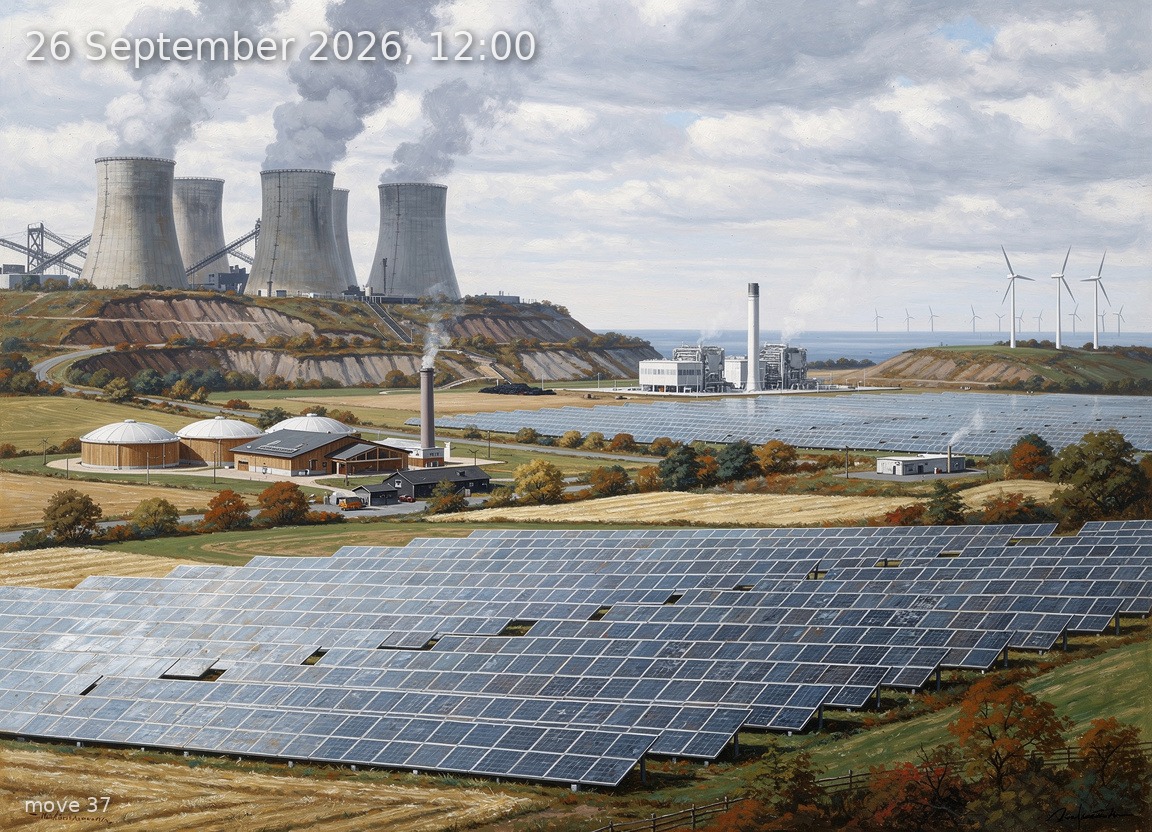
Solar at 44 GW drives 86% renewables and 8.4 GW net export, suppressing prices to 11 EUR/MWh at midday.
Generation mix
Wind onshore 2%
Wind offshore 1%
Solar 75%
Biomass 7%
Hydro 2%
Natural gas 3%
Hard coal 1%
Brown coal 9%
86%
Renewable share
1.6 GW
Wind (on + offshore)
44.0 GW
Solar
58.7 GW
Total generation
+8.5 GW
Net export
11.0 EUR/MWh
Day-ahead price
17.1°C / 13 km/h
Temp / Wind speed
Open-Meteo, Kassel (51.3°N 9.5°E) · surface estimate from 100 m wind
100.0% / 323.0 W/m²
Cloud cover / Radiation
100
gCO₂/kWh
Image prompt
Solar 44.0 GW dominates the scene as a vast expanse of aluminium-framed crystalline silicon photovoltaic panels stretching across roughly three-quarters of the composition, covering rolling hills and flat agricultural fields in neat geometric rows glinting under diffused white light. Brown coal 5.2 GW appears in the left background as a cluster of massive hyperbolic cooling towers with thick grey-white steam plumes rising into the overcast sky, flanked by conveyor belts and lignite excavation terraces. Biomass 4.0 GW sits in the mid-left as a collection of industrial biogas domes and timber-clad CHP facilities with thin exhaust streams. Natural gas 2.0 GW is rendered as a compact pair of CCGT units with single tall exhaust stacks and low transparent heat shimmer. Wind onshore 1.0 GW appears as a small group of three-blade turbines on a distant ridge, blades barely turning in light breeze. Wind offshore 0.6 GW is suggested as faint turbine silhouettes on a far horizon line. Hydro 1.1 GW appears as a small dam and powerhouse nestled in a forested valley corner. Hard coal 0.8 GW is a single smokestack facility, modest in scale, near the brown coal complex. The sky is fully overcast at 100% cloud cover but luminous and bright — a high, thin, silvery-white blanket of stratus allowing significant diffuse radiation through, lit from above as midday daylight. The landscape is early autumn: fields of faded green and gold stubble, trees showing the first amber and russet at their edges, temperature mild at 17°C. The atmosphere is calm and open, reflecting the very low electricity price — no oppressiveness, a serene pale sky. Painted as a highly detailed oil painting in the tradition of 19th-century German Romantic landscape masters such as Caspar David Friedrich and Carl Blechen, with rich layered colour, visible expressive brushwork, atmospheric aerial perspective, and meticulous engineering accuracy in every turbine nacelle, PV module frame, and cooling tower curvature. No text, no labels.