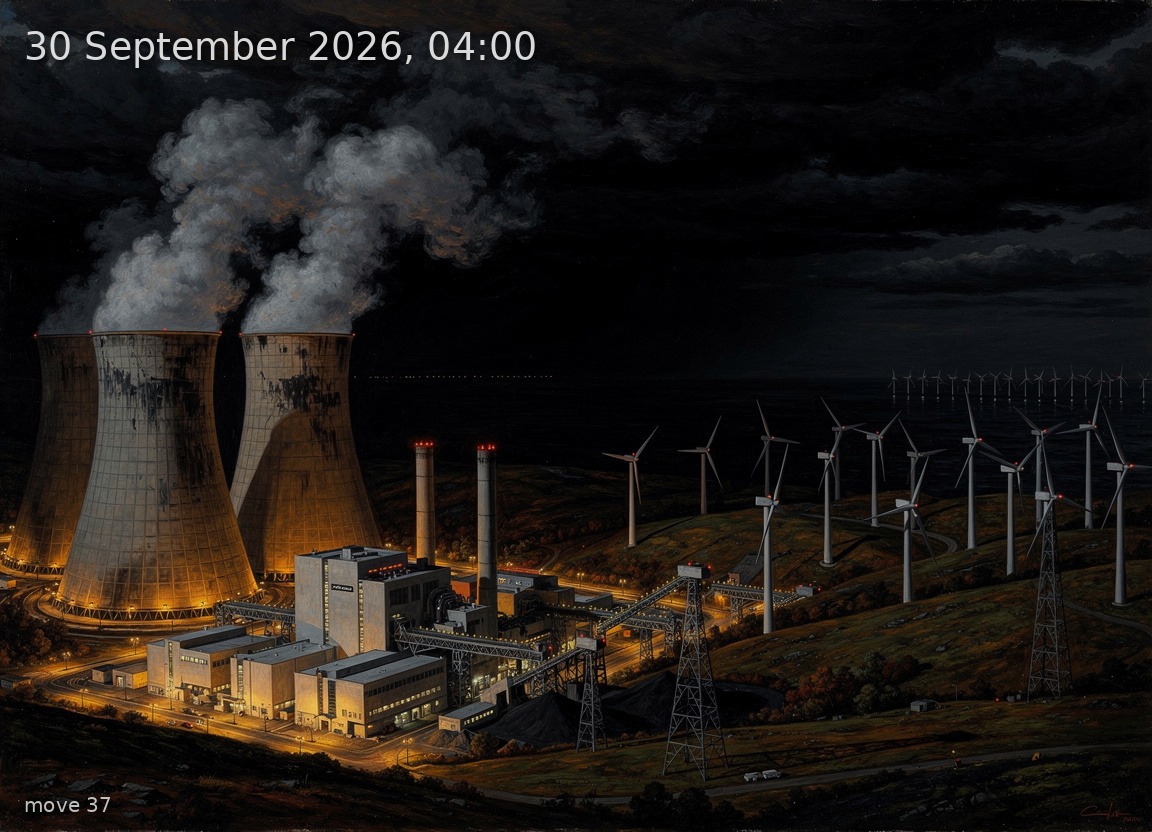
Strong overnight wind (24.4 GW) pairs with 9.9 GW brown coal baseload under elevated prices at 4 a.m.
Generation mix
Wind onshore 40%
Wind offshore 14%
Biomass 8%
Hydro 2%
Natural gas 8%
Hard coal 6%
Brown coal 22%
64%
Renewable share
24.5 GW
Wind (on + offshore)
0.0 GW
Solar
45.2 GW
Total generation
+1.0 GW
Net export
104.3 EUR/MWh
Day-ahead price
10.9°C / 2 km/h
Temp / Wind speed
Open-Meteo, Kassel (51.3°N 9.5°E) · surface estimate from 100 m wind
61.0% / 0.0 W/m²
Cloud cover / Radiation
263
gCO₂/kWh
Image prompt
Brown coal 9.9 GW occupies the left quarter as a cluster of massive hyperbolic cooling towers with thick white-grey steam plumes billowing upward into the darkness; natural gas 3.8 GW appears as two compact CCGT plants with slender single exhaust stacks and faint orange flue glow just left of centre; hard coal 2.6 GW sits as a smaller coal-fired station with a rectangular stack and conveyor structures beside the gas units; wind onshore 18.2 GW spans the entire right half and background as dozens of tall three-blade turbines on lattice and tubular towers stretching across rolling hills, their red aviation warning lights blinking; wind offshore 6.2 GW is suggested by a distant row of turbines on the far-right horizon standing in a dark sea; biomass 3.7 GW is a modest industrial facility with a wood-chip silo and low exhaust near centre-right; hydro 0.8 GW appears as a small dam spillway in the lower-right foreground with faintly lit cascading water. The scene is set at 4 a.m. in complete darkness—a black sky with no twilight glow, no stars visible through 61% cloud cover, only sodium-orange streetlights lining a road in the foreground, warm yellow-white industrial floodlights illuminating the power stations, and the red blinking nacelle lights of the wind turbines dotting the dark hills. The atmosphere is heavy and oppressive, hinting at a high electricity price: low clouds press down, trapping the steam plumes. Early-autumn vegetation—browning grass, scattered deciduous trees just beginning to turn—is barely visible in the peripheral glow of the industrial lights. Temperature around 11°C is conveyed by a thin ground mist drifting through the foreground fields. Rendered as a highly detailed oil painting in the tradition of 19th-century German Romantic landscape art—Caspar David Friedrich meets industrial sublime—with rich impasto brushwork, deep chiaroscuro, atmospheric depth receding into blackness, and meticulous engineering accuracy on every turbine nacelle, cooling tower reinforcement rib, and CCGT exhaust stack. No text, no labels.