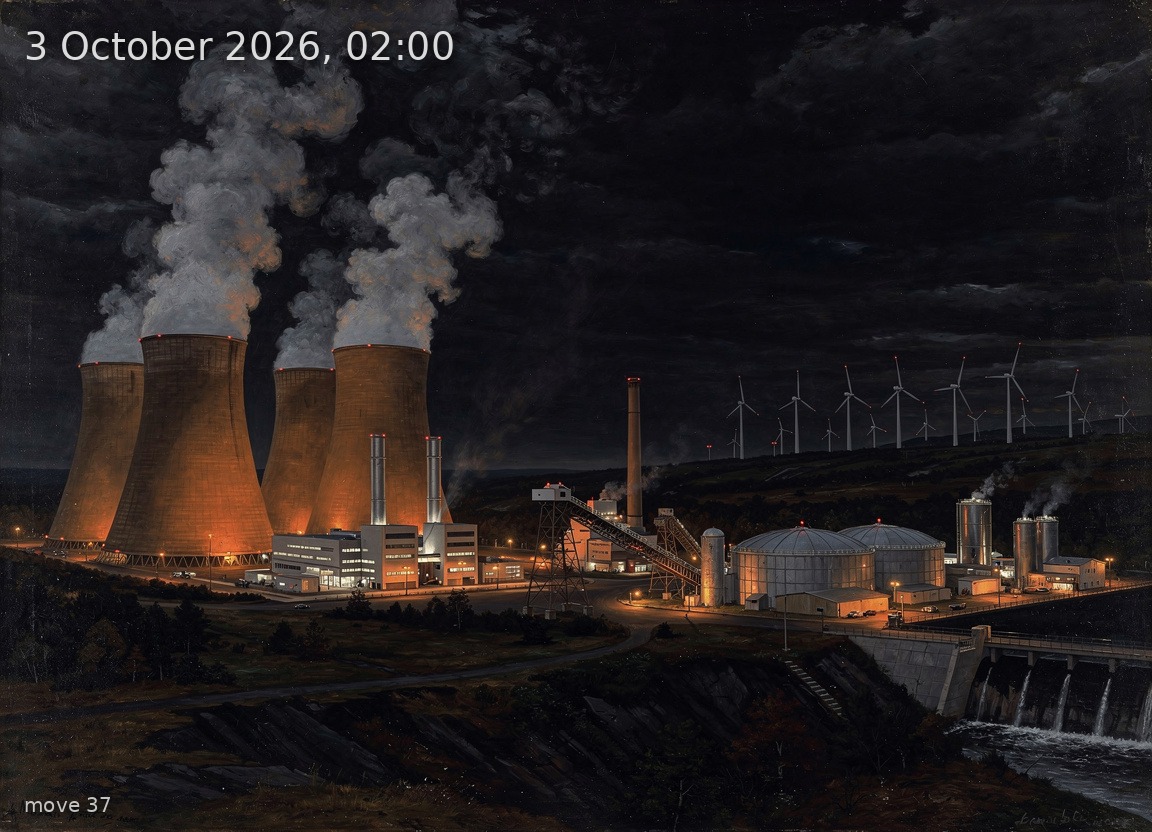
Brown coal and gas dominate overnight generation as near-calm winds and no solar force 7.2 GW of net imports.
Generation mix
Wind onshore 6%
Wind offshore 5%
Biomass 13%
Hydro 3%
Natural gas 27%
Hard coal 10%
Brown coal 37%
26%
Renewable share
3.2 GW
Wind (on + offshore)
0.0 GW
Solar
31.0 GW
Total generation
7.1 GW
Net import
173.5 EUR/MWh
Day-ahead price
9.0°C / 2 km/h
Temp / Wind speed
Open-Meteo, Kassel (51.3°N 9.5°E) · surface estimate from 100 m wind
100.0% / 0.0 W/m²
Cloud cover / Radiation
512
gCO₂/kWh
Image prompt
Brown coal 11.5 GW occupies the left third of the scene as a massive lignite power complex with four hyperbolic cooling towers emitting thick white-grey steam plumes into the black sky; natural gas 8.2 GW fills the centre-left as two compact CCGT plants with tall single exhaust stacks venting thin heat shimmer, lit by sodium-orange floodlights; hard coal 3.2 GW appears centre-right as a smaller coal-fired station with a single tall chimney and conveyor belt infrastructure; biomass 3.9 GW is rendered as a cluster of industrial biogas facilities with cylindrical digesters and small stacks, glowing warmly under work lights; wind onshore 1.8 GW and wind offshore 1.4 GW appear in the far right background as a sparse row of three-blade turbines on a dark ridge, their rotors nearly still, with tiny red aviation warning lights blinking; hydro 0.9 GW is suggested as a small dam structure at the far right edge with faint white water visible. The sky is completely black with 100% cloud cover — no stars, no moon, no twilight, an opaque and heavy October night sky pressing down on the scene. The temperature is 9°C — autumn vegetation is sparse and brown, bare branches on scattered deciduous trees. The air feels thick and oppressive, reflecting the high electricity price. All structures are illuminated only by harsh industrial sodium-vapour floodlights casting deep orange pools of light and hard shadows. Steam from the lignite cooling towers billows heavily upward into the impenetrable dark overcast, lit from below. Style: highly detailed oil painting in the tradition of 19th-century German Romantic landscape painters — rich, dark palette dominated by blacks, deep navy, burnt sienna, and sodium orange — visible expressive brushwork — atmospheric depth with industrial haze — meticulous engineering detail on every turbine nacelle, cooling tower hyperbolic curvature, CCGT exhaust stack, and conveyor system — the scene evokes a brooding industrial sublime. No text, no labels.