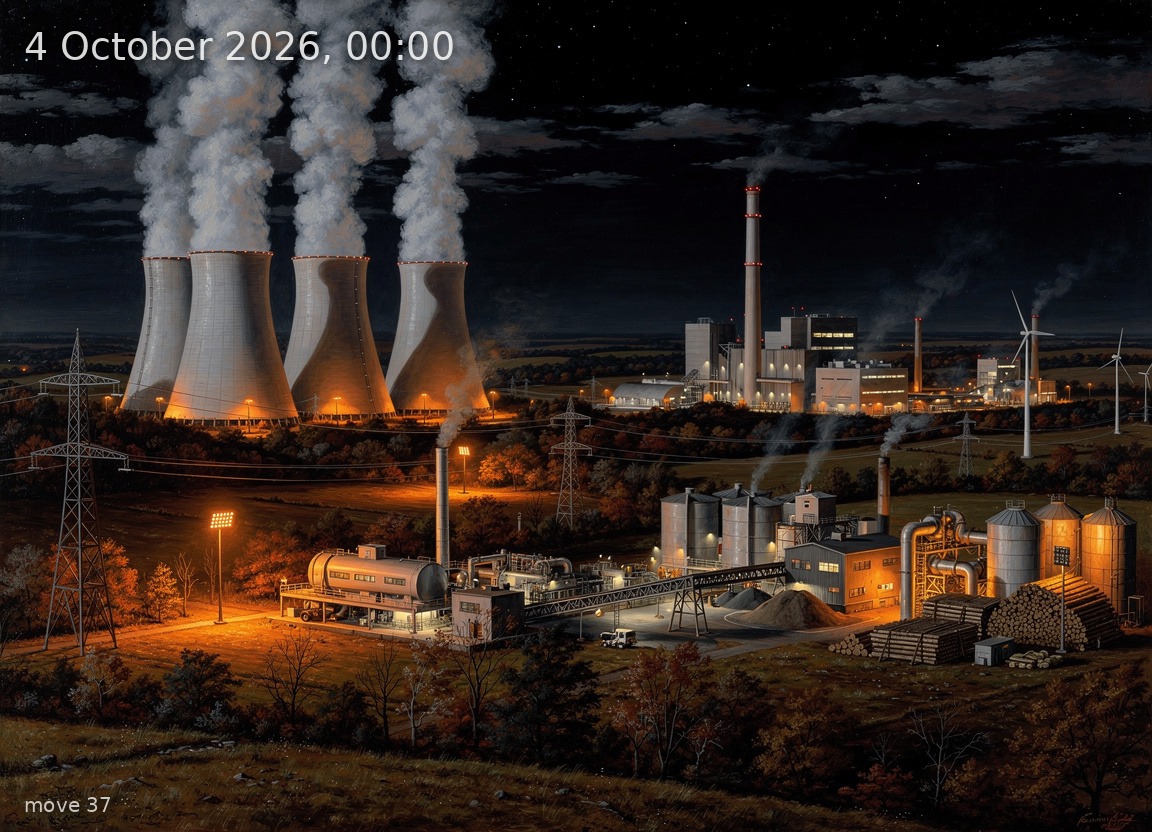
Brown coal and gas dominate overnight generation as near-zero wind and high imports push prices above 194 EUR/MWh.
Generation mix
Wind onshore 4%
Wind offshore 2%
Biomass 14%
Hydro 3%
Natural gas 27%
Hard coal 11%
Brown coal 39%
23%
Renewable share
1.9 GW
Wind (on + offshore)
0.0 GW
Solar
29.9 GW
Total generation
11.6 GW
Net import
194.1 EUR/MWh
Day-ahead price
12.8°C / 1 km/h
Temp / Wind speed
Open-Meteo, Kassel (51.3°N 9.5°E) · surface estimate from 100 m wind
35.0% / 0.0 W/m²
Cloud cover / Radiation
537
gCO₂/kWh
Image prompt
Brown coal 11.7 GW dominates the left third of the scene as a vast complex of hyperbolic cooling towers with thick white steam plumes rising into the black night sky; natural gas 8.2 GW fills the centre-left as a row of compact CCGT power plants with tall single exhaust stacks emitting thin vapour, lit by harsh sodium-orange industrial floodlights; hard coal 3.2 GW appears centre-right as a smaller conventional power station with a single rectangular smokestack and coal conveyor belts visible under work lights; biomass 4.1 GW is rendered as a cluster of medium-sized biomass CHP plants with timber-fuel storage yards and modest chimneys, occupying the right-centre; wind onshore 1.1 GW and wind offshore 0.7 GW appear as a sparse handful of three-blade turbines on lattice and tubular towers at the far right, their rotors completely still in the dead-calm air; hydro 0.8 GW is a small dam structure with penstock visible at the far right edge. The scene is set at midnight — the sky is entirely black with no twilight or sky glow, only faint stars visible through 35% scattered cloud patches. The autumn landscape of central Germany shows drying grass and half-bare deciduous trees in shades of brown and amber, visible only where sodium streetlights and industrial floods cast their orange pools. The atmosphere is heavy and oppressive, reflecting extreme electricity prices — a low haze hangs at ground level, diffusing the artificial lights into murky halos. Power lines on steel lattice pylons stretch across the scene connecting the facilities. Highly detailed oil painting in the tradition of 19th-century German Romantic landscape painters — rich dark palette of blacks, deep blues, burnt oranges, and sickly yellows; visible confident brushwork; atmospheric depth with industrial sublime grandeur. Each technology rendered with meticulous engineering accuracy: turbine nacelles, three-blade rotors, aluminium cooling tower shells with condensation plumes, CCGT gas turbine housings. No text, no labels.