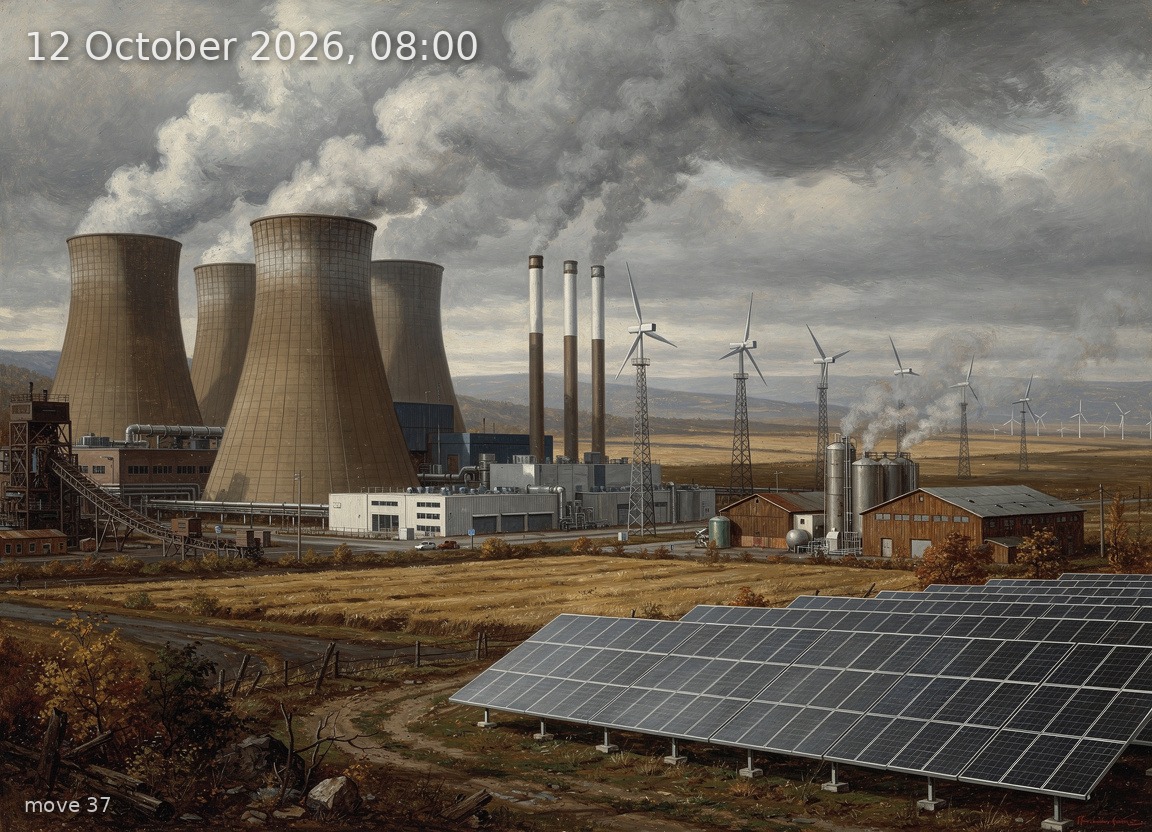
Brown coal and natural gas dominate as heavy cloud, cold temperatures, and modest wind drive large net imports and elevated prices.
Generation mix
Wind onshore 13%
Wind offshore 3%
Solar 12%
Biomass 10%
Hydro 2%
Natural gas 23%
Hard coal 9%
Brown coal 28%
40%
Renewable share
7.2 GW
Wind (on + offshore)
5.3 GW
Solar
44.5 GW
Total generation
19.3 GW
Net import
263.2 EUR/MWh
Day-ahead price
6.2°C / 13 km/h
Temp / Wind speed
Open-Meteo, Kassel (51.3°N 9.5°E) · surface estimate from 100 m wind
88.0% / 0.0 W/m²
Cloud cover / Radiation
412
gCO₂/kWh
Image prompt
Brown coal 12.7 GW dominates the left third of the scene as a massive lignite power station complex with five hyperbolic cooling towers issuing thick white-grey steam plumes into the overcast sky; natural gas 10.1 GW fills the centre-left as a row of modern CCGT plants with slender exhaust stacks trailing thin vapour; wind onshore 6.0 GW occupies the centre-right as a line of large three-blade turbines on lattice towers turning slowly on a gentle breeze across stubbled autumn fields; solar 5.3 GW appears in the right foreground as an array of aluminium-framed crystalline silicon panels angled southward but reflecting only flat grey light; biomass 4.4 GW stands behind the solar field as a cluster of wood-clad industrial buildings with short chimneys emitting pale smoke; hard coal 4.0 GW appears in the far left background as a traditional coal plant with a single large stack and conveyor infrastructure; wind offshore 1.2 GW is suggested on the distant horizon as tiny turbine silhouettes barely visible through haze; hydro 0.8 GW is a small concrete dam and spillway at the far right edge beside a cold stream. The time is 8 AM in mid-October — full but muted daylight with an 88% overcast sky forming a heavy, low, oppressive grey ceiling with no blue breaks, no direct sunlight, casting flat diffuse illumination across the entire landscape. The atmosphere feels dense, weighty, and claustrophobic, reflecting the extreme 263 EUR/MWh price. Temperature is 6°C: frost lingers on brown grass and bare hedgerows, breath-mist rising from a solitary figure in a high-vis vest inspecting the solar array. Autumn vegetation — yellowed birch trees, bare oaks, damp earth tones. Painted as a highly detailed oil painting in the tradition of 19th-century German Romantic landscape painters such as Caspar David Friedrich and Carl Blechen, with rich impasto brushwork, deep atmospheric perspective, moody tonal gradations from charcoal greys to muted ochres, and meticulous engineering detail on every turbine nacelle, cooling tower rib, PV panel frame, and exhaust stack. No text, no labels.