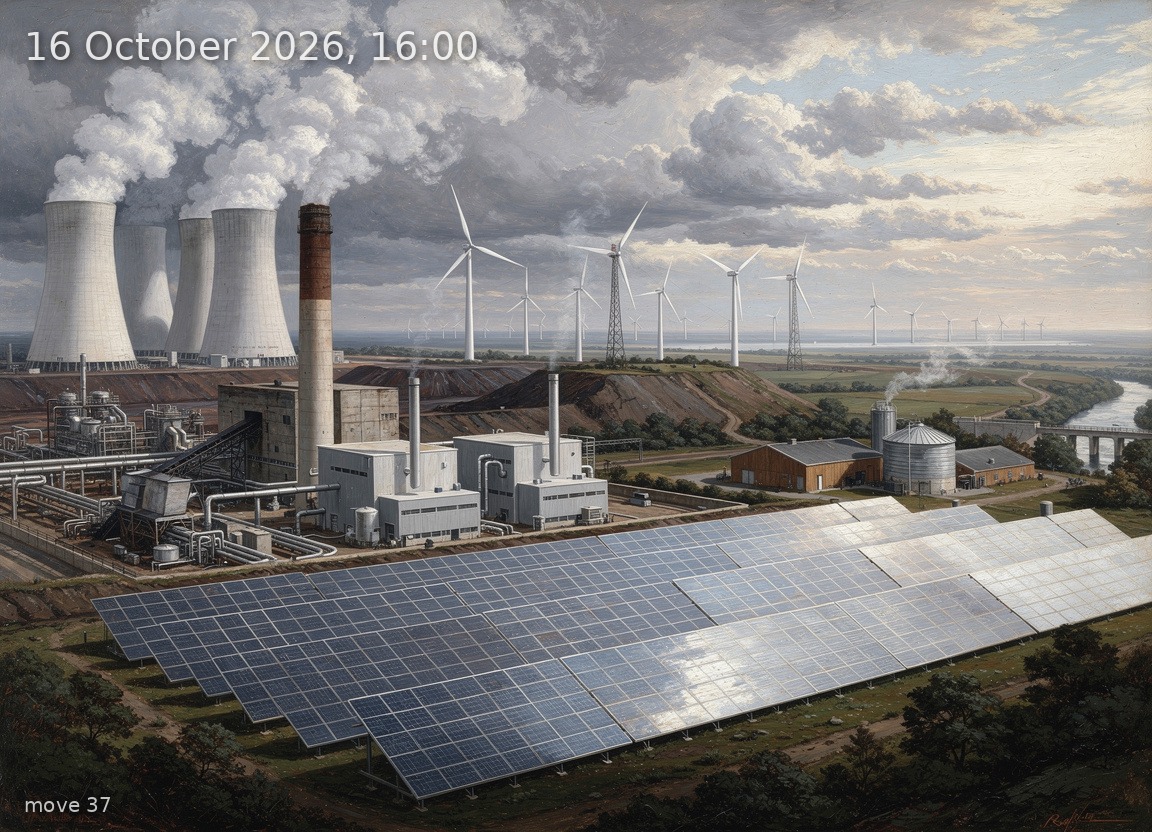
Brown coal leads thermal output at 10.9 GW as solar fades and 12.2 GW net imports fill a high-demand afternoon gap.
Generation mix
Wind onshore 11%
Wind offshore 6%
Solar 33%
Biomass 8%
Hydro 2%
Natural gas 9%
Hard coal 6%
Brown coal 23%
61%
Renewable share
7.9 GW
Wind (on + offshore)
15.4 GW
Solar
46.5 GW
Total generation
12.2 GW
Net import
202.8 EUR/MWh
Day-ahead price
18.7°C / 14 km/h
Temp / Wind speed
Open-Meteo, Kassel (51.3°N 9.5°E) · surface estimate from 100 m wind
72.0% / 218.0 W/m²
Cloud cover / Radiation
286
gCO₂/kWh
Image prompt
Brown coal 10.9 GW dominates the left third of the scene as a cluster of massive hyperbolic cooling towers with thick white-grey steam plumes rising into an overcast sky; solar 15.4 GW fills the centre-right foreground as expansive fields of aluminium-framed crystalline silicon photovoltaic panels catching diffused afternoon light filtering through broken clouds; wind onshore 5.0 GW appears as a line of tall three-blade turbines with white nacelles on lattice-and-tubular towers turning moderately on a low ridge behind the solar field; wind offshore 3.0 GW is suggested by distant turbines visible on a hazy horizon line; natural gas 4.3 GW occupies the centre-left as two compact CCGT units with slender single exhaust stacks emitting thin transparent heat shimmer; hard coal 3.0 GW sits beside the brown coal complex as a smaller conventional power station with a single rectangular chimney and conveyor belts carrying dark fuel; biomass 3.9 GW appears as a modest wood-clad industrial facility with a rounded silo and low steam vent near the right edge; hydro 1.1 GW is a small concrete dam and penstock visible in a river valley in the far right background. The sky is 72% overcast with heavy layered clouds, but patches of direct sunlight at roughly 218 W/m² break through, casting warm golden-amber patches on the landscape below — the sun sits low at a late-afternoon angle, about 20° above the horizon. The atmosphere feels heavy and oppressive, reflecting the high electricity price: a thick haze hangs between the cooling towers, and the cloud ceiling presses down. Vegetation is mid-autumn: trees with thinning golden-brown and rust-orange foliage, green-brown meadows at 18.7°C, scattered fallen leaves. Style: highly detailed oil painting in the tradition of 19th-century German Romantic landscape painters such as Caspar David Friedrich and Carl Blechen — rich impasto colour, visible expressive brushwork, dramatic atmospheric depth and chiaroscuro where light breaks through clouds, meticulous engineering accuracy on every turbine blade, panel frame, and cooling tower. No text, no labels.