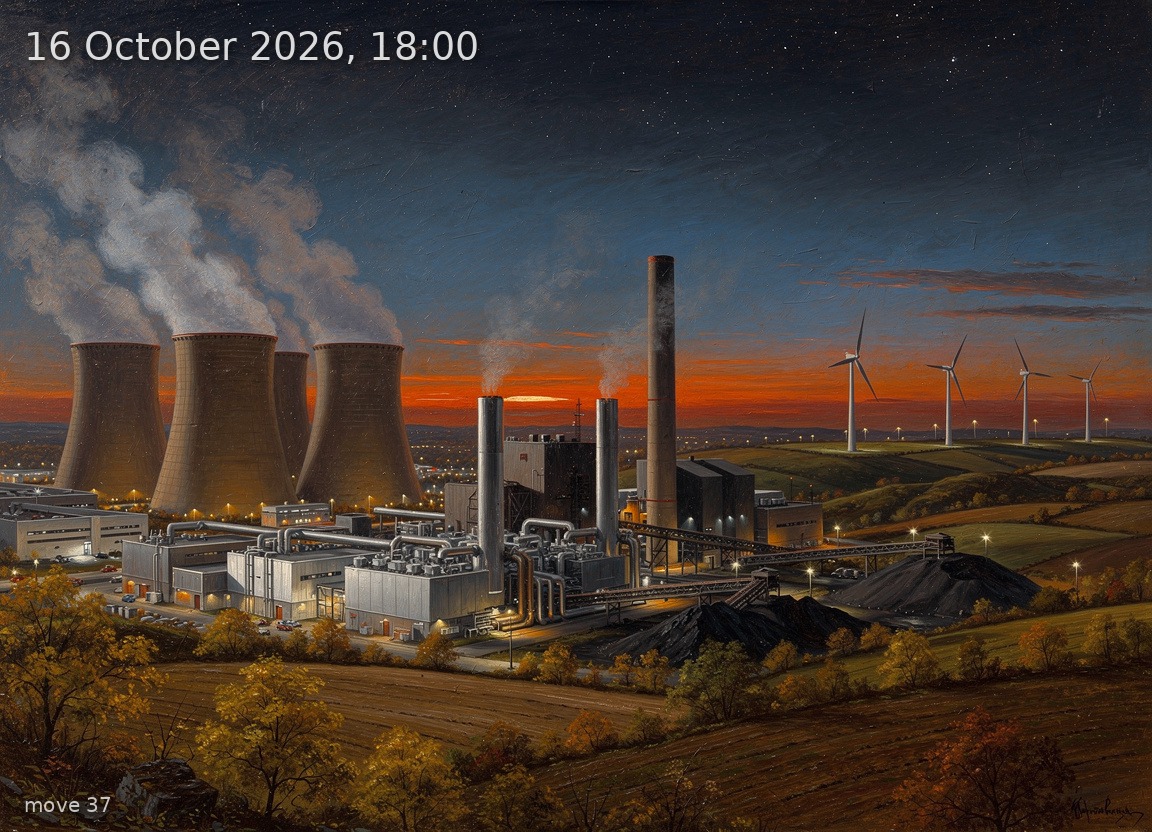
Brown coal and gas dominate as evening demand peaks at 60.2 GW, requiring 20.2 GW of net imports.
Generation mix
Wind onshore 15%
Wind offshore 10%
Solar 1%
Biomass 11%
Hydro 2%
Natural gas 23%
Hard coal 9%
Brown coal 30%
38%
Renewable share
9.9 GW
Wind (on + offshore)
0.3 GW
Solar
40.0 GW
Total generation
20.2 GW
Net import
254.6 EUR/MWh
Day-ahead price
17.5°C / 16 km/h
Temp / Wind speed
Open-Meteo, Kassel (51.3°N 9.5°E) · surface estimate from 100 m wind
0.0% / 34.0 W/m²
Cloud cover / Radiation
422
gCO₂/kWh
Image prompt
Brown coal 11.9 GW occupies the left third of the scene as a massive lignite power station complex with five hyperbolic cooling towers emitting thick white-grey steam plumes; natural gas 9.3 GW fills the centre-left as a bank of compact CCGT units with tall single exhaust stacks and visible heat shimmer; wind onshore 5.9 GW appears as a line of three-blade turbines on rolling hills in the centre-right middle distance, rotors turning moderately in 15.5 km/h wind; wind offshore 3.9 GW is suggested by smaller turbines on the far-right horizon above a faint strip of sea; biomass 4.4 GW appears as a cluster of industrial wood-chip facilities with modest chimneys and conveyor belts in the right foreground; hard coal 3.5 GW is rendered as a coal-fired plant with a pair of tall rectangular stacks and coal bunkers between the lignite complex and the gas units; hydro 0.9 GW appears as a small concrete dam with water flowing, nestled in a valley at the far right; solar 0.3 GW is represented only by a few barely visible darkened PV panels on a rooftop, catching no light. The sky is a dusk scene at 18:00 in mid-October: the lower horizon glows deep orange-red fading rapidly upward into steel blue and then near-dark navy at the zenith, with the last sliver of sunlight gone below the horizon. The atmosphere is heavy, oppressive, and hazy, reflecting the extreme 254.6 EUR/MWh price — a sullen, weighty industrial mood. The landscape shows mid-autumn central German terrain with yellowing deciduous trees, browning fields, and mild 17.5°C conditions with no frost. Clear sky, zero cloud cover, stars beginning to appear in the upper darkness. Rendered as a highly detailed oil painting in the tradition of 19th-century German Romantic landscape painters such as Caspar David Friedrich and Carl Blechen — rich impasto brushwork, luminous atmospheric depth, dramatic chiaroscuro between the glowing industrial facilities and the darkening sky, meticulous engineering detail on every turbine nacelle, cooling tower, and exhaust stack. No text, no labels.