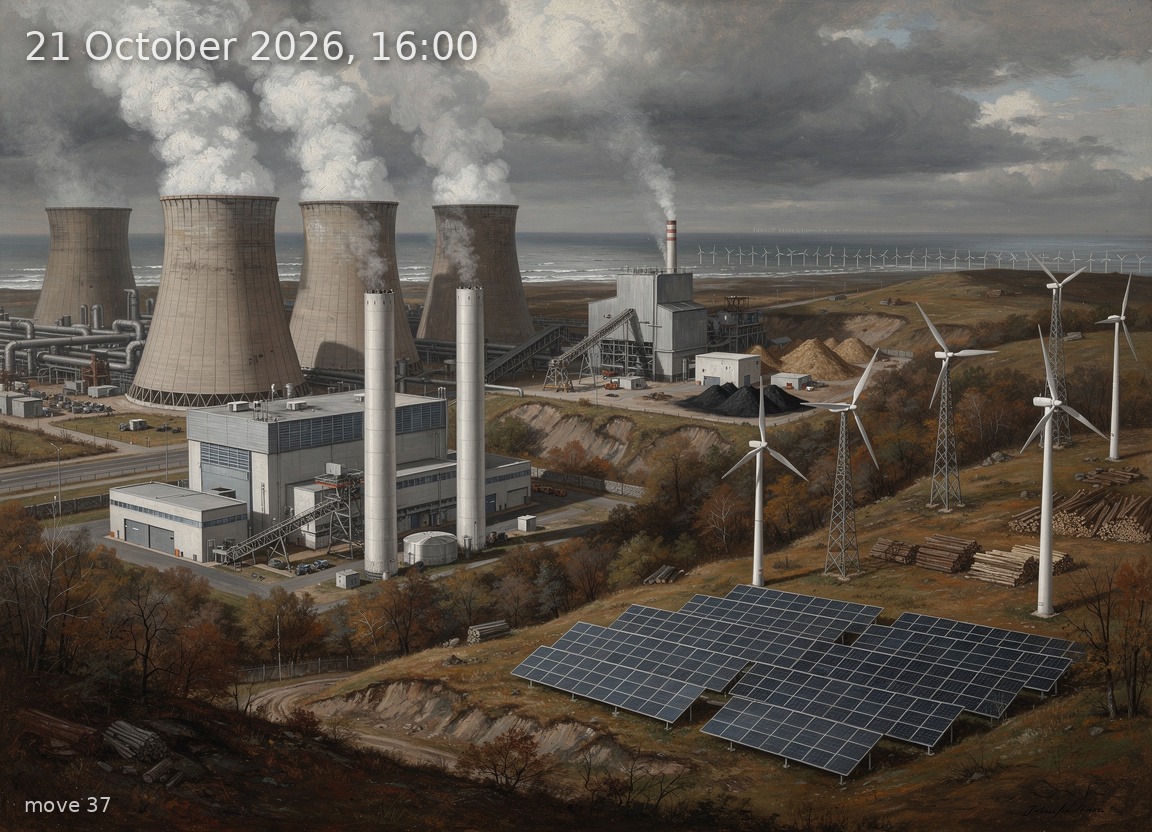
Brown coal, gas, and wind lead generation as full overcast and high imports drive prices to 252 EUR/MWh.
Generation mix
Wind onshore 17%
Wind offshore 7%
Solar 7%
Biomass 9%
Hydro 2%
Natural gas 25%
Hard coal 8%
Brown coal 25%
42%
Renewable share
10.5 GW
Wind (on + offshore)
3.1 GW
Solar
43.7 GW
Total generation
15.4 GW
Net import
251.7 EUR/MWh
Day-ahead price
10.2°C / 14 km/h
Temp / Wind speed
Open-Meteo, Kassel (51.3°N 9.5°E) · surface estimate from 100 m wind
100.0% / 0.0 W/m²
Cloud cover / Radiation
388
gCO₂/kWh
Image prompt
Brown coal 10.9 GW dominates the left third of the scene as a massive lignite power complex with four hyperbolic cooling towers belching thick white steam plumes into a heavy grey sky; natural gas 10.8 GW fills the centre-left as three modern CCGT power stations with tall slender exhaust stacks emitting thin heat shimmer; hard coal 3.7 GW appears centre-right as a smaller coal plant with a single rectangular cooling tower and conveyor belt feeding dark fuel; wind onshore 7.6 GW spans the right side as two dozen three-blade turbines on lattice and tubular towers across rolling autumn hills with faded brown-gold grass and bare-branching trees; wind offshore 3.0 GW is glimpsed in the far-right distance as a row of turbines on a grey, choppy sea horizon; solar 3.1 GW appears as a modest field of aluminium-framed crystalline PV panels in the mid-ground, their surfaces dull and reflecting only flat grey light with no sunshine; biomass 4.0 GW is rendered as a wood-chip-fed industrial plant with a modest smokestack and timber storage yard in the centre background; hydro 0.8 GW is a small run-of-river weir with a low concrete dam in the lower right foreground. The sky is entirely overcast at 100% cloud cover, a thick oppressive blanket of dark grey stratus pressing low over the landscape, the late afternoon light at 16:00 in October diffuse and wan, casting no shadows, everything lit with a flat silvery-grey tone leaning toward early dusk amber near the horizon. The atmosphere feels heavy and pressured, reflecting the extreme electricity price — the air itself seems thick, almost tangible. Temperature is 10°C: the vegetation is late-autumn sparse, leaves mostly fallen, grass sere, patches of mud. Wind at 14 km/h gives moderate motion to turbine blades and causes steam plumes to lean and shred. Painted in the style of a highly detailed 19th-century German Romantic oil painting — rich impasto brushwork, dramatic atmospheric depth, moody chiaroscuro in the tradition of Caspar David Friedrich and Carl Blechen — but with meticulous modern industrial-engineering accuracy in every turbine nacelle, cooling tower, and panel frame. No text, no labels.