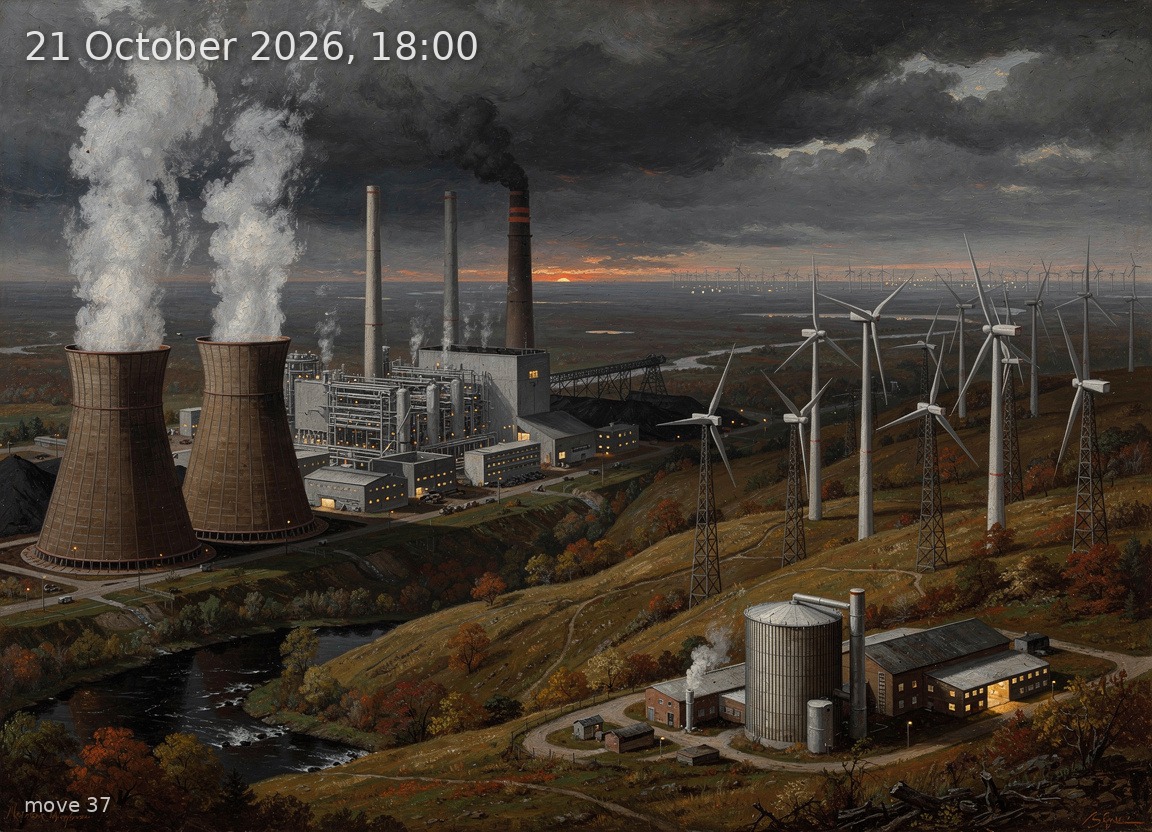
Gas, brown coal, and wind dominate as high evening demand and zero solar drive 14.6 GW net imports at peak price.
Generation mix
Wind onshore 23%
Wind offshore 9%
Solar 0%
Biomass 9%
Hydro 2%
Natural gas 25%
Hard coal 9%
Brown coal 23%
43%
Renewable share
15.2 GW
Wind (on + offshore)
0.0 GW
Solar
47.6 GW
Total generation
14.6 GW
Net import
243.6 EUR/MWh
Day-ahead price
10.3°C / 20 km/h
Temp / Wind speed
Open-Meteo, Kassel (51.3°N 9.5°E) · surface estimate from 100 m wind
100.0% / 0.5 W/m²
Cloud cover / Radiation
376
gCO₂/kWh
Image prompt
Brown coal 10.8 GW dominates the left third of the scene as a massive lignite power station complex with four hyperbolic cooling towers billowing thick white steam plumes into the heavy sky; natural gas 12.0 GW fills the centre-left as a sprawling CCGT facility with tall slender exhaust stacks emitting thin heat shimmer; wind onshore 10.9 GW spans the right third as dozens of three-blade turbines on lattice and tubular towers stretched across rolling hills, blades spinning briskly in 19.5 km/h winds; wind offshore 4.2 GW appears as a distant cluster of turbines visible on a grey horizon line at far right; hard coal 4.2 GW sits as a coal-fired plant with a single large smokestack and coal conveyor behind the gas facility; biomass 4.4 GW is rendered as a modest wood-chip-fed CHP plant with a ribbed cylindrical silo near the centre-right; hydro 0.9 GW appears as a small run-of-river weir with a powerhouse tucked into a river valley in the far background. The sky is dusk at 18:00 in late October: a narrow band of deep burnt-orange and crimson light clings to the low western horizon, while the upper sky darkens rapidly to slate grey and near-black overhead, fully overcast at 100% cloud cover with no stars visible. The atmosphere feels heavy and oppressive, conveying the 243.6 EUR/MWh price tension. Autumn vegetation — bare-branching oaks, muted brown and amber grasses — covers the hillsides at 10°C. Sodium streetlights along an access road flicker to life, casting amber pools on wet asphalt. Transmission towers with high-voltage lines arc across the entire composition, symbolising the massive import flows. Painted in the style of a highly detailed 19th-century German Romantic oil painting — rich impasto brushwork, Caspar David Friedrich's atmospheric depth fused with meticulous industrial engineering accuracy, dramatic chiaroscuro between the fading horizon glow and the dark industrial silhouettes. No text, no labels.