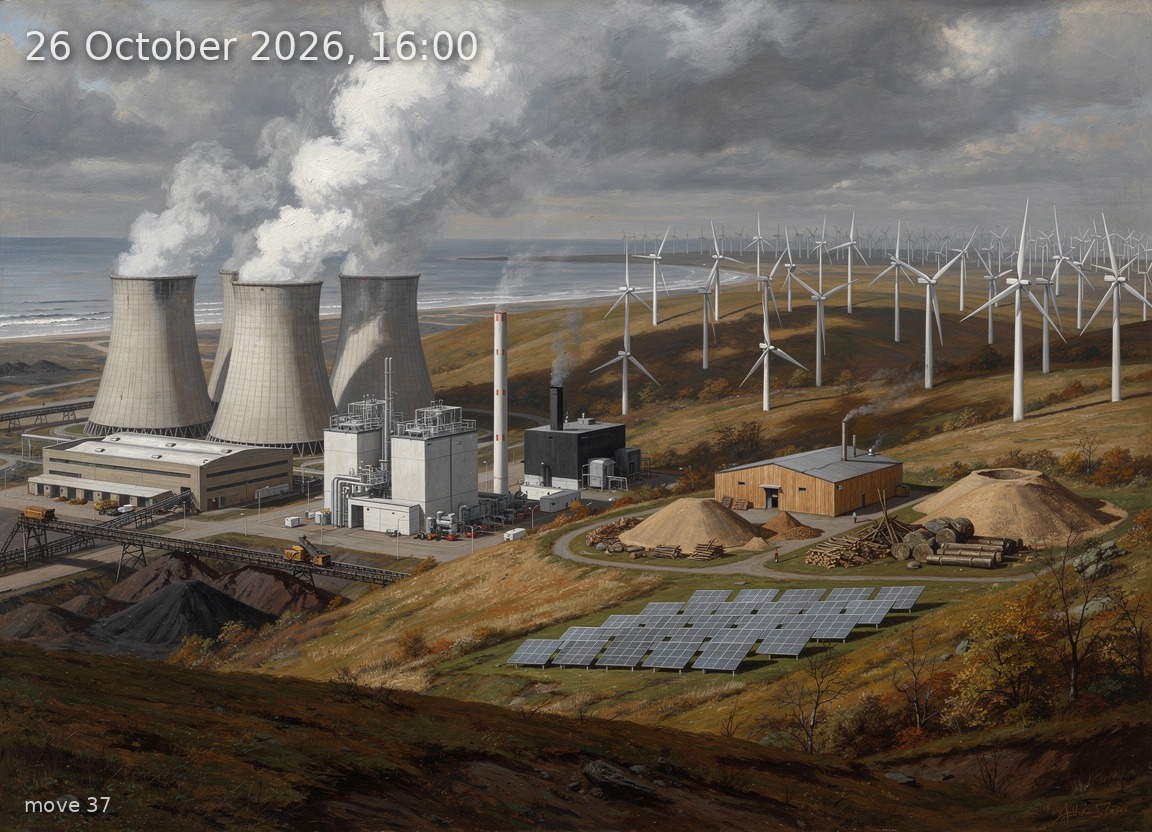
Strong wind and heavy lignite and gas dispatch meet high demand under overcast October skies, with 13.5 GW net imports required.
Generation mix
Wind onshore 37%
Wind offshore 15%
Solar 4%
Biomass 8%
Hydro 2%
Natural gas 11%
Hard coal 5%
Brown coal 18%
66%
Renewable share
24.9 GW
Wind (on + offshore)
1.9 GW
Solar
48.2 GW
Total generation
13.5 GW
Net import
190.5 EUR/MWh
Day-ahead price
11.6°C / 16 km/h
Temp / Wind speed
Open-Meteo, Kassel (51.3°N 9.5°E) · surface estimate from 100 m wind
99.0% / 12.3 W/m²
Cloud cover / Radiation
239
gCO₂/kWh
Image prompt
Wind onshore 17.8 GW dominates the right half of the canvas as dozens of three-blade turbines with white tubular towers and detailed nacelles stretching across rolling autumnal hills with fading brown-gold grasses; wind offshore 7.1 GW appears in the far right background as a dense array of turbines on a grey North Sea horizon. Brown coal 8.5 GW occupies the left foreground as a massive lignite power station with four hyperbolic cooling towers emitting thick white steam plumes and conveyor belts feeding raw brown coal. Natural gas 5.3 GW sits left of centre as two compact CCGT blocks with tall slender exhaust stacks trailing thin heat shimmer. Hard coal 2.6 GW appears as a smaller coal plant with a single rectangular boiler house and stockpile behind the gas units. Biomass 3.9 GW is rendered as a mid-ground timber-clad biomass facility with a modest chimney and woodchip storage yard. Solar 1.9 GW is a small cluster of aluminium-framed crystalline silicon panels on a nearby field, their surfaces dull and unreflective under the overcast sky. Hydro 1.1 GW is a small run-of-river weir with turbine house visible along a quiet river in the middle distance. The sky is entirely overcast at 99% cloud cover — a heavy, low, uniform grey-white ceiling pressing down oppressively, with no blue visible, no sunlight breaking through. Time is 4 PM late October: the last diffuse daylight is weak and flat, the light fading toward a premature dusk, giving the entire scene a muted, dim, slightly yellowish-grey tone. Temperature 11.6°C: trees show sparse brown and amber foliage, some bare branches, damp ground. Wind at 15.5 km/h animates the turbine blades mid-rotation, bends tall grass, and shreds steam plumes from the cooling towers to the right. The atmosphere is heavy and oppressive, reflecting a high electricity price — a brooding industrial weight to the air. Style: highly detailed oil painting in the tradition of 19th-century German Romantic landscape painters such as Caspar David Friedrich and Carl Blechen, with rich impasto brushwork, deep atmospheric perspective, dramatic chiaroscuro in the industrial steam, meticulous engineering detail on every turbine nacelle, cooling tower ribbing, and panel frame. The composition balances sublime natural landscape with the monumental presence of energy infrastructure. No text, no labels.