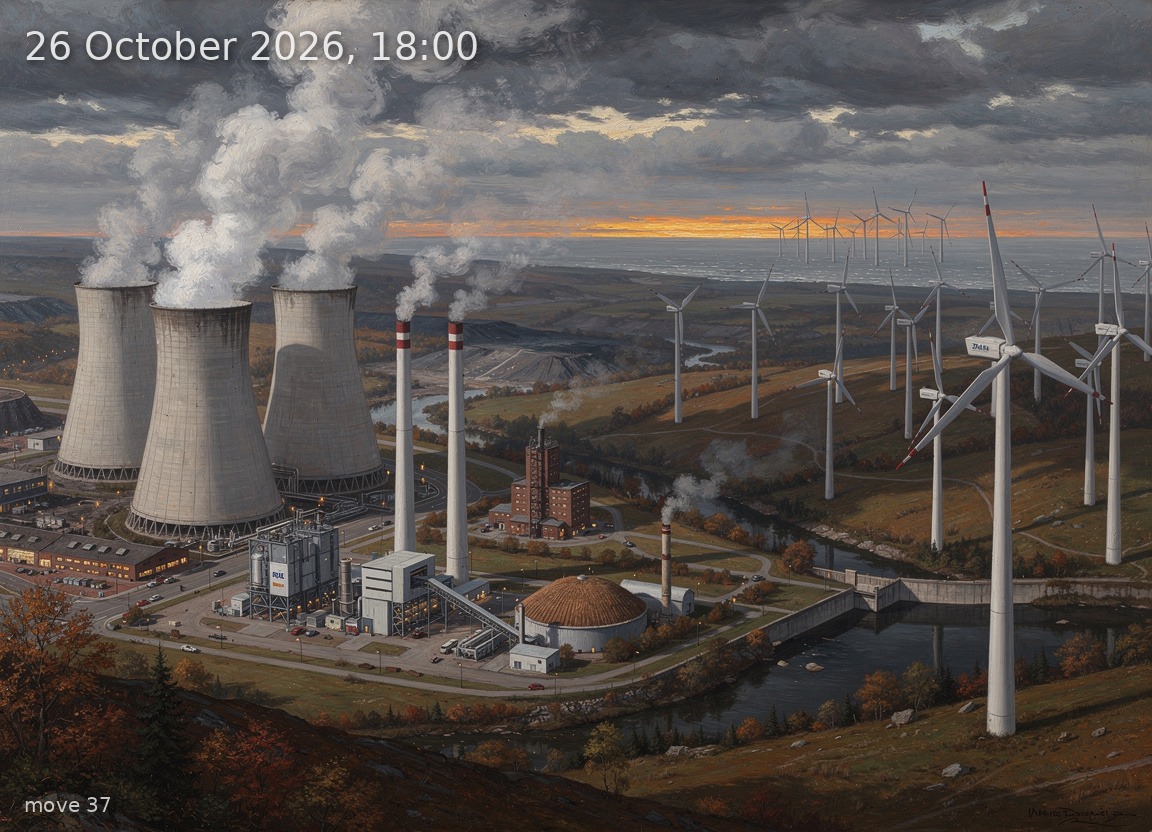
Wind leads at 27.9 GW but 14.5 GW net imports fill the evening peak gap as coal and gas support.
Generation mix
Wind onshore 40%
Wind offshore 14%
Biomass 8%
Hydro 2%
Natural gas 13%
Hard coal 4%
Brown coal 19%
64%
Renewable share
27.9 GW
Wind (on + offshore)
0.0 GW
Solar
51.0 GW
Total generation
14.5 GW
Net import
243.3 EUR/MWh
Day-ahead price
9.8°C / 19 km/h
Temp / Wind speed
Open-Meteo, Kassel (51.3°N 9.5°E) · surface estimate from 100 m wind
87.0% / 0.0 W/m²
Cloud cover / Radiation
247
gCO₂/kWh
Image prompt
Wind onshore 20.5 GW dominates the right two-thirds of the scene as dozens of tall three-blade turbines with white tubular towers and detailed nacelles stretching across rolling autumn hills, blades visibly turning in moderate wind. Wind offshore 7.4 GW appears in the far-right background as a cluster of turbines rising from a grey sea visible on the horizon. Brown coal 9.5 GW occupies the left foreground as a massive lignite power station with four hyperbolic concrete cooling towers emitting thick white steam plumes that merge into the heavy overcast sky. Natural gas 6.4 GW sits in the centre-left as two compact CCGT units with tall slender exhaust stacks and smaller vapour trails. Hard coal 2.3 GW is a single older brick-and-steel power station with a square chimney, positioned behind the gas plant. Biomass 3.9 GW appears as a medium-sized industrial facility with a wood-chip storage dome and a modest smokestack, placed between the gas and wind sections. Hydro 1.1 GW is suggested by a small dam and reservoir visible in a valley between hills on the centre-right. No solar panels anywhere — it is after sunset. The sky is a dusk scene at 18:00 in late October: the lower western horizon holds a narrow band of deep orange-red fading glow, while the upper sky transitions rapidly through dark grey-purple overcast clouds to near-darkness above, 87% cloud cover making the sky heavy and oppressive. The atmosphere is dense, hazy, and brooding, conveying high electricity prices. Autumn vegetation — bare or nearly bare deciduous trees, brown-gold grass, damp fields. Temperature near 10°C suggested by mist clinging to low ground. Sodium streetlights beginning to glow amber along a road in the foreground. Rendered as a highly detailed oil painting in the tradition of 19th-century German Romantic landscape painters such as Caspar David Friedrich and Carl Blechen — rich impasto brushwork, deep atmospheric perspective, dramatic chiaroscuro between the glowing industrial fires and the darkening sky. Meticulous engineering accuracy on all turbine rotors, cooling tower geometry, and exhaust stacks. No text, no labels, no human figures prominent.