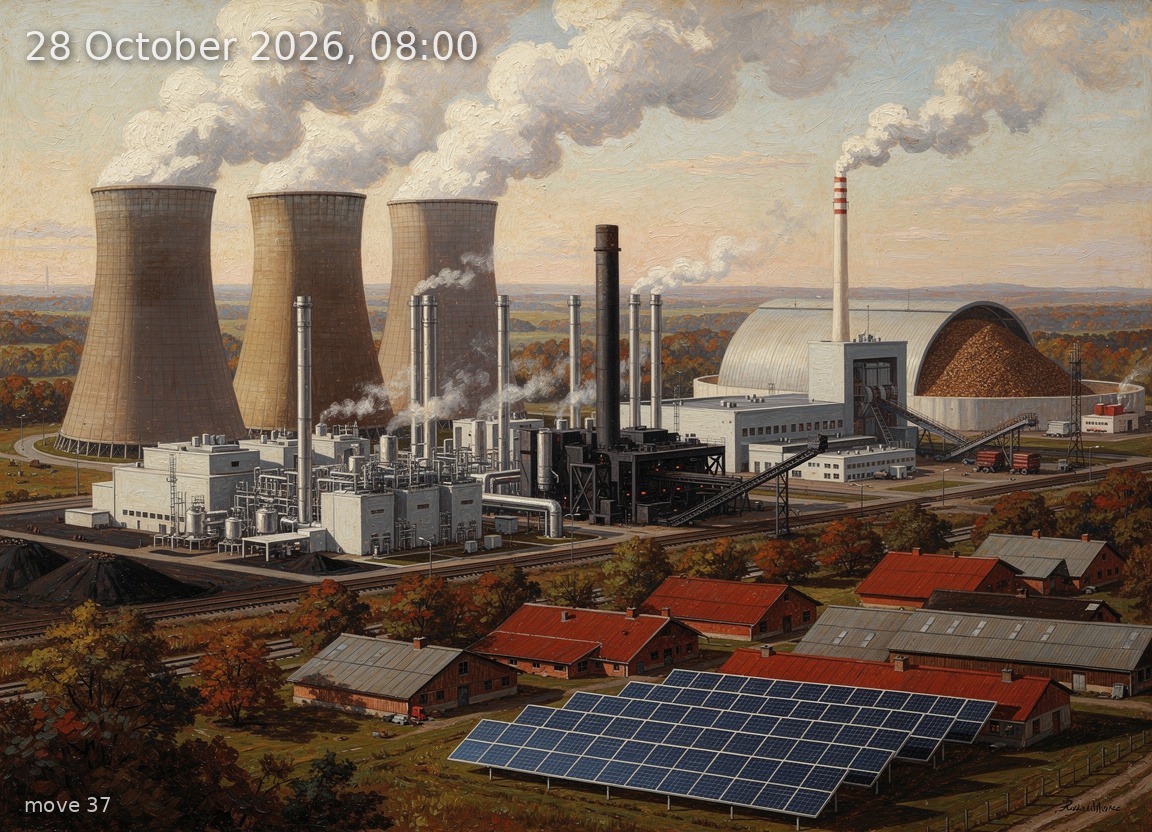
Brown coal and gas anchor generation as 13.7 GW net imports fill a wide supply gap, pushing prices above 294 EUR/MWh.
Generation mix
Wind onshore 19%
Wind offshore 7%
Solar 11%
Biomass 9%
Hydro 2%
Natural gas 22%
Hard coal 7%
Brown coal 24%
47%
Renewable share
12.2 GW
Wind (on + offshore)
5.6 GW
Solar
48.3 GW
Total generation
13.7 GW
Net import
294.1 EUR/MWh
Day-ahead price
9.2°C / 6 km/h
Temp / Wind speed
Open-Meteo, Kassel (51.3°N 9.5°E) · surface estimate from 100 m wind
31.0% / 5.8 W/m²
Cloud cover / Radiation
356
gCO₂/kWh
Image prompt
Brown coal 11.4 GW dominates the left third of the scene as a massive lignite power complex with four hyperbolic cooling towers trailing thick white steam plumes into an autumn sky; natural gas 10.4 GW fills the centre-left as a row of modern CCGT plants with tall slim exhaust stacks venting thin heat haze; wind onshore 9.0 GW spans the right third as dozens of three-blade turbines on lattice and tubular towers dotting rolling farmland with blades turning slowly in light breeze; wind offshore 3.2 GW appears on the far-right horizon as a cluster of turbines rising from a grey North Sea glimpsed through a gap in terrain; solar 5.6 GW is rendered as aluminium-framed crystalline silicon panels across barn rooftops and a ground-mounted array in the mid-ground catching weak early morning light; biomass 4.1 GW appears as a medium-sized industrial plant with a wood-chip storage dome and a single smokestack with pale exhaust, positioned behind the gas units; hard coal 3.6 GW is a compact coal-fired station with a single large smokestack and coal conveyor visible between the brown coal complex and gas plants; hydro 1.0 GW is a small run-of-river weir with a powerhouse nestled along a stream in the foreground valley. Lighting is early-morning October daylight at 08:00 in central Germany — sun low on the eastern horizon, casting long golden-orange rays across the landscape but partially filtered by 31% cloud cover creating patches of haze and thin alto-cumulus clouds; sky is mostly pale blue with scattered clouds. Vegetation is distinctly late-autumn: deciduous trees in fading amber and rust foliage, some bare branches, brown stubble fields, dew on grass. The atmosphere feels heavy and oppressive despite partial sun, suggesting strain — a faint yellowish industrial pall hangs over the thermal plants, the air thick with moisture and coal particulate haze, evoking the high electricity price. Style: highly detailed oil painting in the tradition of 19th-century German Romantic landscape painters such as Caspar David Friedrich and Carl Blechen — rich, deep colour palette with visible impasto brushwork, dramatic atmospheric depth, chiaroscuro interplay of industrial steam and morning sunlight, meticulous engineering accuracy in every turbine nacelle, cooling tower profile, panel frame, and exhaust stack. No text, no labels.