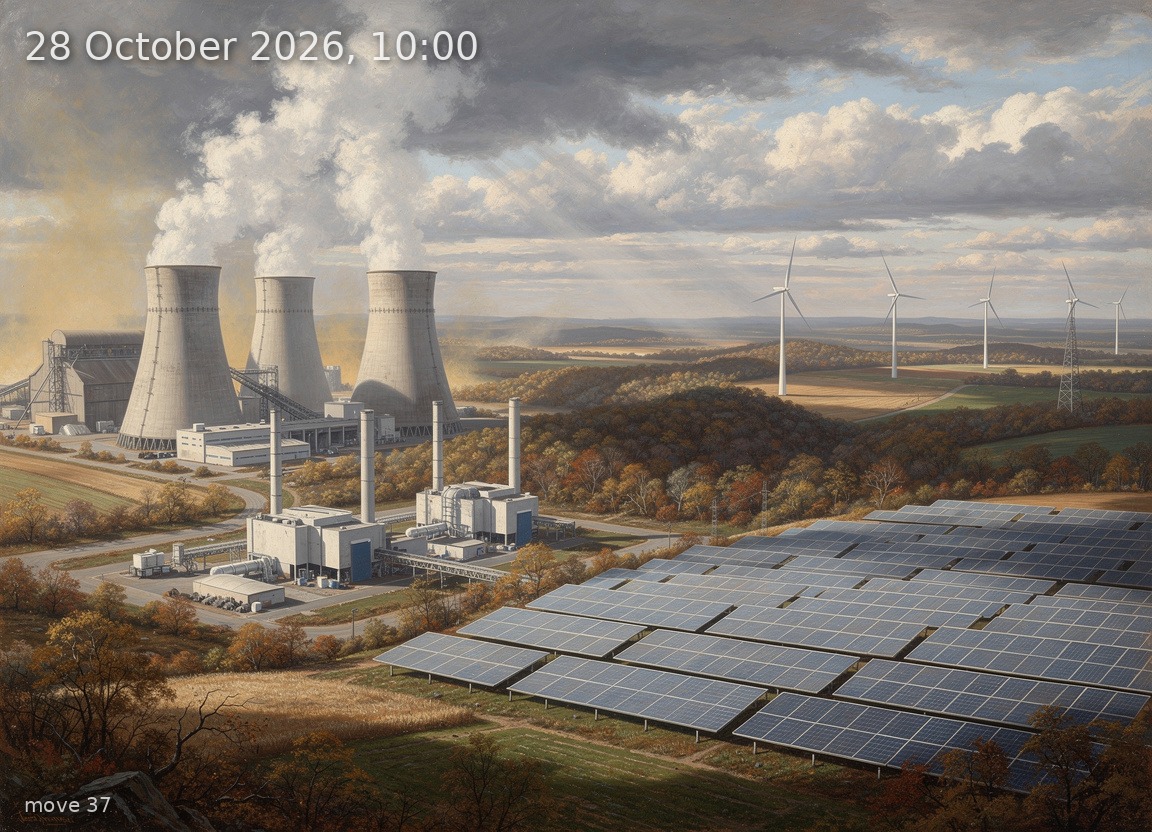
Solar leads at 16.3 GW alongside brown coal and gas, with 7 GW net imports driving a high clearing price.
Generation mix
Wind onshore 11%
Wind offshore 6%
Solar 29%
Biomass 7%
Hydro 2%
Natural gas 19%
Hard coal 6%
Brown coal 20%
55%
Renewable share
10.0 GW
Wind (on + offshore)
16.3 GW
Solar
57.2 GW
Total generation
7.0 GW
Net import
224.6 EUR/MWh
Day-ahead price
11.4°C / 10 km/h
Temp / Wind speed
Open-Meteo, Kassel (51.3°N 9.5°E) · surface estimate from 100 m wind
53.0% / 76.8 W/m²
Cloud cover / Radiation
300
gCO₂/kWh
Image prompt
Solar 16.3 GW dominates the right third of the scene as vast fields of aluminium-framed crystalline silicon photovoltaic panels reflecting diffuse autumn light across rolling farmland; brown coal 11.2 GW occupies the left quarter as a massive lignite power station complex with four hyperbolic cooling towers releasing thick white steam plumes into the sky; natural gas 10.7 GW fills the centre-left as a row of modern CCGT plants with tall single exhaust stacks emitting thin heat shimmer; wind onshore 6.5 GW appears as a line of three-blade turbines on lattice and tubular towers stretching across low hills in the centre-right middle distance, blades turning slowly in light wind; wind offshore 3.6 GW is suggested by a cluster of turbines on the far horizon above a distant grey sea glimpsed through a valley; biomass 4.3 GW appears as a medium-sized industrial facility with a rounded woodchip silo and a single smokestack near the coal complex; hard coal 3.7 GW is a smaller conventional power station with a rectangular brick boiler house and twin stacks beside the lignite plant; hydro 1.0 GW is a small concrete dam with a modest reservoir visible in the far right background among wooded hills. Time is 10:00 AM on an October morning: full daylight but filtered through 53% cloud cover — a partly cloudy sky with banks of grey cumulus interspersed with patches of pale blue, sunlight breaking through in broad shafts that illuminate the solar fields while shadows drift across the coal plant. The atmosphere feels heavy and oppressive despite the daylight, with a yellowish industrial haze hanging low over the thermal plants, suggesting high electricity prices. Autumn vegetation: trees in muted gold and rust-brown foliage, stubble fields, damp grass. Temperature around 11°C — a cool, slightly damp feel with no frost. Rendered as a highly detailed oil painting in the tradition of 19th-century German Romantic landscape painters such as Caspar David Friedrich and Carl Blechen, with rich tonal depth, visible impasto brushwork, dramatic chiaroscuro in the cloud formations, and meticulous engineering accuracy in every turbine nacelle, cooling tower hyperbolic profile, PV panel frame, and exhaust stack. The composition sweeps panoramically across the German industrial-pastoral landscape, balancing sublime natural beauty with the monumental scale of energy infrastructure. No text, no labels.