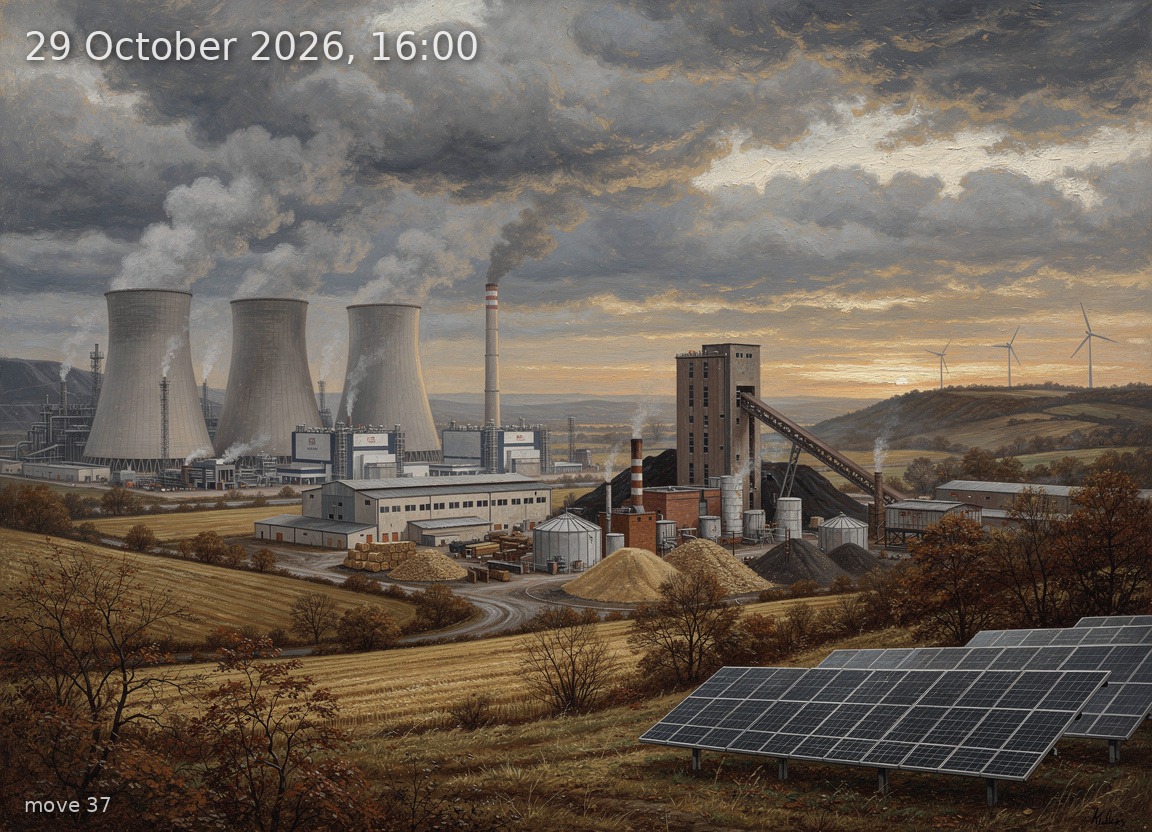
Brown coal and natural gas dominate as negligible wind and weak solar force 24.7 GW of net imports at extreme prices.
Generation mix
Wind onshore 4%
Wind offshore 1%
Solar 6%
Biomass 11%
Hydro 3%
Natural gas 31%
Hard coal 11%
Brown coal 34%
24%
Renewable share
1.6 GW
Wind (on + offshore)
2.1 GW
Solar
36.1 GW
Total generation
24.7 GW
Net import
414.1 EUR/MWh
Day-ahead price
10.6°C / 1 km/h
Temp / Wind speed
Open-Meteo, Kassel (51.3°N 9.5°E) · surface estimate from 100 m wind
84.0% / 14.0 W/m²
Cloud cover / Radiation
511
gCO₂/kWh
Image prompt
Brown coal 12.3 GW dominates the left third of the scene as a massive lignite power complex with four hyperbolic cooling towers emitting thick white-grey steam plumes; natural gas 11.1 GW fills the centre-left as three compact CCGT units with tall single exhaust stacks trailing heat shimmer; hard coal 3.9 GW appears centre-right as a smaller coal plant with a single rectangular boiler building and conveyor belt feeding from a dark coal pile; biomass 4.0 GW sits as a cluster of wood-chip-fed industrial boilers with modest chimneys at centre; solar 2.1 GW shows as a modest field of aluminium-framed crystalline silicon panels in the right foreground, their surfaces dull under overcast light reflecting almost nothing; wind onshore 1.3 GW appears as three widely spaced three-blade turbines on a distant ridge at the far right, rotors nearly motionless; wind offshore 0.2 GW is barely hinted as a single tiny turbine silhouette on the far horizon; hydro 1.2 GW is suggested by a small dam structure with water spilling in the right middle-ground valley. The sky is 84% overcast with heavy stratocumulus clouds in slate-grey and muted ochre tones, allowing only a thin band of weak late-afternoon light near the western horizon — it is 16:00 in late October, so sunlight is already low and diffuse, almost amber at the horizon but smothered by cloud. The landscape is late-autumn central German rolling hills, bare-branched deciduous trees with last brown leaves, damp stubble fields, grass fading to straw-yellow. The atmosphere feels heavy and oppressive, reflecting the extreme electricity price — a brooding weight presses down on the industrial panorama. Rendered as a highly detailed oil painting in the tradition of 19th-century German Romantic landscape painters such as Caspar David Friedrich and Carl Blechen, with rich impasto brushwork, deep atmospheric perspective, dramatic chiaroscuro in the cloud formations, and meticulous engineering accuracy in every power plant component. No text, no labels.