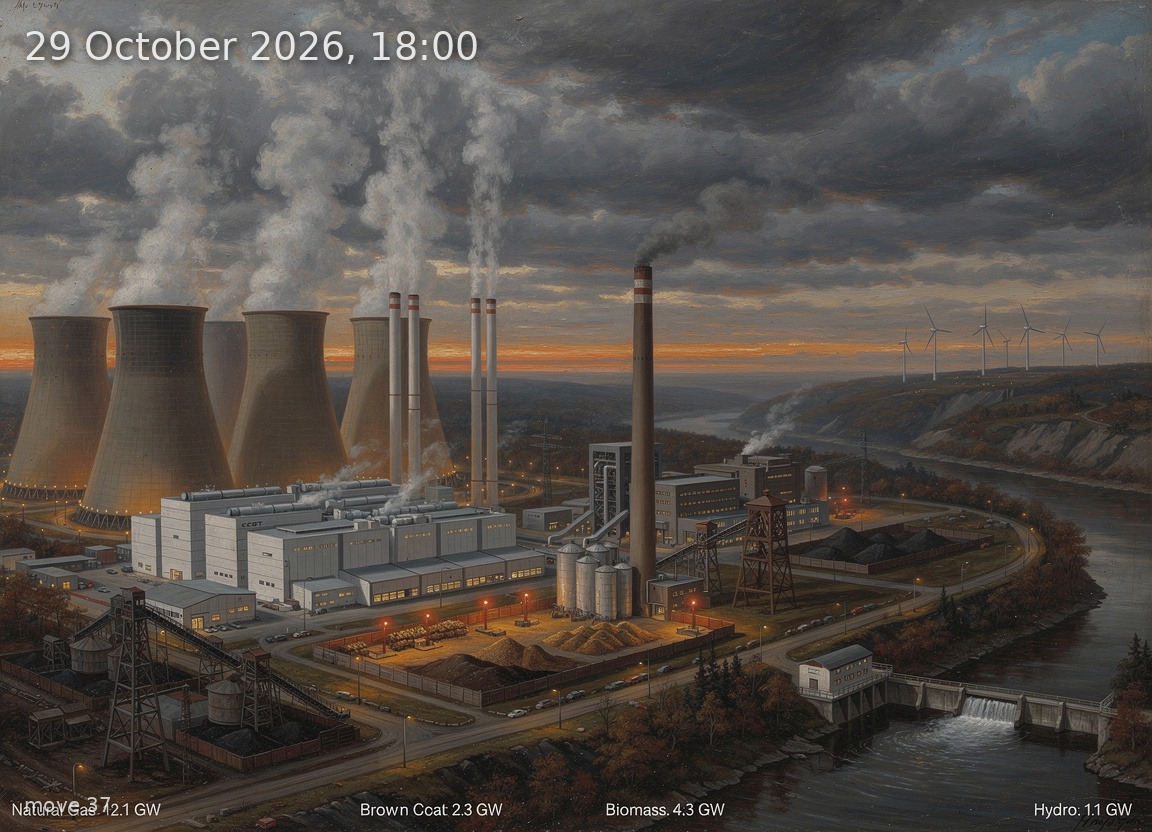
Brown coal and gas dominate as wind collapses and 26.4 GW of net imports fill Germany's evening peak.
Generation mix
Wind onshore 6%
Wind offshore 1%
Biomass 11%
Hydro 3%
Natural gas 33%
Hard coal 12%
Brown coal 35%
21%
Renewable share
2.5 GW
Wind (on + offshore)
0.0 GW
Solar
37.0 GW
Total generation
26.4 GW
Net import
473.4 EUR/MWh
Day-ahead price
9.7°C / 4 km/h
Temp / Wind speed
Open-Meteo, Kassel (51.3°N 9.5°E) · surface estimate from 100 m wind
60.0% / 0.0 W/m²
Cloud cover / Radiation
532
gCO₂/kWh
Image prompt
Brown coal 12.9 GW dominates the left third of the scene as a dense cluster of massive hyperbolic cooling towers with thick white-grey steam plumes rising into the heavy sky; natural gas 12.1 GW occupies the centre-left as a row of compact CCGT plant blocks with slender exhaust stacks emitting translucent heat haze; hard coal 4.3 GW appears centre-right as a smaller coal-fired station with a single tall chimney and conveyor belt infrastructure; biomass 4.2 GW is rendered as a wood-chip-fed CHP plant with a modest stack and piled fuel stores near the centre; wind onshore 2.3 GW appears as a sparse handful of three-blade turbines on a low ridge in the right background, rotors barely turning in the still air; hydro 1.1 GW is a small run-of-river weir with a concrete powerhouse glimpsed in the far right valley. The sky is an autumn dusk at 18:00 in late October — a narrow band of deep burnt-orange glow clings to the lower horizon, rapidly giving way to slate-grey and indigo overhead; 60% cloud cover forms a low oppressive blanket that traps and reflects the industrial glow. The atmosphere is heavy, almost suffocating, conveying the extreme 473 EUR/MWh price as a palpable weight pressing down on the landscape. No solar panels anywhere — no sun, no direct radiation. Vegetation is sparse late-autumn brown and muted olive; bare-branched deciduous trees frame the foreground; temperature around 10°C suggested by damp ground and faint mist pooling in low areas. High-voltage transmission pylons march across the middle distance, cables receding toward the horizon, visually evoking the massive cross-border power flows. Painted in the style of a highly detailed 19th-century German Romantic oil painting — rich impasto brushwork, dramatic chiaroscuro between the glowing industrial cores and the darkening sky, atmospheric depth receding into haze, meticulous engineering accuracy on every turbine nacelle, cooling tower shell, and lattice pylon. No text, no labels.