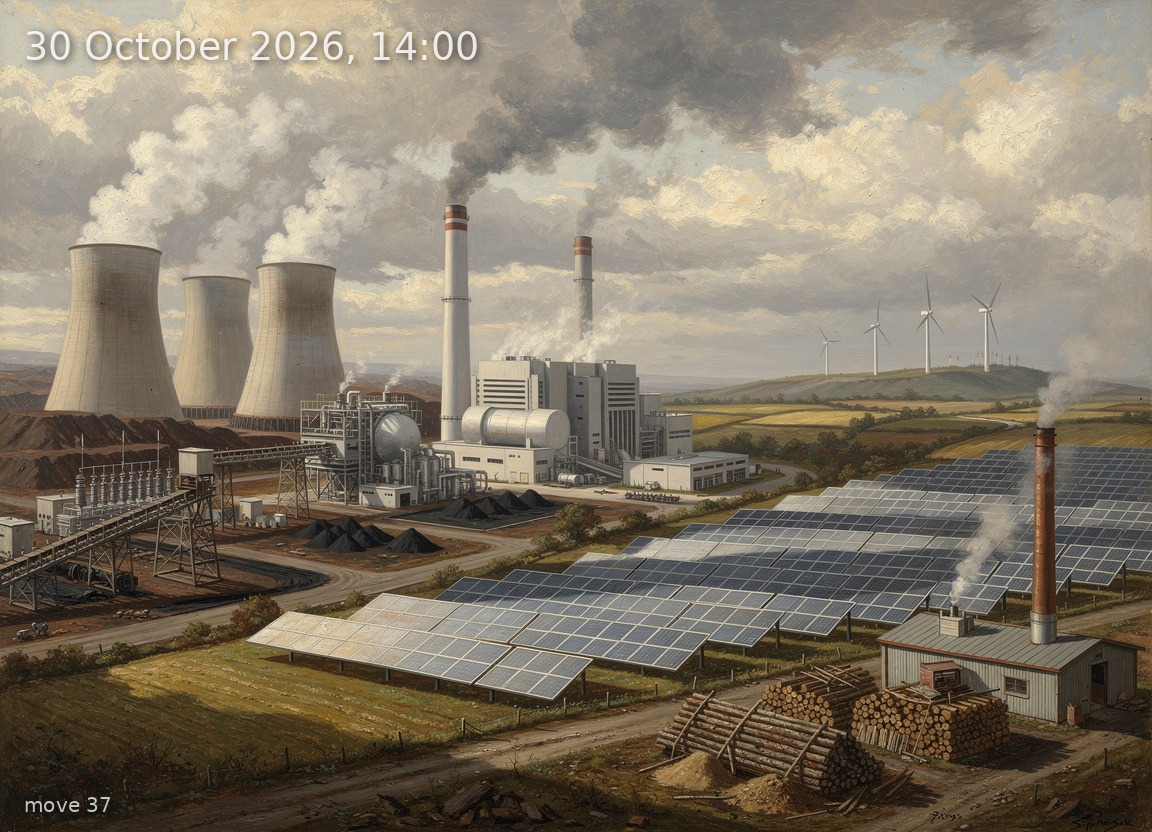
Brown coal, gas, and solar dominate as weak wind forces heavy fossil dispatch and 5.1 GW net imports.
Generation mix
Wind onshore 5%
Wind offshore 1%
Solar 30%
Biomass 8%
Hydro 2%
Natural gas 22%
Hard coal 9%
Brown coal 24%
46%
Renewable share
3.0 GW
Wind (on + offshore)
16.0 GW
Solar
53.2 GW
Total generation
5.1 GW
Net import
237.3 EUR/MWh
Day-ahead price
12.6°C / 5 km/h
Temp / Wind speed
Open-Meteo, Kassel (51.3°N 9.5°E) · surface estimate from 100 m wind
62.0% / 143.8 W/m²
Cloud cover / Radiation
369
gCO₂/kWh
Image prompt
Brown coal 12.8 GW dominates the left third of the scene as a massive lignite power station complex with four hyperbolic cooling towers releasing thick white steam plumes into the overcast sky; natural gas 11.6 GW fills the centre-left as a cluster of modern CCGT plants with tall slender exhaust stacks venting shimmering heat haze; solar 16.0 GW occupies the right third and extends into the midground as vast fields of aluminium-framed crystalline silicon photovoltaic panels catching filtered afternoon light on gently rolling farmland; hard coal 4.6 GW appears as a smaller coal-fired station with a single wide chimney trailing grey smoke, positioned between the lignite and gas plants; biomass 4.1 GW is rendered as a wood-chip burning facility with a modest smokestack and timber storage yard at the far right edge; wind onshore 2.7 GW appears as a small cluster of three-blade turbines on a distant ridge, rotors barely turning in the still air; wind offshore 0.4 GW is suggested by two tiny turbines on a hazy horizon line; hydro 1.1 GW is a small run-of-river station with a weir visible along a river in the middle distance. Time of day is early afternoon with full but diffuse daylight; the sky is 62% covered with layered alto-cumulus and stratocumulus clouds in grey and cream tones, allowing patches of weak direct sunlight to illuminate the solar fields with a soft golden sheen. The atmosphere feels heavy and oppressive, suggesting high electricity prices — a low, dense ceiling of cloud presses down on the industrial landscape. Autumn vegetation: fields of stubble, scattered deciduous trees with thinning amber and russet foliage, temperature around 12–13°C lending a cool dampness to the air. Style: highly detailed oil painting in the tradition of 19th-century German Romantic landscape painters such as Caspar David Friedrich and Carl Blechen — rich impasto brushwork, atmospheric sfumato in the distance, warm earth tones contrasting with cool grey skies, dramatic compositional depth drawing the eye from foreground solar panels through the industrial heart to the misty ridge of wind turbines. Every technology rendered with meticulous engineering accuracy: turbine nacelles, lattice towers, PV cell grid patterns, cooling tower parabolic curves, conveyor belts at coal yards. No text, no labels.