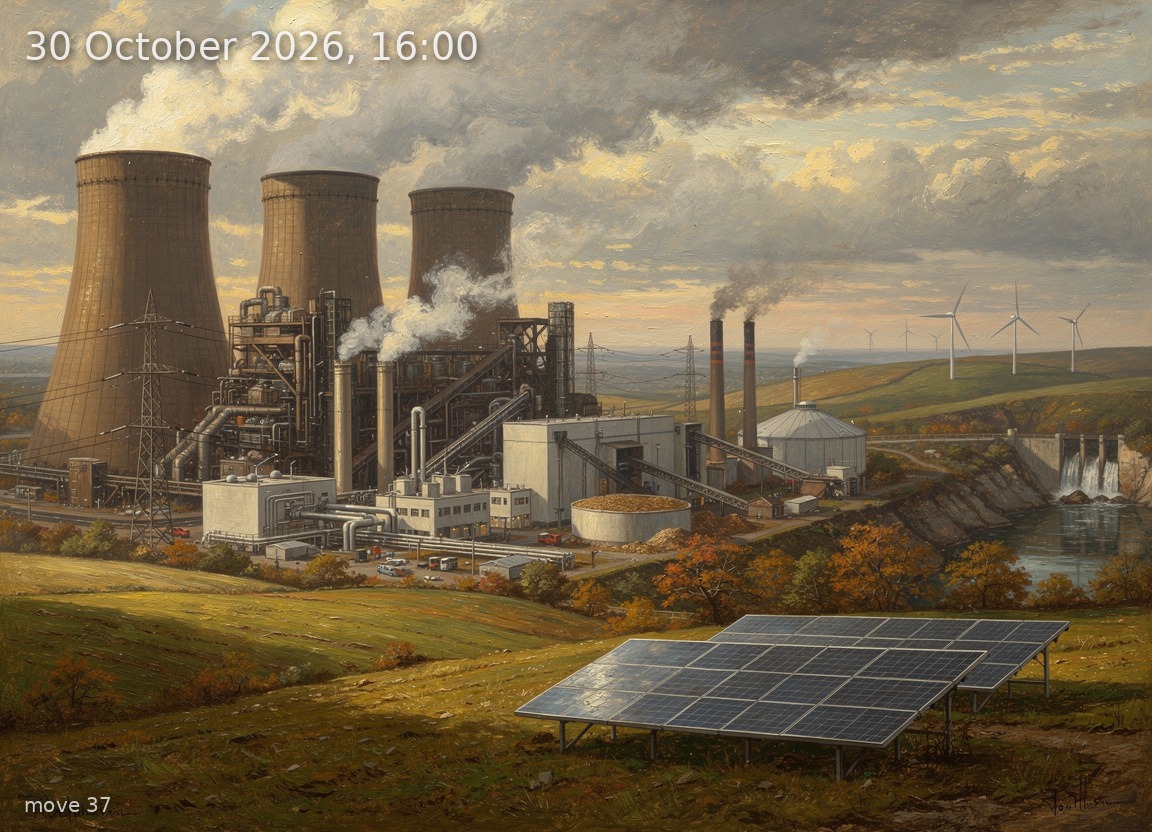
Brown coal, gas, and hard coal dominate as weak wind and fading solar force heavy thermal dispatch and 17.7 GW net imports.
Generation mix
Wind onshore 9%
Wind offshore 1%
Solar 5%
Biomass 10%
Hydro 3%
Natural gas 26%
Hard coal 11%
Brown coal 31%
27%
Renewable share
4.0 GW
Wind (on + offshore)
2.0 GW
Solar
41.5 GW
Total generation
17.7 GW
Net import
324.0 EUR/MWh
Day-ahead price
12.2°C / 8 km/h
Temp / Wind speed
Open-Meteo, Kassel (51.3°N 9.5°E) · surface estimate from 100 m wind
62.0% / 45.8 W/m²
Cloud cover / Radiation
467
gCO₂/kWh
Image prompt
Brown coal 13.1 GW dominates the left third of the scene as a massive lignite power station complex with four hyperbolic cooling towers releasing thick white steam plumes; natural gas 11.0 GW fills the centre-left as a cluster of compact CCGT plants with tall single exhaust stacks and shimmering heat haze; hard coal 4.4 GW appears centre-right as a pair of smaller conventional coal plants with rectangular boiler houses and twin chimneys trailing grey smoke; biomass 4.0 GW is rendered as a wood-chip burning facility with a domed storage silo and modest stack behind the coal plants; wind onshore 3.6 GW shows as a small group of three-blade turbines on gentle hills in the right background, blades barely turning in light wind; solar 2.0 GW appears as a modest field of aluminium-framed crystalline silicon panels in the right foreground, angled low, catching weak diffuse light; hydro 1.1 GW is suggested by a small concrete dam and reservoir visible in a valley far right; wind offshore 0.4 GW is a faint silhouette of two turbines on the distant horizon line. The sky is late-afternoon October daylight at 16:00 — sun low in the west, partially obscured by 62% cloud cover in layered grey-cream cumulus, with muted golden light filtering through gaps, casting long shadows across an autumn landscape of fading green and amber fields. The atmosphere feels heavy and oppressive, with a thick industrial haze settling across the scene reflecting the extreme electricity price. Temperature is mild at 12°C; trees show early autumn colour — yellowing birch and oak at the margins. Style: highly detailed oil painting in the tradition of 19th-century German Romantic landscape painters such as Caspar David Friedrich and Carl Blechen — rich, sombre colour palette of ochre, slate grey, warm amber, and deep olive; visible impasto brushwork; atmospheric depth achieved through layered aerial perspective with industrial haze softening distant elements; meticulous engineering detail on every turbine nacelle, cooling tower fluting, PV panel frame, and exhaust stack; the composition balances sublime industrial grandeur with melancholic autumnal beauty. No text, no labels.