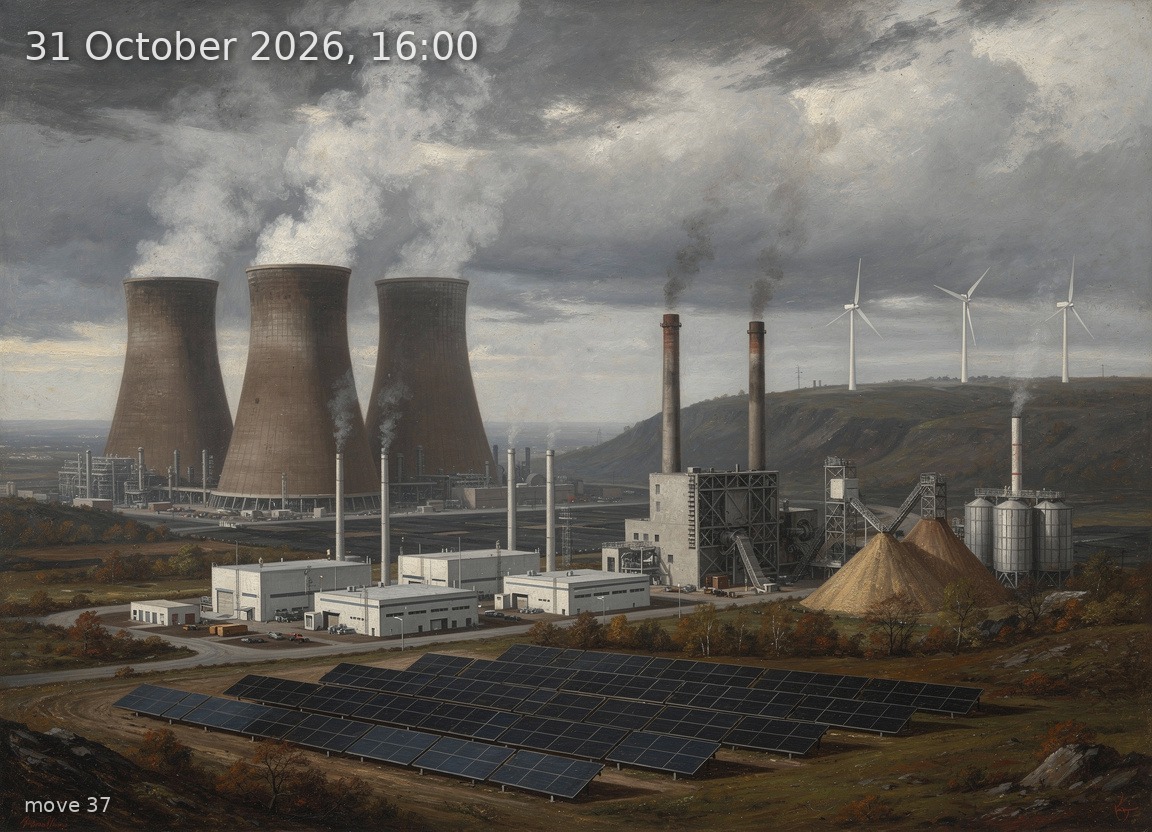
Brown coal and natural gas dominate as weak wind, full overcast, and 16.2 GW net imports drive prices to 290 EUR/MWh.
Generation mix
Wind onshore 10%
Wind offshore 1%
Solar 4%
Biomass 11%
Hydro 3%
Natural gas 30%
Hard coal 11%
Brown coal 31%
27%
Renewable share
3.8 GW
Wind (on + offshore)
1.4 GW
Solar
36.8 GW
Total generation
16.2 GW
Net import
290.3 EUR/MWh
Day-ahead price
9.0°C / 10 km/h
Temp / Wind speed
Open-Meteo, Kassel (51.3°N 9.5°E) · surface estimate from 100 m wind
100.0% / 3.8 W/m²
Cloud cover / Radiation
488
gCO₂/kWh
Image prompt
Brown coal 11.6 GW occupies the left third of the scene as a massive lignite power station complex with four hyperbolic cooling towers emitting thick white-grey steam plumes rising into the overcast; natural gas 11.1 GW fills the centre-left as a cluster of compact CCGT plants with tall singular exhaust stacks trailing thinner vapour; hard coal 4.0 GW appears centre-right as a traditional coal plant with rectangular boiler houses and twin chimneys; biomass 4.0 GW sits beside it as a wood-chip-fired plant with conical fuel silos and a modest smokestack; wind onshore 3.6 GW is rendered as a sparse line of three-blade turbines on a distant ridge, rotors barely turning in light breeze; solar 1.4 GW appears as a small field of aluminium-framed crystalline silicon panels in the mid-ground reflecting no sunlight under the dense clouds; hydro 1.0 GW is depicted as a small concrete run-of-river dam with spillway at the far right edge near a dark autumn river; wind offshore 0.2 GW is a single distant turbine barely visible on the far horizon. The sky is entirely overcast with low, heavy, oppressive stratiform clouds in tones of slate grey and dull pewter, no break or blue visible anywhere, conveying the extreme 290 EUR/MWh price tension. The time is 4 PM on October 31 — late afternoon daylight is already weak and diffuse, the light flat and cold, shadows nearly absent. Vegetation is late-autumn: bare-branched oaks, brown-gold remnant leaves, damp stubble fields. Temperature is 9°C — the air looks raw and damp. The entire scene is composed as a highly detailed oil painting in the tradition of 19th-century German Romantic landscape painters such as Caspar David Friedrich and Carl Blechen, with rich but muted earth tones, visible impasto brushwork, atmospheric depth through layered haze, and meticulous engineering accuracy on every turbine nacelle, lattice tower, cooling tower curvature, and panel frame. The mood is sombre, industrial, monumental. No text, no labels.