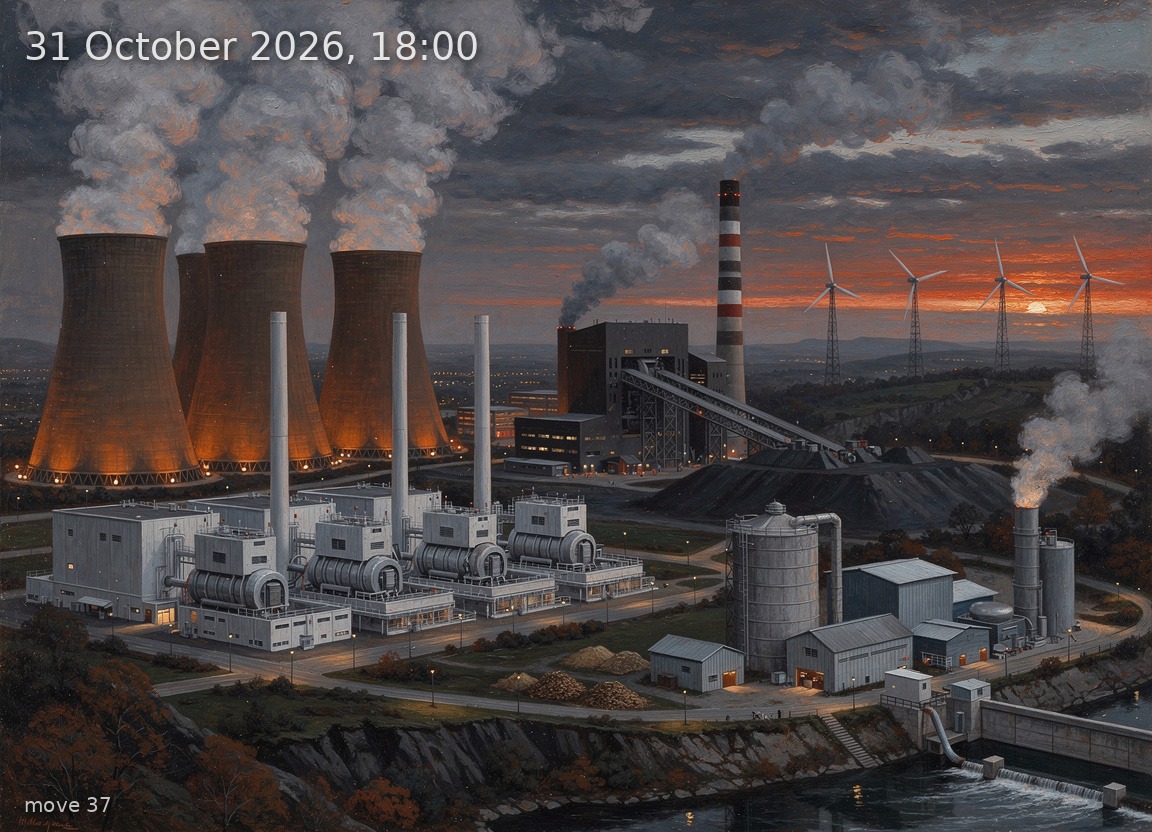
Brown coal and gas dominate a tight evening grid as weak wind and no solar drive high prices and heavy imports.
Generation mix
Wind onshore 13%
Wind offshore 1%
Biomass 10%
Hydro 2%
Natural gas 30%
Hard coal 10%
Brown coal 33%
26%
Renewable share
5.5 GW
Wind (on + offshore)
0.0 GW
Solar
39.8 GW
Total generation
15.9 GW
Net import
299.0 EUR/MWh
Day-ahead price
8.7°C / 11 km/h
Temp / Wind speed
Open-Meteo, Kassel (51.3°N 9.5°E) · surface estimate from 100 m wind
86.0% / 0.0 W/m²
Cloud cover / Radiation
497
gCO₂/kWh
Image prompt
Brown coal 13.3 GW dominates the left third of the scene as a cluster of massive hyperbolic cooling towers with thick white-grey steam plumes rising into the sky, lit from below by orange sodium lamps; natural gas 11.9 GW fills the centre-left as a row of compact CCGT power plants with tall single exhaust stacks emitting thin heat shimmer; wind onshore 5.2 GW appears in the right-centre as a modest line of three-blade turbines on lattice towers turning slowly on a distant ridge; hard coal 4.1 GW is rendered as a single large coal plant with conveyor belts and a tall smokestack in the mid-ground behind the gas units; biomass 4.2 GW appears as a medium-sized industrial facility with a wood-chip silo and shorter stack near the right edge; hydro 0.9 GW is suggested by a small dam and penstock structure in the far right background; wind offshore 0.3 GW is barely visible as a tiny silhouette of a few turbines on the far horizon line. The time is 18:00 on October 31st in central Germany — dusk, with the last thin band of deep orange-red light clinging to the low western horizon, the sky above rapidly darkening to deep indigo and charcoal grey, heavy overcast clouds at 86% cover pressing down oppressively. Temperature is 8.7°C — late autumn, bare branches on deciduous trees, brown and amber fallen leaves on the ground, dead grass. The atmosphere is heavy and foreboding, reflecting the 299 EUR/MWh price — a thick, brooding industrial haze hangs across the scene, sodium streetlights casting harsh amber pools on wet roads. Transmission towers with high-voltage lines stretch across the middle distance, symbolizing import flows. Style: highly detailed oil painting in the tradition of 19th-century German Romantic landscape painters such as Caspar David Friedrich, with rich impasto brushwork, dramatic chiaroscuro between the glowing industrial facilities and the darkening sky, atmospheric depth with layers of haze and steam, meticulous engineering accuracy on all turbine nacelles, cooling tower geometries, and plant structures. No text, no labels.