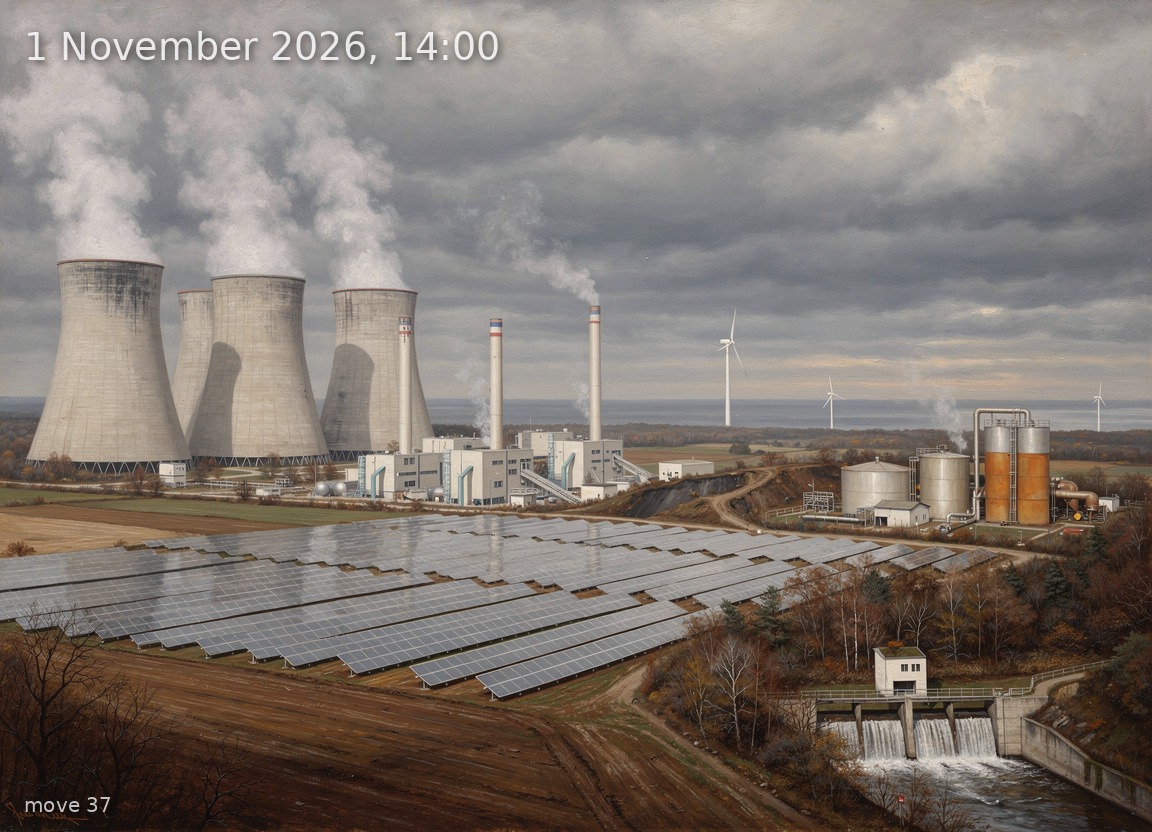
Coal and gas dominate as wind collapses; overcast skies limit solar, driving 6.9 GW net imports and high prices.
Generation mix
Wind onshore 3%
Wind offshore 1%
Solar 26%
Biomass 9%
Hydro 2%
Natural gas 26%
Hard coal 10%
Brown coal 23%
41%
Renewable share
1.6 GW
Wind (on + offshore)
11.3 GW
Solar
43.4 GW
Total generation
6.9 GW
Net import
242.3 EUR/MWh
Day-ahead price
9.9°C / 6 km/h
Temp / Wind speed
Open-Meteo, Kassel (51.3°N 9.5°E) · surface estimate from 100 m wind
100.0% / 21.3 W/m²
Cloud cover / Radiation
389
gCO₂/kWh
Image prompt
Brown coal 10.0 GW dominates the left third of the scene as a cluster of massive hyperbolic cooling towers with thick white-grey steam plumes merging into the overcast sky; natural gas 11.1 GW fills the centre-left as a row of modern CCGT power stations with tall slender exhaust stacks trailing faint heat shimmer; solar 11.3 GW occupies the centre as vast fields of aluminium-framed crystalline silicon PV panels stretching across flat farmland, their surfaces dull and reflective under diffuse grey light; hard coal 4.3 GW appears centre-right as a traditional coal plant with rectangular boiler houses and a single large smokestack; biomass 4.1 GW stands to the right as a modest industrial facility with cylindrical digesters and wood-chip silos; wind onshore 1.3 GW is represented by only two or three distant three-blade turbines on a low ridge, their rotors barely turning; wind offshore 0.3 GW is a single faint turbine silhouette on the far horizon; hydro 1.0 GW appears as a small concrete dam and powerhouse nestled in a wooded valley at the far right. The sky is entirely overcast with heavy, low, uniform grey stratus clouds — no blue sky visible, no sun disk — casting flat, shadowless November daylight at 14:00. The landscape is late-autumn central German: bare deciduous trees with a few remaining brown leaves, damp stubble fields, muted green-brown grass, temperature around 10°C suggested by figures in warm jackets. The air feels still and oppressive, almost no wind, a heaviness in the atmosphere reflecting extreme electricity prices. Highly detailed oil painting in the tradition of 19th-century German Romantic landscape painters — Caspar David Friedrich meets industrial realism — rich earth tones, visible confident brushwork, deep atmospheric perspective with haze softening distant towers, meticulous engineering accuracy on every turbine nacelle, every cooling tower hyperboloid curve, every PV panel frame. No text, no labels.