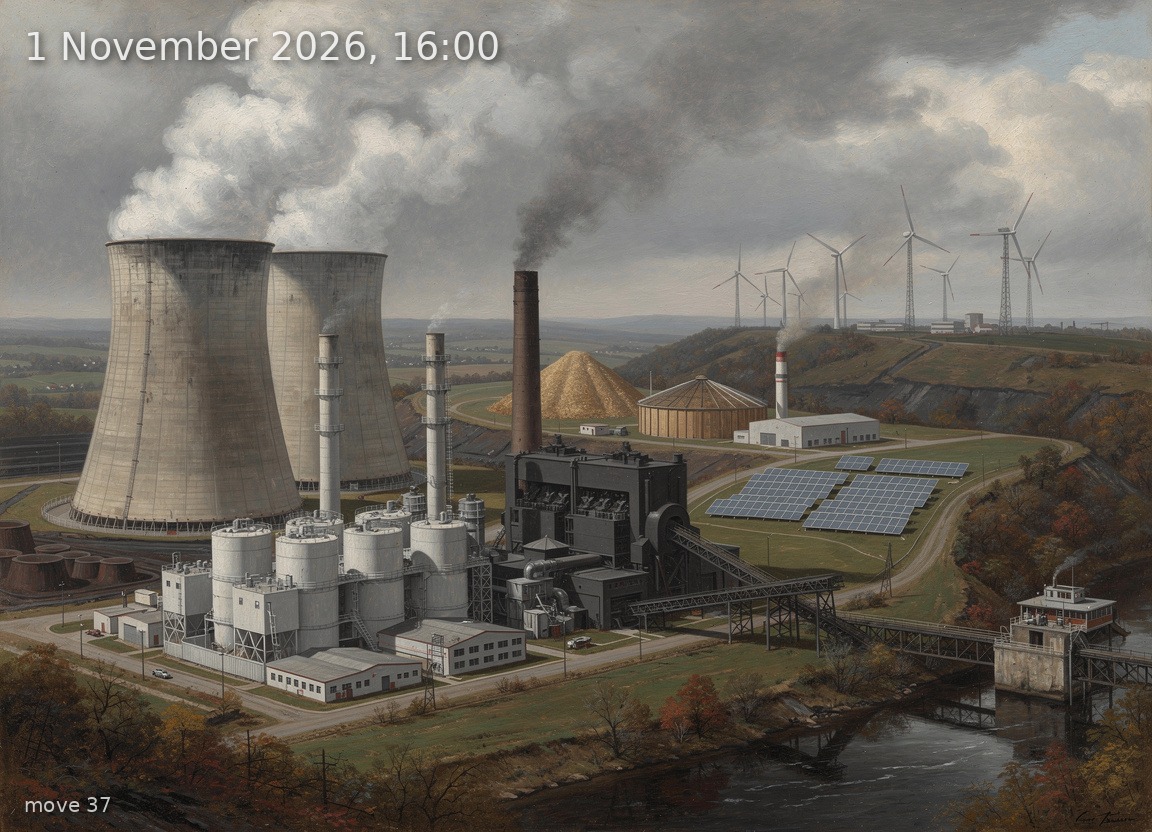
Brown coal and gas dominate a fossil-heavy dispatch as calm winds and fading sun force 16 GW of net imports.
Generation mix
Wind onshore 4%
Wind offshore 1%
Solar 3%
Biomass 11%
Hydro 3%
Natural gas 31%
Hard coal 12%
Brown coal 35%
22%
Renewable share
1.8 GW
Wind (on + offshore)
1.3 GW
Solar
36.3 GW
Total generation
16.1 GW
Net import
295.3 EUR/MWh
Day-ahead price
8.9°C / 3 km/h
Temp / Wind speed
Open-Meteo, Kassel (51.3°N 9.5°E) · surface estimate from 100 m wind
68.0% / 34.8 W/m²
Cloud cover / Radiation
526
gCO₂/kWh
Image prompt
Brown coal 12.6 GW dominates the left third of the scene as a vast complex of hyperbolic cooling towers with thick white-grey steam plumes rising into the overcast sky; natural gas 11.2 GW fills the centre-left as multiple compact CCGT power blocks with tall single exhaust stacks emitting thin heat shimmer; hard coal 4.3 GW appears centre-right as a dark industrial plant with conveyor belts and a chunky smokestack; biomass 4.0 GW sits behind as a mid-sized facility with a wooden-chip storage dome and modest flue; wind onshore 1.5 GW shows as a small cluster of three-blade turbines on a distant ridge, rotors barely turning in the still air; solar 1.3 GW appears as a modest field of aluminium-framed crystalline silicon panels catching the last weak diffuse light; hydro 1.0 GW is a small dam and powerhouse nestled in a valley at the far right; wind offshore 0.4 GW is suggested by tiny turbine silhouettes on a hazy horizon line. The time is 4 PM on November 1st in central Germany — late afternoon daylight is fading rapidly, the sun low and invisible behind 68% grey cloud cover, weak diffuse light casting flat grey tones across the landscape. Temperature is about 9°C; late-autumn vegetation with bare deciduous trees, dull brown-gold remnant leaves, muted green grass. The atmosphere is heavy and oppressive, suggesting the high electricity price — a thick overcast presses down on the industrial panorama, the air hazy with moisture and emissions. Highly detailed oil painting in the tradition of 19th-century German Romantic landscape painters such as Caspar David Friedrich and Carl Blechen — rich sombre colour palette of ochres, slate greys, muted browns, and steel blues; visible confident brushwork; deep atmospheric perspective with layered recession. Each energy technology rendered with meticulous engineering accuracy: turbine nacelles with three-blade rotors on lattice or tubular towers, lignite hyperbolic concrete cooling towers with condensation plumes, gas CCGT units with cylindrical HRSGs and tall stacks, coal conveyor systems. The scene conveys the weight of an industrial nation leaning on thermal generation under a brooding autumn sky. No text, no labels.