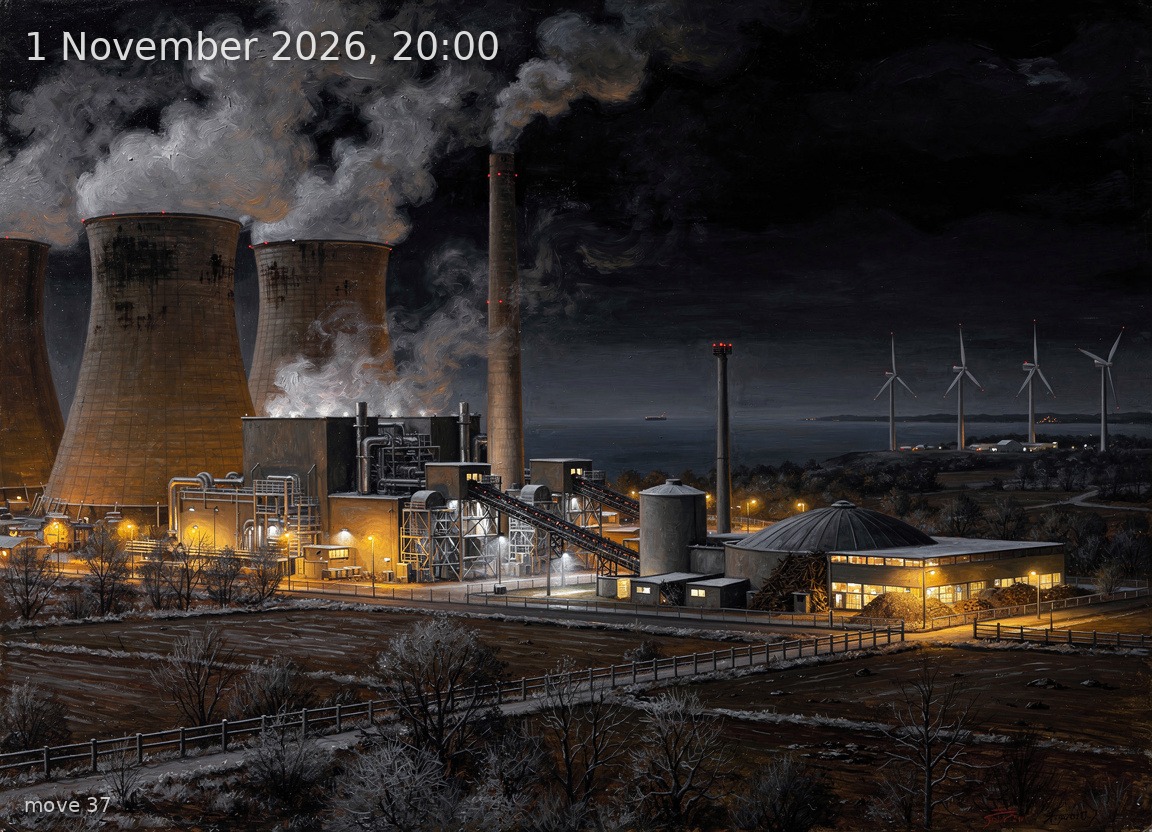
Gas and brown coal dominate a calm, dark November evening; low wind and heavy imports drive prices near 285 EUR/MWh.
Generation mix
Wind onshore 7%
Wind offshore 3%
Biomass 12%
Hydro 2%
Natural gas 32%
Hard coal 12%
Brown coal 32%
24%
Renewable share
3.6 GW
Wind (on + offshore)
0.0 GW
Solar
37.7 GW
Total generation
15.2 GW
Net import
284.8 EUR/MWh
Day-ahead price
6.2°C / 3 km/h
Temp / Wind speed
Open-Meteo, Kassel (51.3°N 9.5°E) · surface estimate from 100 m wind
100.0% / 0.0 W/m²
Cloud cover / Radiation
508
gCO₂/kWh
Image prompt
Brown coal 12.1 GW occupies the left third of the scene as massive hyperbolic cooling towers with thick white-grey steam plumes rising into the night sky; natural gas 12.2 GW fills the centre-left as a cluster of compact CCGT power blocks with tall single exhaust stacks emitting shimmering heat haze, lit by sodium-orange industrial floodlights; hard coal 4.4 GW appears centre-right as a smaller coal-fired station with a single rectangular chimney and conveyor belts visible under arc lights; biomass 4.5 GW is rendered as a mid-sized wood-chip combustion plant with a domed fuel silo and a modest stack, glowing warmly from interior lighting; wind onshore 2.7 GW appears as a sparse row of three-blade turbines on a distant ridge to the far right, their red aviation warning lights blinking faintly, rotors nearly still; wind offshore 0.9 GW is suggested by a barely visible cluster of turbine lights on the far horizon; hydro 0.9 GW appears as a small dam structure at the far right edge with a faint cascade of water catching reflected light. The sky is completely dark, deep black-navy with 100% overcast cloud cover eliminating all stars, no twilight glow whatsoever — a full November night at 20:00. The landscape is cold early-winter central Germany: bare deciduous trees, dormant brown fields, frost forming on railings and fences. The atmosphere feels heavy, oppressive, weighed down by high energy prices — thick industrial haze clings low to the ground, mixing with steam. Sodium streetlights cast amber pools along access roads. The entire composition is rendered as a highly detailed oil painting in the tradition of 19th-century German Romantic landscape painters such as Caspar David Friedrich — rich saturated darks, visible impasto brushwork, dramatic chiaroscuro between the glowing industrial facilities and the surrounding darkness, atmospheric depth receding into murky distance. Each power technology is depicted with meticulous engineering accuracy: turbine nacelles and three-blade rotors, lattice transmission towers with catenary cables, hyperbolic concrete cooling tower shells, gas turbine exhaust diffusers. No text, no labels.