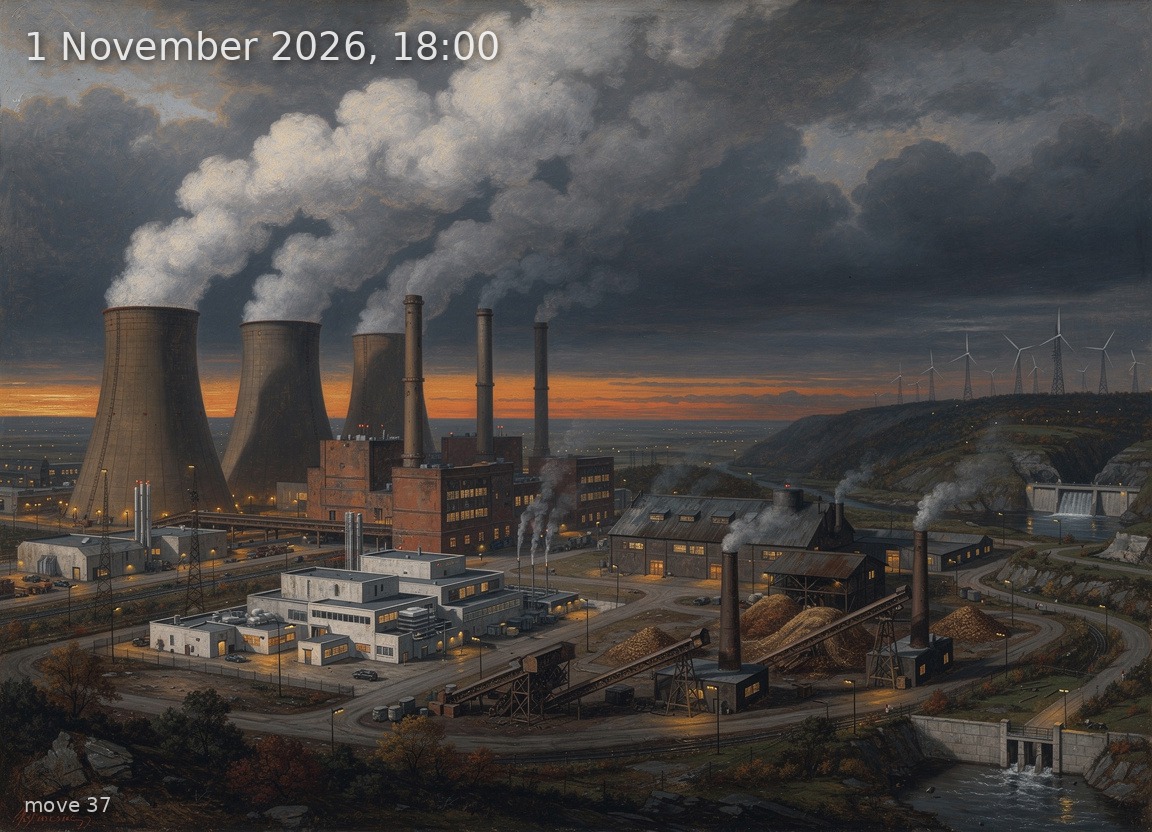
Brown coal and gas dominate as wind and solar fail on a cold, dark November evening with heavy imports needed.
Generation mix
Wind onshore 6%
Wind offshore 1%
Biomass 11%
Hydro 2%
Natural gas 31%
Hard coal 12%
Brown coal 36%
21%
Renewable share
2.7 GW
Wind (on + offshore)
0.0 GW
Solar
37.2 GW
Total generation
18.7 GW
Net import
300.0 EUR/MWh
Day-ahead price
7.6°C / 4 km/h
Temp / Wind speed
Open-Meteo, Kassel (51.3°N 9.5°E) · surface estimate from 100 m wind
100.0% / 0.0 W/m²
Cloud cover / Radiation
535
gCO₂/kWh
Image prompt
Brown coal 13.3 GW dominates the left third of the scene as a vast complex of hyperbolic cooling towers rising against the sky, thick white steam plumes billowing upward and drifting right; natural gas 11.7 GW fills the centre-left as a cluster of modern CCGT power plants with tall slender exhaust stacks emitting shimmering heat haze and thin vapour trails; hard coal 4.4 GW appears centre-right as a pair of older coal-fired stations with rectangular block structures and shorter stacks trailing grey smoke; biomass 4.2 GW is rendered as a set of medium-sized industrial plants with wood-chip conveyors and modest chimneys, positioned right of centre; wind onshore 2.3 GW appears in the far right background as a sparse row of three-blade turbines on lattice towers, their rotors barely turning in the still air; hydro 0.9 GW is a small dam structure visible in the far distance at the right edge. The time is 18:00 in early November — dusk is nearly finished, with only a thin band of deep burnt-orange glow lingering on the far western horizon, the sky above transitioning rapidly to dark steel-blue and near-black overhead, complete overcast with no stars or moon visible. The atmosphere feels heavy, oppressive, and leaden, reflecting the extreme 300 EUR/MWh price — low clouds press down claustrophobically on the industrial landscape. Temperature is 7.6°C: bare deciduous trees with skeletal branches line the foreground, brown dead grass, a thin ground mist creeping across cold earth. Sodium-orange streetlights and industrial floodlights illuminate the power plants from below, casting warm pools of artificial light against the encroaching darkness. High-voltage transmission pylons recede into the murk toward the horizon, their lines sagging with the weight of imported current. No solar panels anywhere. Painted in the style of a highly detailed 19th-century German Romantic oil painting — rich impasto brushwork, atmospheric chiaroscuro depth, dramatic interplay of artificial warm light against cold natural twilight, meticulous engineering accuracy in every cooling tower, turbine nacelle, and exhaust stack, evoking Caspar David Friedrich's sublime melancholy applied to an industrial energy landscape. No text, no labels.