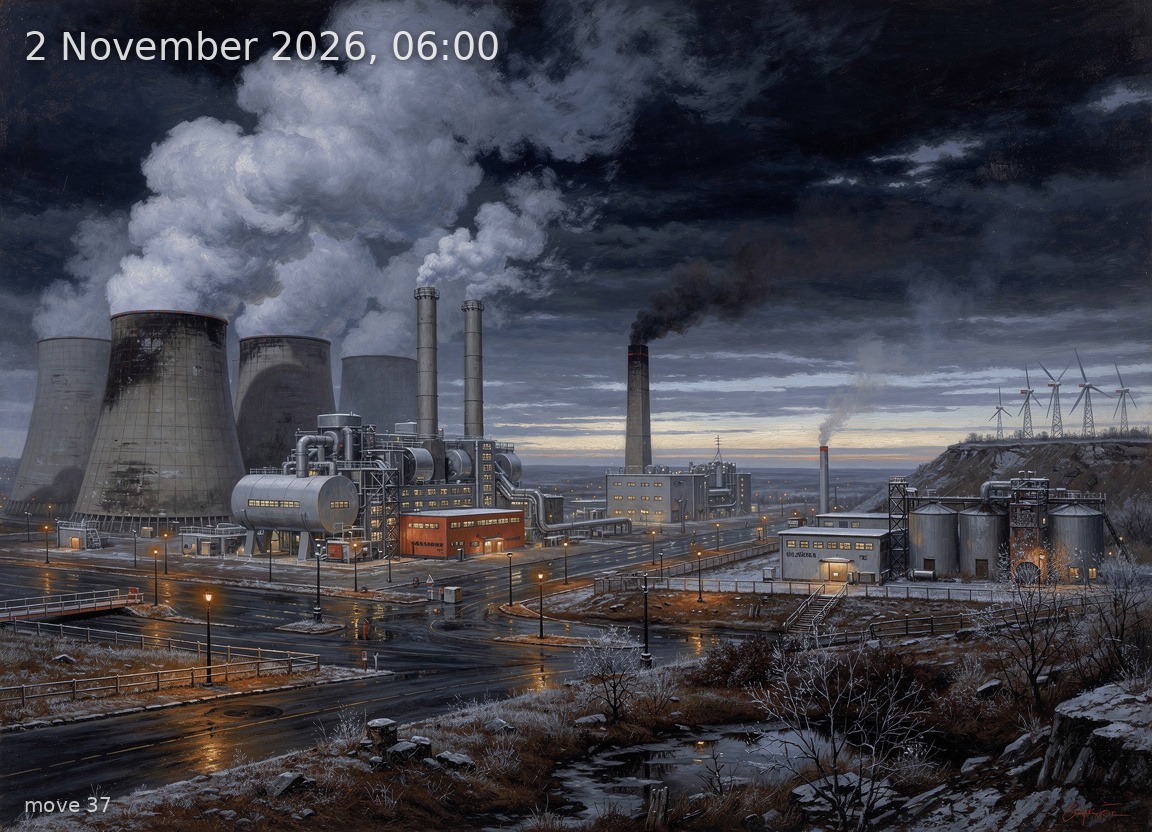
Gas and brown coal dominate as near-calm winds, zero solar, and 17.4 GW net imports drive prices above 300 EUR/MWh.
Generation mix
Wind onshore 7%
Wind offshore 13%
Solar 0%
Biomass 10%
Hydro 2%
Natural gas 30%
Hard coal 10%
Brown coal 28%
32%
Renewable share
7.9 GW
Wind (on + offshore)
0.0 GW
Solar
39.3 GW
Total generation
17.4 GW
Net import
304.9 EUR/MWh
Day-ahead price
3.0°C / 2 km/h
Temp / Wind speed
Open-Meteo, Kassel (51.3°N 9.5°E) · surface estimate from 100 m wind
100.0% / 0.0 W/m²
Cloud cover / Radiation
448
gCO₂/kWh
Image prompt
Brown coal 11.0 GW occupies the left third of the scene as a cluster of massive hyperbolic cooling towers emitting dense white steam plumes into the frigid air; natural gas 11.8 GW fills the centre-left as a row of modern combined-cycle gas turbine plants with tall single exhaust stacks and glowing orange-lit control buildings; hard coal 3.8 GW appears centre-right as a smaller coal-fired station with a single square chimney trailing dark exhaust; wind offshore 5.0 GW is suggested in the far right background as a line of turbines barely visible on a dark grey sea horizon with slow-turning blades; wind onshore 2.9 GW stands as a small cluster of three-blade turbines on a low ridge to the right, blades nearly still in the calm air; biomass 4.0 GW appears as a wood-chip-fired plant with a modest smokestack in the middle distance; hydro 0.8 GW is a small dam structure partially hidden in a dark valley at far right. No solar panels anywhere — zero solar output. Time is 06:00 dawn in early November: the sky shows the faintest pale steel-blue pre-dawn light along the eastern horizon, but overhead remains deep navy-black, heavy with 100% overcast cloud. Temperature is 3°C — frost clings to bare branches, dormant brown grass, and metal railings; breath-like condensation curls from every exhaust. The atmosphere is oppressive and heavy, reflecting the extreme 304.9 EUR/MWh price — low clouds press down on the industrial landscape, sodium streetlights cast amber pools across wet roads, and the air feels thick with moisture and combustion particulates. Painted in the style of a highly detailed 19th-century German Romantic oil painting — rich, dark palette of Prussian blue, raw umber, and burnt sienna, visible impasto brushwork, atmospheric sfumato in the distance — yet every engineering detail is meticulous: lattice tower structures, nacelle housings, triple-blade rotor geometry, the parabolic curves of cooling towers, aluminium cladding on gas turbine enclosures. The scene conveys an industrial sublime — the awesome, almost fearful power of a fossil-heavy grid straining against winter darkness. No text, no labels.