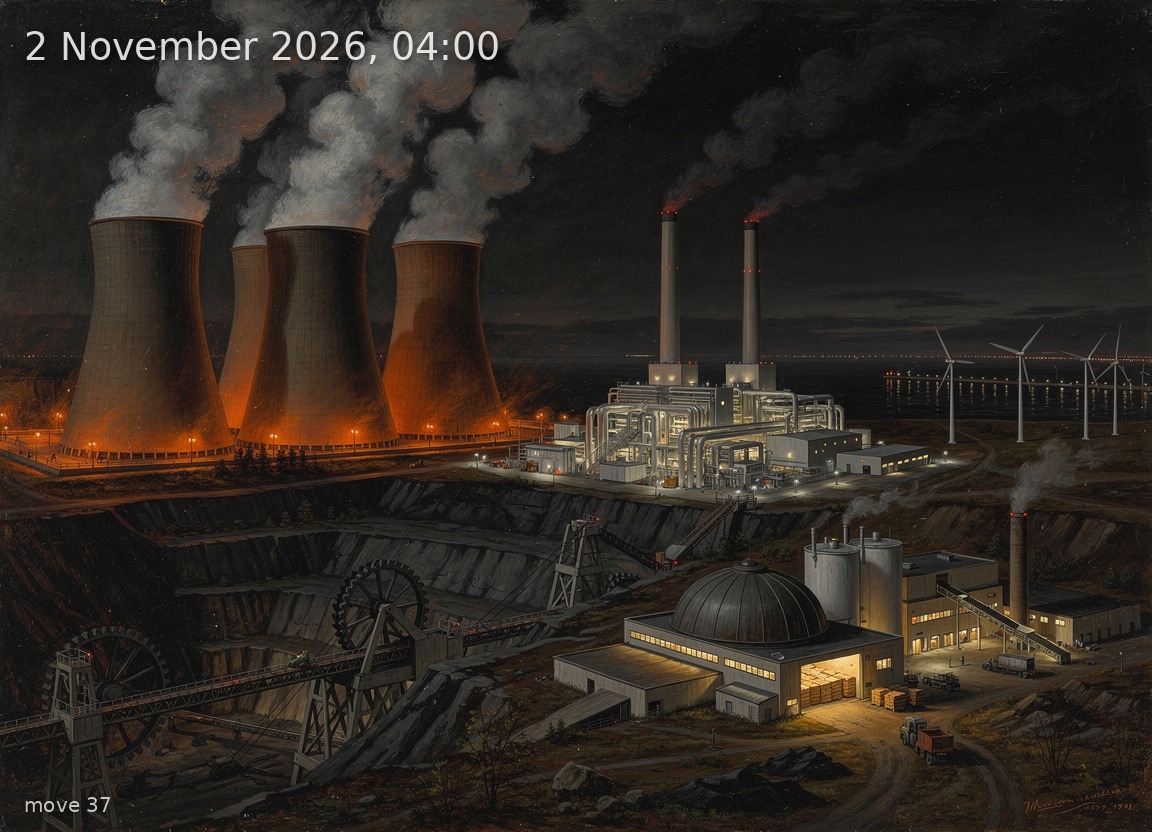
Brown coal, natural gas, and hard coal dominate overnight generation as low wind and cold weather drive elevated prices.
Generation mix
Wind onshore 8%
Wind offshore 13%
Biomass 10%
Hydro 2%
Natural gas 30%
Hard coal 9%
Brown coal 28%
33%
Renewable share
7.9 GW
Wind (on + offshore)
0.0 GW
Solar
38.6 GW
Total generation
6.8 GW
Net import
228.0 EUR/MWh
Day-ahead price
4.3°C / 3 km/h
Temp / Wind speed
Open-Meteo, Kassel (51.3°N 9.5°E) · surface estimate from 100 m wind
100.0% / 0.0 W/m²
Cloud cover / Radiation
443
gCO₂/kWh
Image prompt
Brown coal 10.7 GW dominates the left third of the scene as a cluster of massive hyperbolic cooling towers rising into the night, thick white-grey steam plumes billowing upward, lit from below by orange sodium lamps revealing the raw lignite conveyors and vast open-pit mine terraces at their feet. Natural gas 11.7 GW occupies the centre as a dense complex of compact CCGT power stations with tall single exhaust stacks emitting thin heat shimmer, their metallic housings reflecting amber industrial floodlights. Hard coal 3.5 GW appears as a smaller conventional power station to the right of centre, its twin square stacks silhouetted against the sky with faint red aviation warning lights. Wind onshore 3.0 GW is represented by a modest row of three-blade turbines on a low ridge in the right middle-ground, their rotors barely turning in the still air, nacelles faintly lit. Wind offshore 4.9 GW appears as a distant line of taller turbines along the far-right horizon, blinking navigation lights reflected on a dark strip of sea. Biomass 4.0 GW shows as a mid-sized industrial facility with a domed wood-chip silo and a single modest smokestack, warm light spilling from its open loading bay. Hydro 0.8 GW is a small concrete dam structure barely visible in the far background. The sky is completely black with heavy 100% overcast—no stars, no moon, no twilight glow whatsoever, only a deep oppressive navy-black canopy pressing down. The temperature is 4.3°C: bare deciduous trees with skeletal branches, patches of frost glistening on the ground, dormant brown grass. The atmosphere feels heavy and costly—thick industrial haze drifts through the scene catching the sodium light in amber halos. No solar panels anywhere. Painted in the style of a highly detailed 19th-century German Romantic oil painting with rich impasto brushwork, deep chiaroscuro contrasts, atmospheric depth receding into industrial murk, technically accurate engineering details on every turbine nacelle, cooling tower curve, and exhaust stack. No text, no labels.