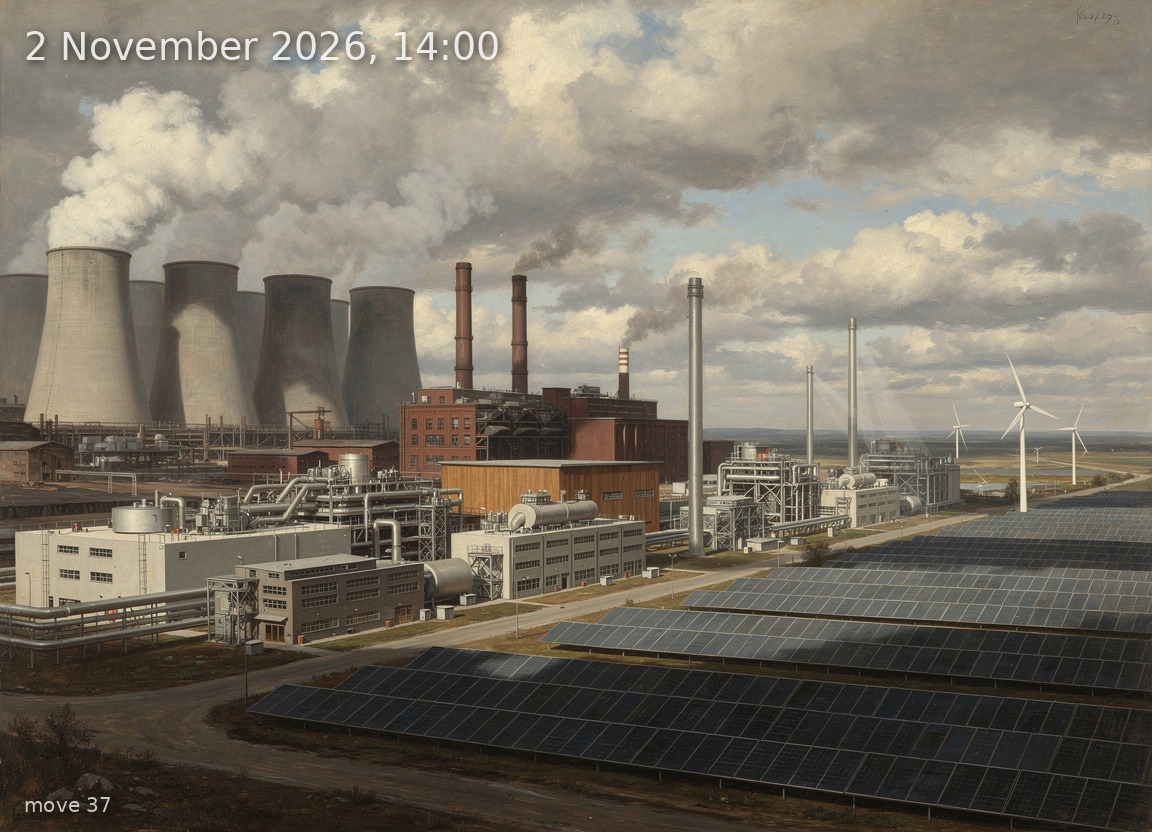
Gas, brown coal, and solar lead generation while weak wind and a large import need drive prices to 217 EUR/MWh.
Generation mix
Wind onshore 5%
Wind offshore 10%
Solar 20%
Biomass 8%
Hydro 2%
Natural gas 25%
Hard coal 8%
Brown coal 22%
45%
Renewable share
7.9 GW
Wind (on + offshore)
10.4 GW
Solar
51.5 GW
Total generation
11.2 GW
Net import
217.0 EUR/MWh
Day-ahead price
9.3°C / 2 km/h
Temp / Wind speed
Open-Meteo, Kassel (51.3°N 9.5°E) · surface estimate from 100 m wind
67.0% / 160.5 W/m²
Cloud cover / Radiation
359
gCO₂/kWh
Image prompt
Brown coal 11.2 GW dominates the left quarter as a cluster of massive hyperbolic cooling towers with thick white-grey steam plumes rising into overcast sky; natural gas 13.0 GW fills the centre-left as a sprawling row of modern CCGT power plants with tall slender exhaust stacks trailing heat shimmer; solar 10.4 GW occupies the centre-right as vast fields of aluminium-framed crystalline silicon photovoltaic panels angled low, catching diffuse pale light filtering through broken cloud; wind offshore 5.2 GW appears in the far right background as distant rows of large three-blade turbines barely turning on a grey sea horizon; wind onshore 2.7 GW stands in the mid-right as a handful of lattice-towered turbines on gentle hills with blades nearly motionless; biomass 4.2 GW is rendered as a wood-clad industrial plant with a modest smokestack near centre; hard coal 4.0 GW appears as a dark brick power station with twin chimneys to the left of the brown coal towers; hydro 0.9 GW is a small dam and penstock visible in a valley in the far background. Time of day is early afternoon with full but muted daylight: the sky is two-thirds covered in heavy, low stratocumulus clouds in shades of pewter and dull cream, with occasional breaks showing pale blue; the light is flat and diffuse, casting soft shadows. The atmosphere feels heavy and oppressive, reflecting the very high electricity price—a leaden, weighty sky pressing down on the industrial landscape. Vegetation is late-autumn: bare deciduous trees with a few clinging brown leaves, faded yellow-brown grass, dark green conifers. Temperature around 9°C gives a damp, chilly feel with faint mist hugging the valley floor. Rendered as a highly detailed oil painting in the tradition of 19th-century German Romantic landscape painters—rich earthy and grey tones, visible impasto brushwork, atmospheric depth and aerial perspective—but with meticulous engineering accuracy on every turbine nacelle, cooling tower, PV module frame, and exhaust stack. No text, no labels.