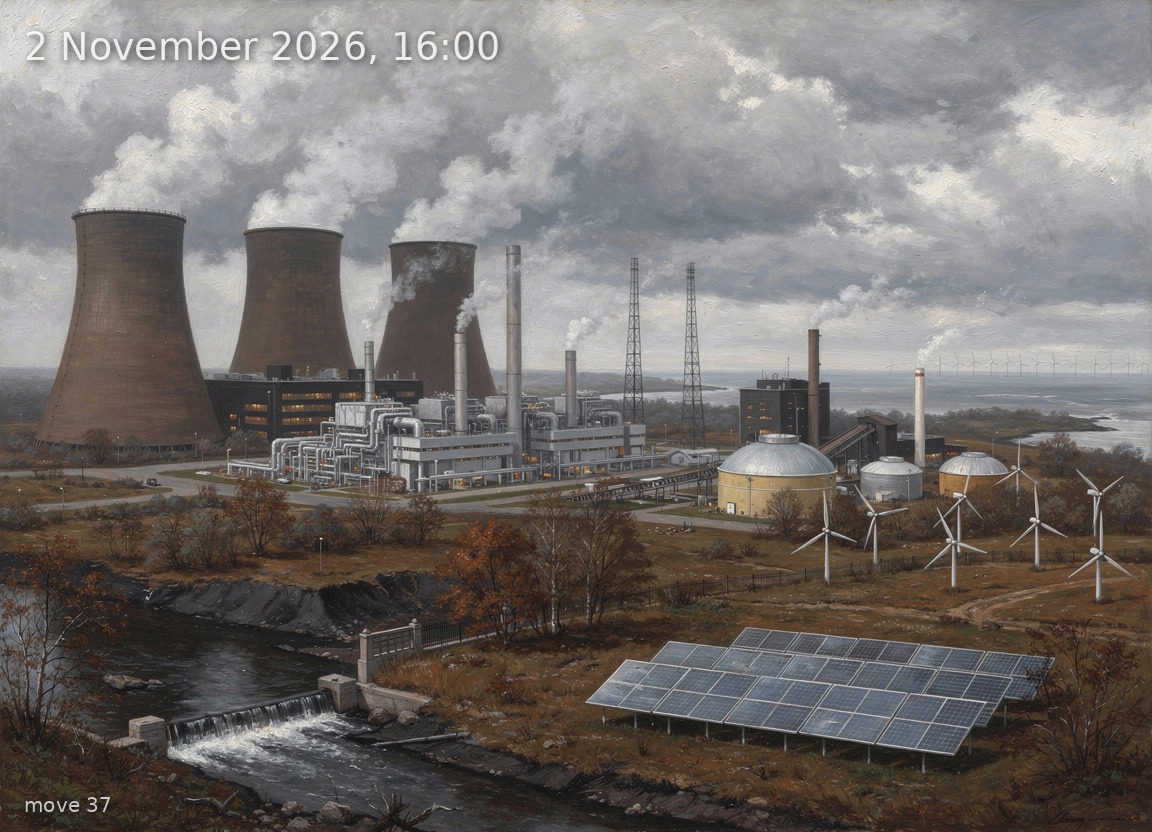
Brown coal, natural gas, and 18 GW net imports sustain Germany through a low-renewable, high-price autumn afternoon.
Generation mix
Wind onshore 8%
Wind offshore 12%
Solar 2%
Biomass 9%
Hydro 2%
Natural gas 30%
Hard coal 10%
Brown coal 26%
34%
Renewable share
9.2 GW
Wind (on + offshore)
1.0 GW
Solar
44.8 GW
Total generation
18.0 GW
Net import
291.3 EUR/MWh
Day-ahead price
9.1°C / 7 km/h
Temp / Wind speed
Open-Meteo, Kassel (51.3°N 9.5°E) · surface estimate from 100 m wind
76.0% / 34.5 W/m²
Cloud cover / Radiation
435
gCO₂/kWh
Image prompt
Brown coal 11.6 GW dominates the left third of the scene as a massive lignite power station complex with four hyperbolic cooling towers emitting thick white-grey steam plumes rising into an overcast sky; natural gas 13.3 GW fills the centre-left as a sprawling array of compact CCGT units with tall single exhaust stacks venting thin heat shimmer; hard coal 4.6 GW appears centre-right as a smaller coal-fired plant with rectangular boiler houses and a single cooling tower trailing vapour; wind onshore 3.7 GW is visible in the middle distance as a modest cluster of three-blade turbines on lattice towers turning slowly in light wind; wind offshore 5.5 GW is suggested on the far-right horizon as a line of turbines barely visible through haze above a grey North Sea inlet; biomass 4.2 GW appears as a mid-sized industrial facility with cylindrical wood-pellet silos and a modest smokestack; hydro 0.9 GW is a small run-of-river weir structure along a dark river in the foreground; solar 1.0 GW is rendered as a small field of aluminium-framed crystalline silicon panels catching almost no light under heavy clouds. The time is 4 PM in early November — the sky is late-afternoon daylight but deeply overcast at 76% cloud cover with only faint diffuse illumination, no visible sun, a muted grey-white ceiling pressing low over the landscape. The atmosphere is heavy and oppressive reflecting the extreme 291 EUR/MWh price — the air feels thick, saturated, almost claustrophobic. Temperature around 9°C: autumn vegetation is sparse, brown grasses, mostly bare deciduous trees with a few clinging rust-coloured leaves, damp earth tones. Light wind barely stirs the turbine blades. Style: highly detailed oil painting in the tradition of 19th-century German Romantic landscape painters such as Caspar David Friedrich and Carl Blechen — rich impasto brushwork, atmospheric depth with layers of industrial haze receding into grey distance, sombre earth tones of umber, ochre, slate grey, and cold steel blue, with warm amber glows from plant interiors visible through windows. Meticulous engineering detail on every installation — turbine nacelles, three-blade rotors, cooling tower parabolic profiles, CCGT exhaust geometries, PV panel grid patterns. The composition conveys an industrial sublime: vast human infrastructure dwarfing the muted autumn landscape beneath an unyielding sky. No text, no labels.