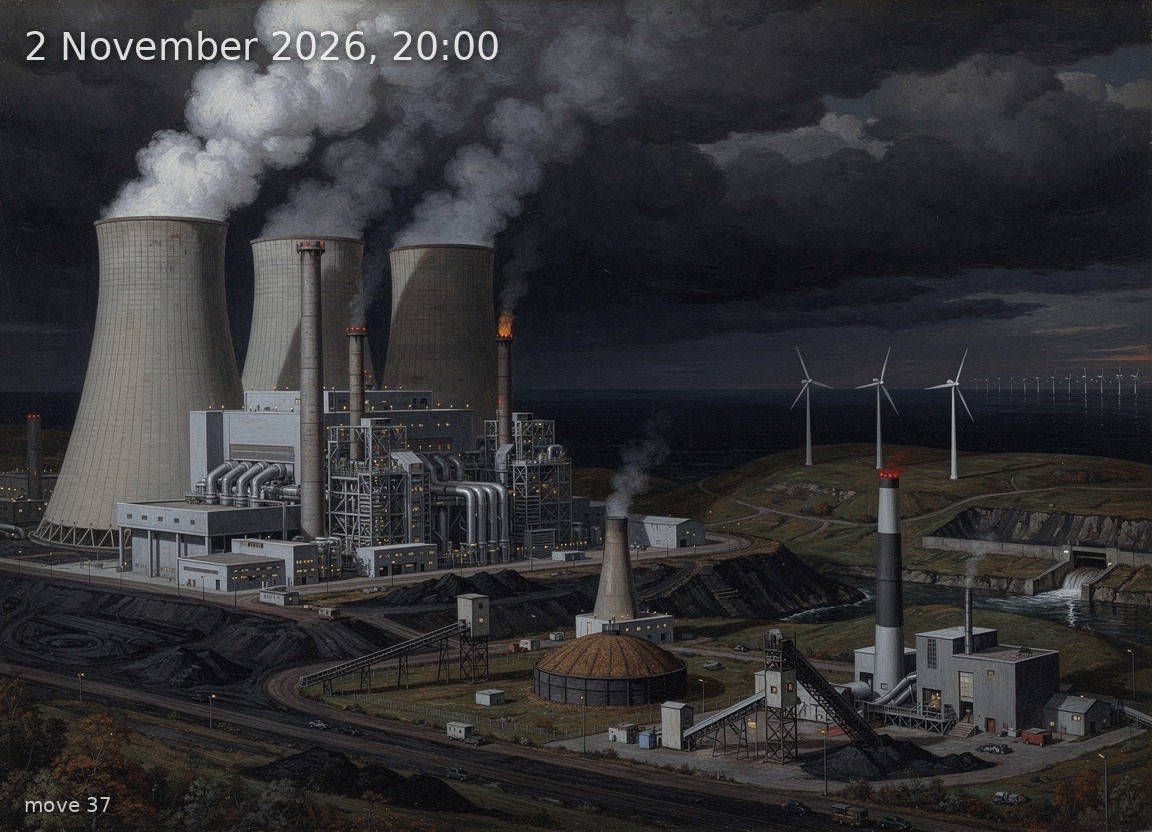
Gas, brown coal, and hard coal dominate as solar is absent and moderate wind leaves Germany importing 11.4 GW.
Generation mix
Wind onshore 13%
Wind offshore 11%
Biomass 9%
Hydro 2%
Natural gas 30%
Hard coal 11%
Brown coal 24%
35%
Renewable share
11.8 GW
Wind (on + offshore)
0.0 GW
Solar
49.2 GW
Total generation
11.3 GW
Net import
289.9 EUR/MWh
Day-ahead price
7.4°C / 3 km/h
Temp / Wind speed
Open-Meteo, Kassel (51.3°N 9.5°E) · surface estimate from 100 m wind
100.0% / 0.0 W/m²
Cloud cover / Radiation
424
gCO₂/kWh
Image prompt
Brown coal 11.9 GW occupies the left quarter as a sprawling lignite power station with four massive hyperbolic cooling towers emitting thick white steam plumes into the black sky; natural gas 14.7 GW fills the centre-left as a large combined-cycle gas turbine complex with tall slender exhaust stacks topped by heat-shimmer and faint orange flare glow; hard coal 5.2 GW appears centre-right as a smaller coal-fired plant with a single tapered chimney and conveyor belts feeding dark fuel into the facility; wind onshore 6.3 GW is rendered as a row of three-blade turbines on low hills in the right-centre background, their red aviation warning lights blinking faintly, blades barely turning in the calm air; wind offshore 5.6 GW is suggested by distant turbines on the far-right horizon over a dark sea, their nacelle lights dotting the blackness; biomass 4.6 GW appears as a modest industrial plant with a rounded wood-chip storage dome and a single stack emitting thin grey vapour, placed between the coal and wind installations; hydro 0.9 GW is a small dam structure visible in the far background with water faintly reflecting artificial light. The scene is set at 20:00 in early November — completely dark sky, no twilight, no sunset glow, deep navy-black heavens with 100% cloud cover obscuring all stars. The atmosphere is heavy, oppressive, humid — reflecting the extreme 289.9 EUR/MWh price. Temperature is a chilly 7.4 °C; bare deciduous trees with last brown leaves clinging, damp ground, patches of mist drifting at ground level. Sodium-orange streetlights line an access road in the foreground. Industrial floodlights illuminate the power stations with harsh white and amber beams. Steam and exhaust merge into the low overcast, creating a claustrophobic ceiling. Painted in the style of a highly detailed 19th-century German Romantic oil painting — rich impasto brushwork, dramatic chiaroscuro between the black sky and the glowing industrial facilities, deep atmospheric perspective, Caspar David Friedrich's sense of sublime scale applied to an industrial landscape. Meticulous engineering accuracy in every turbine nacelle, every cooling tower's parabolic curve, every lattice transmission tower. No text, no labels, no solar panels visible.