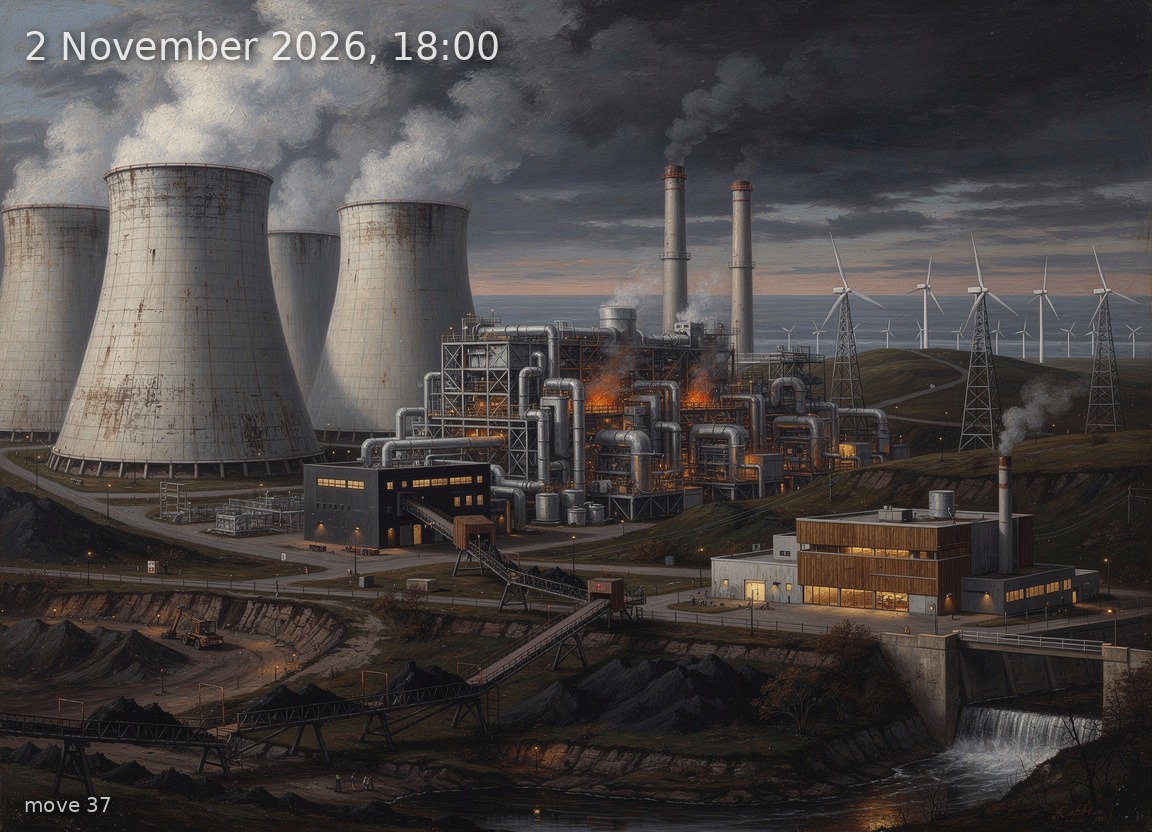
Gas, brown coal, and heavy imports power Germany through a windless, sunless November evening at extreme prices.
Generation mix
Wind onshore 11%
Wind offshore 12%
Biomass 9%
Hydro 2%
Natural gas 30%
Hard coal 11%
Brown coal 25%
34%
Renewable share
11.0 GW
Wind (on + offshore)
0.0 GW
Solar
47.1 GW
Total generation
18.1 GW
Net import
313.3 EUR/MWh
Day-ahead price
8.1°C / 5 km/h
Temp / Wind speed
Open-Meteo, Kassel (51.3°N 9.5°E) · surface estimate from 100 m wind
99.0% / 0.0 W/m²
Cloud cover / Radiation
432
gCO₂/kWh
Image prompt
Natural gas 14.1 GW dominates the centre-right of the composition as a sprawling complex of combined-cycle gas turbine plants with tall single exhaust stacks venting shimmering heat haze into the dusk sky; brown coal 11.8 GW occupies the left third as massive hyperbolic cooling towers releasing thick white steam plumes, flanked by conveyor belts carrying dark lignite from open pits; wind offshore 5.6 GW appears as a row of tall three-blade turbines on the distant horizon over a grey sea, their rotors turning slowly; wind onshore 5.4 GW stands as a cluster of lattice-towered turbines on low rolling hills in the mid-ground, blades barely moving in the still air; hard coal 5.0 GW sits in the centre-left as a rectangular power station with twin chimneys emitting grey smoke; biomass 4.3 GW is rendered as a smaller industrial facility with a timber-clad facade and a single modest stack with pale exhaust, positioned in the lower right; hydro 0.9 GW appears as a small concrete dam with a thin waterfall in the far lower-right corner. The sky is a dusk scene at 18:00 in early November: the upper sky deepening to dark slate-blue, a narrow band of fading orange-red glow along the lower horizon silhouetting the industrial structures. No sun visible, no solar panels anywhere. Temperature is cool at 8°C — bare deciduous trees with last brown leaves clinging, dormant grey-brown grass. Cloud cover is near total at 99%, a heavy oppressive blanket of low stratus pressing down on the scene. The atmosphere feels heavy and expensive — thick humid air, sodium streetlights beginning to glow amber around the plant perimeters, lit windows in control buildings. Transmission towers with high-voltage lines recede into the murky distance toward national borders, suggesting massive power imports. Painted in the style of a highly detailed 19th-century German Romantic oil painting — rich impasto brushwork, dramatic atmospheric depth, Caspar David Friedrich's sense of sublime scale applied to industrial infrastructure, deep chiaroscuro between the glowing furnaces and the encroaching November darkness. Meticulous engineering detail on every turbine nacelle, cooling tower, and exhaust stack. No text, no labels.