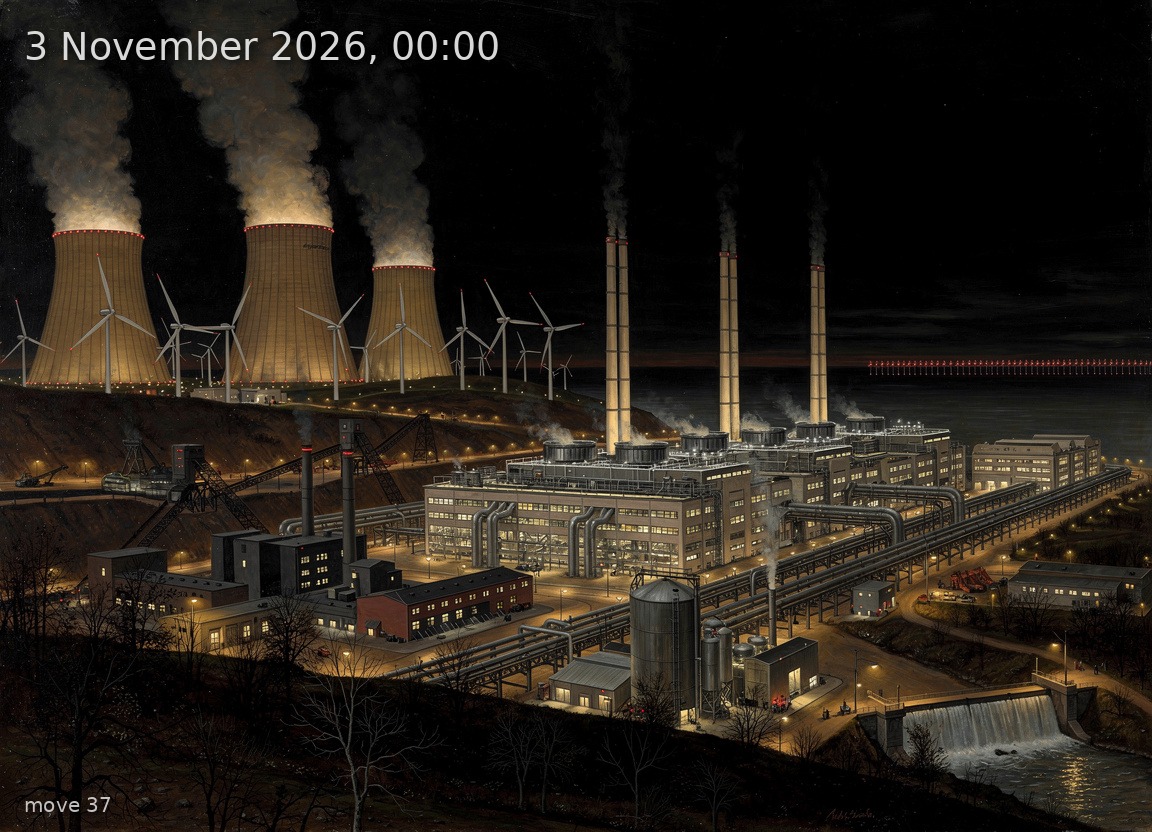
Gas, brown coal, and wind anchor overnight supply as tight margins and thermal-heavy dispatch push prices above 220 EUR/MWh.
Generation mix
Wind onshore 15%
Wind offshore 10%
Biomass 9%
Hydro 2%
Natural gas 31%
Hard coal 10%
Brown coal 23%
36%
Renewable share
11.1 GW
Wind (on + offshore)
0.0 GW
Solar
45.0 GW
Total generation
4.1 GW
Net import
222.4 EUR/MWh
Day-ahead price
6.0°C / 6 km/h
Temp / Wind speed
Open-Meteo, Kassel (51.3°N 9.5°E) · surface estimate from 100 m wind
100.0% / 0.0 W/m²
Cloud cover / Radiation
414
gCO₂/kWh
Image prompt
Natural gas 13.9 GW dominates the centre-right as a sprawling complex of combined-cycle gas turbine units with tall slender exhaust stacks emitting shimmering heat haze and faint white plumes; brown coal 10.5 GW occupies the left quarter as massive hyperbolic cooling towers releasing thick columns of steam into the black sky, alongside open-pit conveyor gantries; wind onshore 6.7 GW appears as a cluster of three-blade turbines on rolling hills in the mid-ground left, their red aviation lights blinking; wind offshore 4.4 GW is suggested by distant turbines on the far horizon right, tiny red dots in a row above a dark sea; hard coal 4.3 GW sits as a compact power station with rectangular stacks and coal bunkers near the brown coal complex; biomass 4.2 GW appears as a smaller industrial facility with a cylindrical silo and modest chimney in the right foreground; hydro 1.0 GW is a small dam structure with water glinting faintly at far right. Time is midnight: the sky is entirely black with complete overcast — no stars, no moon, no twilight glow whatsoever, only a deep oppressive blanket of invisible clouds reflecting the amber sodium-vapor glow of industrial facilities below. Temperature is 6 °C in early November: bare deciduous trees with dark skeletal branches, damp ground, thin mist clinging to a river in the foreground. The atmosphere is heavy and foreboding, conveying expensive power — the air itself feels dense and costly. Painted in the style of a highly detailed 19th-century German Romantic oil painting, rich in chiaroscuro, with warm amber and deep umber tones from industrial lighting contrasting against the cold navy-black sky, visible impasto brushwork, atmospheric perspective lending depth across the vast industrial panorama, every turbine nacelle, cooling tower rib, and gas-stack flange rendered with meticulous engineering accuracy. No text, no labels.