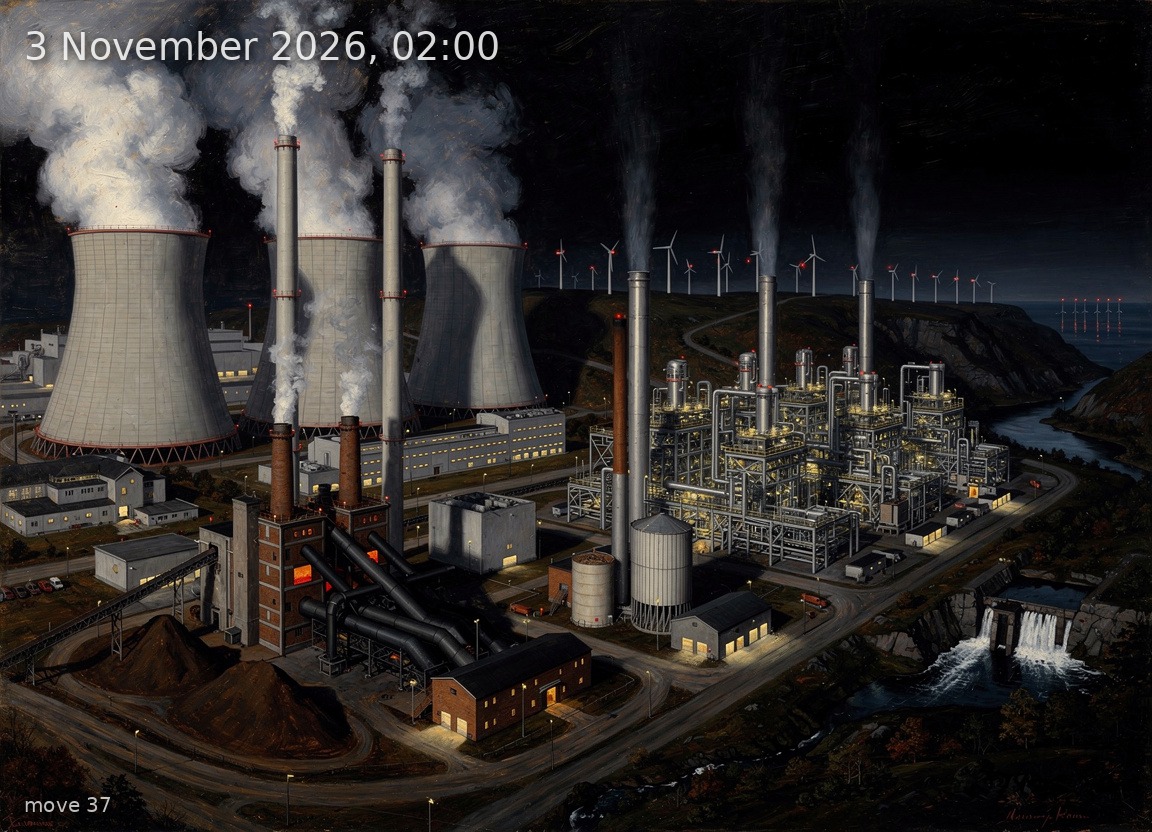
Gas, brown coal, and moderate wind dominate a high-price November night requiring 3.9 GW net imports.
Generation mix
Wind onshore 17%
Wind offshore 10%
Biomass 9%
Hydro 2%
Natural gas 30%
Hard coal 10%
Brown coal 21%
39%
Renewable share
11.6 GW
Wind (on + offshore)
0.0 GW
Solar
43.0 GW
Total generation
4.0 GW
Net import
224.3 EUR/MWh
Day-ahead price
4.9°C / 6 km/h
Temp / Wind speed
Open-Meteo, Kassel (51.3°N 9.5°E) · surface estimate from 100 m wind
47.0% / 0.0 W/m²
Cloud cover / Radiation
395
gCO₂/kWh
Image prompt
Natural gas 12.8 GW dominates the centre-right as a sprawling complex of compact CCGT units with tall single exhaust stacks venting pale plumes into the dark sky; brown coal 9.1 GW occupies the left quarter as massive hyperbolic cooling towers with thick white steam columns rising from a lignite power station with conveyor belts and ash-grey structures; hard coal 4.4 GW appears as a smaller coal-fired plant with twin chimneys and reddish glow from furnace windows in the centre-left; wind onshore 7.4 GW is rendered as a line of three-blade turbines on a distant ridge behind the thermal plants, their red aircraft-warning lights blinking in the darkness; wind offshore 4.2 GW is suggested by a cluster of turbines visible far out on a dark sea horizon at the far right edge; biomass 4.1 GW appears as a modest industrial facility with a wood-chip silo and single smokestack near the centre; hydro 1.1 GW is a small dam and powerhouse nestled in a dark valley in the far background. The scene is set at 2 AM on a cold November night — the sky is completely black with no twilight, no sky glow, only a deep navy-black firmament with scattered stars visible through 47% cloud cover rendered as drifting grey masses. All illumination comes from sodium-orange and white industrial floodlights casting harsh pools of light on concrete structures, glowing furnace windows, blinking red tower lights, and the faint amber haze of a distant town on the horizon. Bare autumn trees with skeletal branches frame the foreground, frost glinting on dead grass in the cold 4.9°C air. The atmosphere is heavy and oppressive, reflecting the high electricity price — a low industrial haze hangs over the scene, diffusing the artificial lights into brooding halos. Highly detailed oil painting in the tradition of 19th-century German Romantic landscape painters — rich dark palette of blacks, deep blues, burnt orange, and sulphur yellow; visible impasto brushwork in the steam plumes and clouds; atmospheric depth with layered planes receding into darkness; meticulous engineering accuracy in every turbine nacelle, cooling tower parabolic curve, and gas turbine exhaust stack. The scene conveys industrial sublimity — humanity's fire burning against the vast indifferent night. No text, no labels.