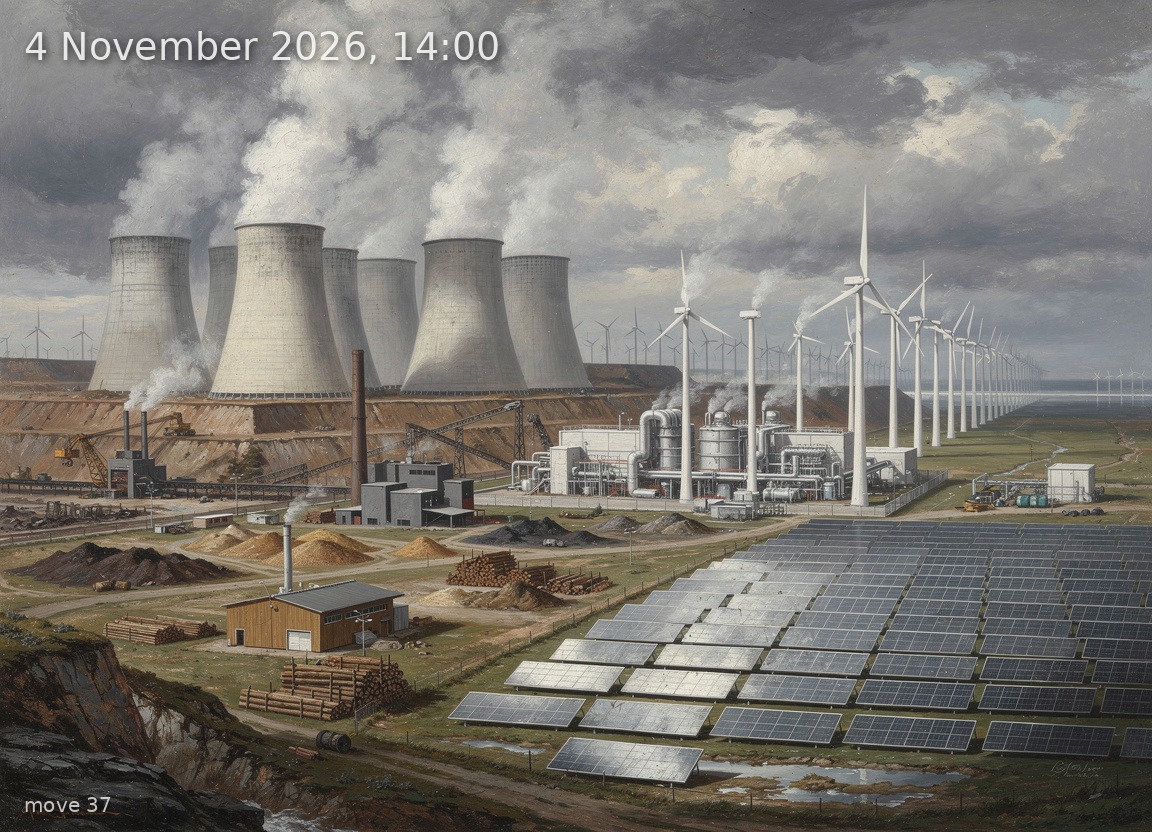
Wind and solar lead at 57% renewables, but heavy thermal dispatch and tight margins drive prices above 235 EUR/MWh.
Generation mix
Wind onshore 25%
Wind offshore 2%
Solar 21%
Biomass 7%
Hydro 2%
Natural gas 20%
Hard coal 8%
Brown coal 15%
57%
Renewable share
16.6 GW
Wind (on + offshore)
12.8 GW
Solar
60.4 GW
Total generation
1.8 GW
Net import
235.1 EUR/MWh
Day-ahead price
9.4°C / 18 km/h
Temp / Wind speed
Open-Meteo, Kassel (51.3°N 9.5°E) · surface estimate from 100 m wind
96.0% / 61.5 W/m²
Cloud cover / Radiation
279
gCO₂/kWh
Image prompt
Wind onshore 15.3 GW dominates the right third of the scene as a vast field of dozens of three-blade turbines on lattice and tubular towers stretching to the horizon, rotors spinning briskly in moderate wind. Solar 12.8 GW fills the centre-right foreground as expansive rows of aluminium-framed crystalline silicon PV panels on flat farmland, their surfaces wet and grey-reflecting under overcast sky with no direct sunlight. Natural gas 11.9 GW occupies the centre as a cluster of modern CCGT power plants with tall slender exhaust stacks venting thin white plumes. Brown coal 9.3 GW fills the left portion as massive hyperbolic cooling towers emitting thick columns of steam rising into the heavy cloud layer, adjacent to open-pit lignite mines with terraced brown earth. Hard coal 4.5 GW appears as a smaller conventional coal plant with rectangular boiler houses and a chimney stack behind the lignite complex. Biomass 4.2 GW is rendered as a modest wood-clad biomass CHP facility with a short stack and stored timber piles in the mid-left ground. Wind offshore 1.4 GW is suggested by faint turbine silhouettes on a distant grey horizon line at the far right. Hydro 1.0 GW appears as a small concrete dam and reservoir tucked in a valley at the far left edge. The sky is 96% overcast — a thick, oppressive blanket of grey-white stratus clouds pressing low, with only the faintest diffuse brightness indicating a hidden midday sun; the atmosphere feels heavy and costly, reflecting the high electricity price. Daylight is flat and shadowless at 14:00 in early November, with muted autumnal tones: bare brown trees, damp stubble fields, grey-green grass. Temperature near 9°C: figures in the scene wear jackets, breath almost visible. Painted in the style of a highly detailed 19th-century German Romantic oil painting — rich impasto brushwork, atmospheric chiaroscuro depth, meticulous engineering detail on every turbine nacelle, every cooling tower's parabolic curve, every PV panel's cell grid — a monumental industrial landscape rendered as a masterwork. No text, no labels.