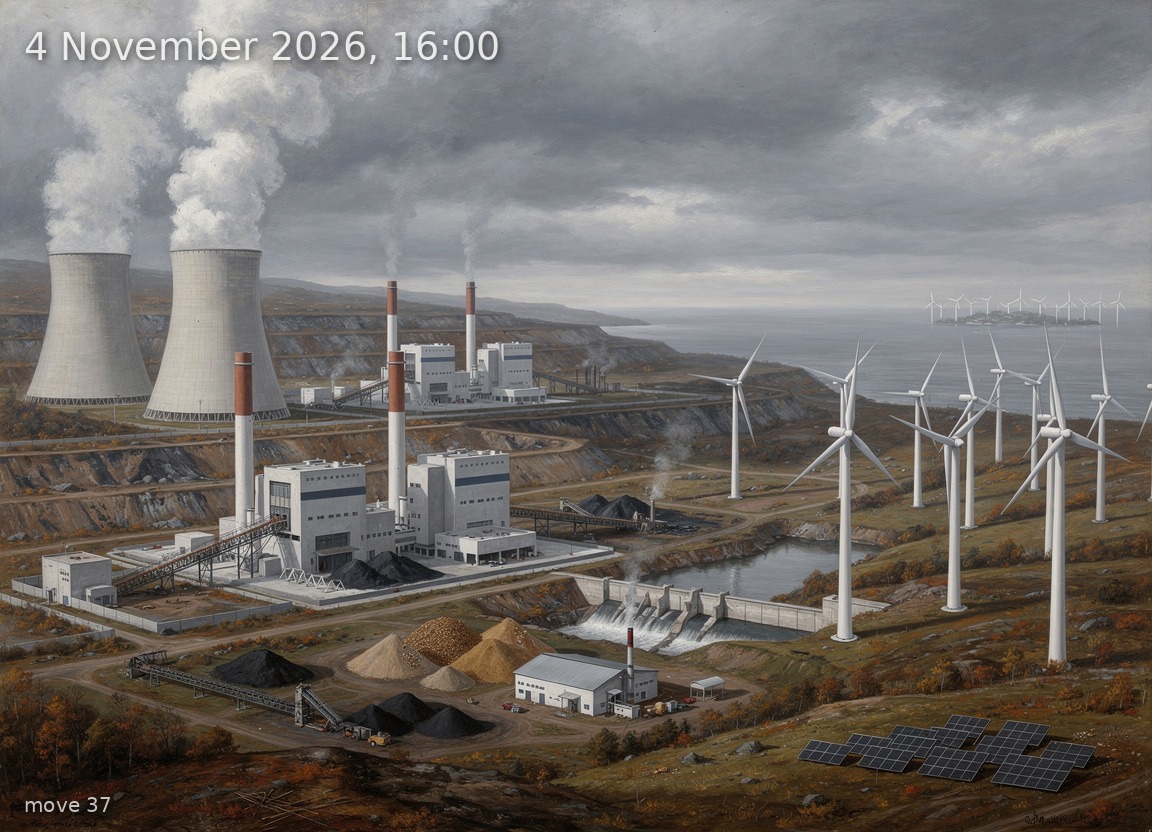
Gas, brown coal, and wind dominate as heavy overcast and high demand drive imports and elevated prices.
Generation mix
Wind onshore 31%
Wind offshore 4%
Solar 2%
Biomass 8%
Hydro 2%
Natural gas 24%
Hard coal 9%
Brown coal 20%
48%
Renewable share
17.9 GW
Wind (on + offshore)
1.2 GW
Solar
51.0 GW
Total generation
11.9 GW
Net import
295.6 EUR/MWh
Day-ahead price
8.8°C / 14 km/h
Temp / Wind speed
Open-Meteo, Kassel (51.3°N 9.5°E) · surface estimate from 100 m wind
100.0% / 7.5 W/m²
Cloud cover / Radiation
346
gCO₂/kWh
Image prompt
Wind onshore 16.0 GW spans the right third of the scene as dozens of large three-blade turbines with white tubular towers and nacelles stretching across rolling autumn hills, blades turning briskly in moderate wind. Wind offshore 2.0 GW appears as a small cluster of turbines on the far-right horizon above a grey sea. Natural gas 12.0 GW fills the centre-left as several compact CCGT power plants with tall single exhaust stacks emitting pale heat shimmer. Brown coal 10.0 GW dominates the left portion as massive hyperbolic cooling towers with thick white-grey steam plumes billowing upward, flanked by open-pit mine terraces. Hard coal 4.7 GW sits just left of centre as a gritty coal-fired station with rectangular stacks and conveyor belts feeding dark fuel. Biomass 4.2 GW appears as a modest wood-chip facility with a small chimney near the centre foreground. Hydro 1.0 GW is a small dam with spillway in the far middle distance. Solar 1.2 GW is represented only as a tiny cluster of aluminium-framed crystalline silicon panels in the foreground, their surfaces dull and unreflective under the completely overcast sky. The time is 16:00 in early November: the last grey daylight of a short autumn afternoon, uniformly overcast with 100% cloud cover, no sun visible, a flat pewter sky pressing down oppressively. The atmosphere feels heavy and brooding, reflecting the extremely high electricity price — the air seems dense, the clouds low and suffocating. Bare and half-bare deciduous trees with brown and amber remnant leaves dot the landscape; grass is dull green-brown. Temperature is cool, about 9°C; a faint mist clings to the valleys. The overall mood is sombre industrial power under a dark autumn ceiling. Rendered as a highly detailed oil painting in the tradition of 19th-century German Romantic landscape painters — rich, muted earth tones, visible impasto brushwork, atmospheric depth and chiaroscuro — yet with meticulous engineering accuracy on every turbine nacelle, cooling tower, and exhaust stack. No text, no labels.