Wind, brown coal, and gas each exceed 11 GW as cold weather and tight supply push prices near 295 EUR/MWh.
Generation mix
Wind onshore 25%
Wind offshore 4%
Solar 14%
Biomass 7%
Hydro 2%
Natural gas 21%
Hard coal 7%
Brown coal 21%
52%
Renewable share
16.6 GW
Wind (on + offshore)
7.9 GW
Solar
57.7 GW
Total generation
6.1 GW
Net import
294.8 EUR/MWh
Day-ahead price
2.0°C / 7 km/h
Temp / Wind speed
Open-Meteo, Kassel (51.3°N 9.5°E) · surface estimate from 100 m wind
0.0% / 2.3 W/m²
Cloud cover / Radiation
325
gCO₂/kWh
Image prompt
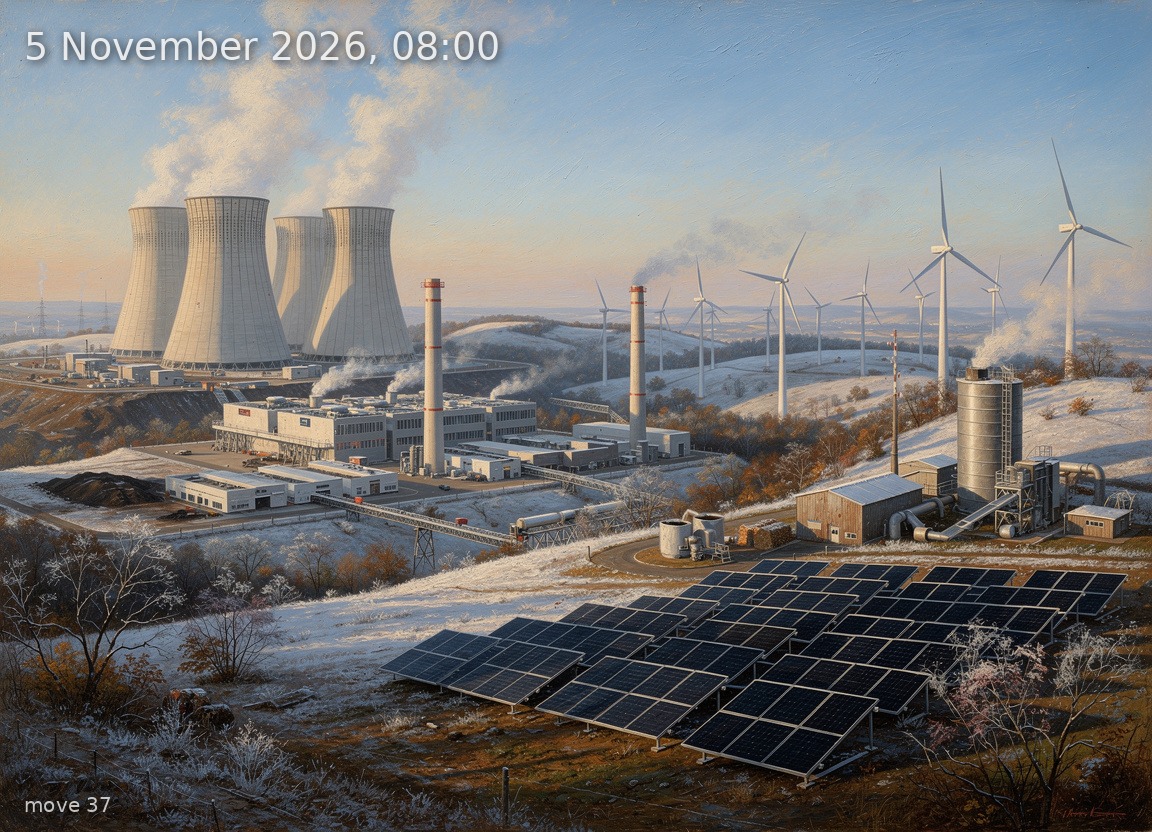
Wind onshore 14.4 GW dominates the right third of the scene as dozens of three-blade turbines with white tubular towers and nacelles arrayed across rolling frost-covered hills, blades turning slowly in light wind. Brown coal 11.9 GW occupies the left quarter as a massive lignite power station with four hyperbolic concrete cooling towers emitting thick white steam plumes rising into the cold air. Natural gas 12.0 GW fills the centre-left as a row of modern CCGT plants with tall slender exhaust stacks and compact turbine halls, heat shimmer and thin exhaust visible. Solar 7.9 GW appears in the centre-right foreground as extensive fields of aluminium-framed crystalline silicon panels catching the very first oblique rays of a low November sun barely above the horizon. Hard coal 4.2 GW is rendered as a smaller coal-fired station with a single large smokestack and coal conveyor beside the lignite complex. Biomass 4.2 GW appears as a wood-chip power plant with a tall cylindrical silo and modest steam output near the wind turbines. Hydro 0.9 GW is a small run-of-river dam visible in a narrow river valley in the far background. The time is 08:00 on a November morning: the sun is just cresting the eastern horizon casting long golden-orange rays at an extremely low angle across a landscape covered in white frost, the sky is perfectly clear with no clouds, deep cold blue overhead transitioning to pale amber near the horizon. Temperature is 2°C: bare deciduous trees, brown dormant grass edged with rime ice, breath-like condensation visible near structures. The atmosphere feels heavy and oppressive despite the clear sky, conveying the tension of extremely high electricity prices—a brooding quality in the cold, sharp light. Highly detailed oil painting in the tradition of 19th-century German Romantic landscape painters such as Caspar David Friedrich and Carl Blechen, with rich colour palette, visible impasto brushwork, atmospheric depth and haze, dramatic chiaroscuro from the low sun, meticulous engineering detail on every turbine nacelle, cooling tower fluting, panel frame, and exhaust stack. No text, no labels.