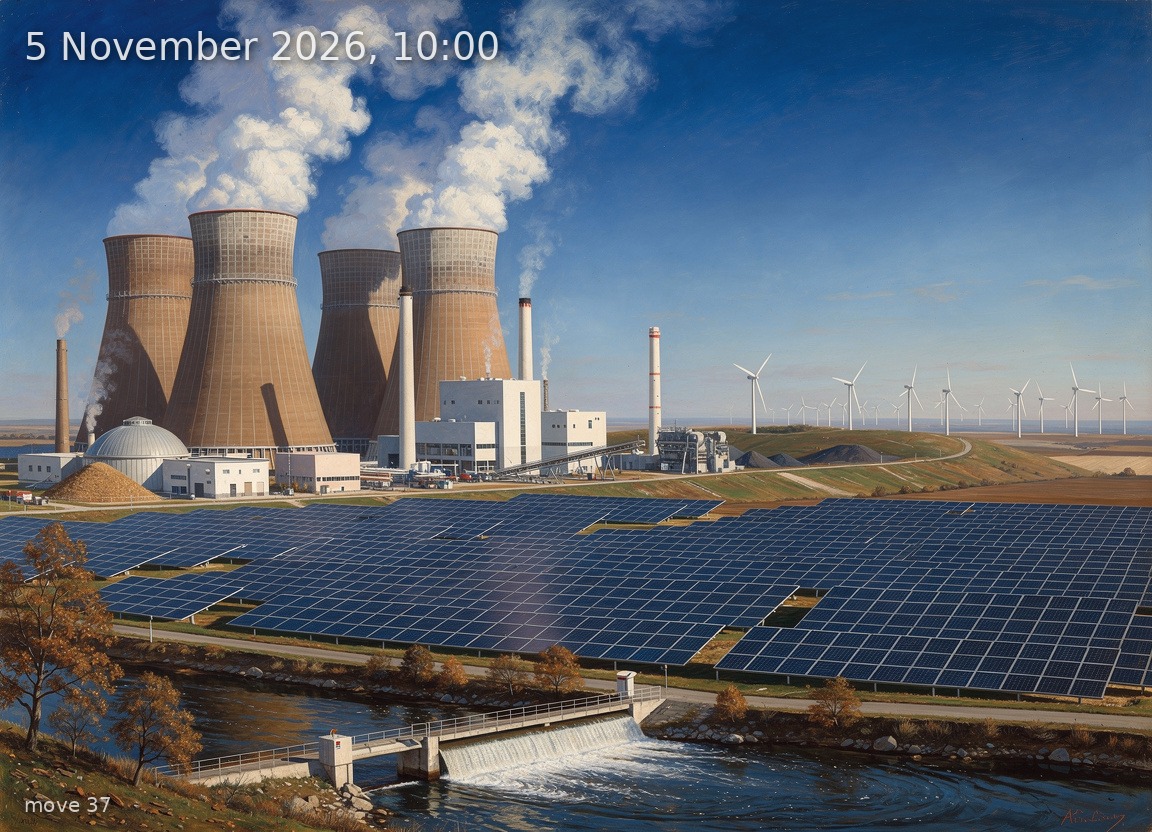
Strong solar (25.1 GW) and persistent thermal generation (29.7 GW) drive 6.6 GW net exports under clear, cold November skies.
Generation mix
Wind onshore 13%
Wind offshore 3%
Solar 35%
Biomass 6%
Hydro 1%
Natural gas 18%
Hard coal 7%
Brown coal 16%
58%
Renewable share
11.3 GW
Wind (on + offshore)
25.1 GW
Solar
71.6 GW
Total generation
+6.6 GW
Net export
224.8 EUR/MWh
Day-ahead price
4.4°C / 5 km/h
Temp / Wind speed
Open-Meteo, Kassel (51.3°N 9.5°E) · surface estimate from 100 m wind
0.0% / 129.5 W/m²
Cloud cover / Radiation
275
gCO₂/kWh
Image prompt
Brown coal 11.7 GW occupies the left quarter as a cluster of massive hyperbolic cooling towers with thick white steam plumes rising into cold air; natural gas 13.2 GW fills the centre-left as several compact CCGT power stations with tall single exhaust stacks venting thin heat shimmer; hard coal 4.8 GW appears as a smaller coal-fired plant with a rectangular stack and coal conveyors behind the gas units; solar 25.1 GW dominates the right half and middle ground as vast fields of aluminium-framed crystalline silicon photovoltaic panels stretching across flat agricultural land, their blue-black surfaces glinting brilliantly under a completely cloudless sky; wind onshore 9.0 GW rises as several dozen three-blade turbines with white tubular towers scattered across rolling hills behind the solar fields, blades turning very slowly in light wind; wind offshore 2.3 GW is suggested by a distant line of larger turbines on the far horizon; biomass 4.5 GW appears as a mid-sized industrial facility with a wood-chip storage dome and modest smokestack on the far left edge; hydro 1.0 GW is a small run-of-river weir with a low concrete dam visible along a river in the foreground. The time is 10:00 AM on a cold late-autumn morning: the sun is relatively low in the southeast, casting long golden shadows across the bare brown and grey November landscape — leafless trees, dormant stubble fields, frost lingering in shadowed hollows, temperature near freezing. The sky is entirely clear, deep blue overhead, paler near the horizon, but carries a heavy, oppressive atmospheric weight suggested by a faint yellowish-brown industrial haze hanging low over the thermal plants, reflecting the very high electricity price. Style: highly detailed oil painting in the tradition of 19th-century German Romantic landscape painters such as Caspar David Friedrich and Carl Blechen — rich saturated colour, visible confident brushwork, masterful atmospheric depth and chiaroscuro, meticulous engineering detail on every turbine nacelle, every cooling tower ribbing, every PV panel frame, every exhaust stack. The scene feels monumental and contemplative, an industrial sublime panorama. No text, no labels, no human figures.