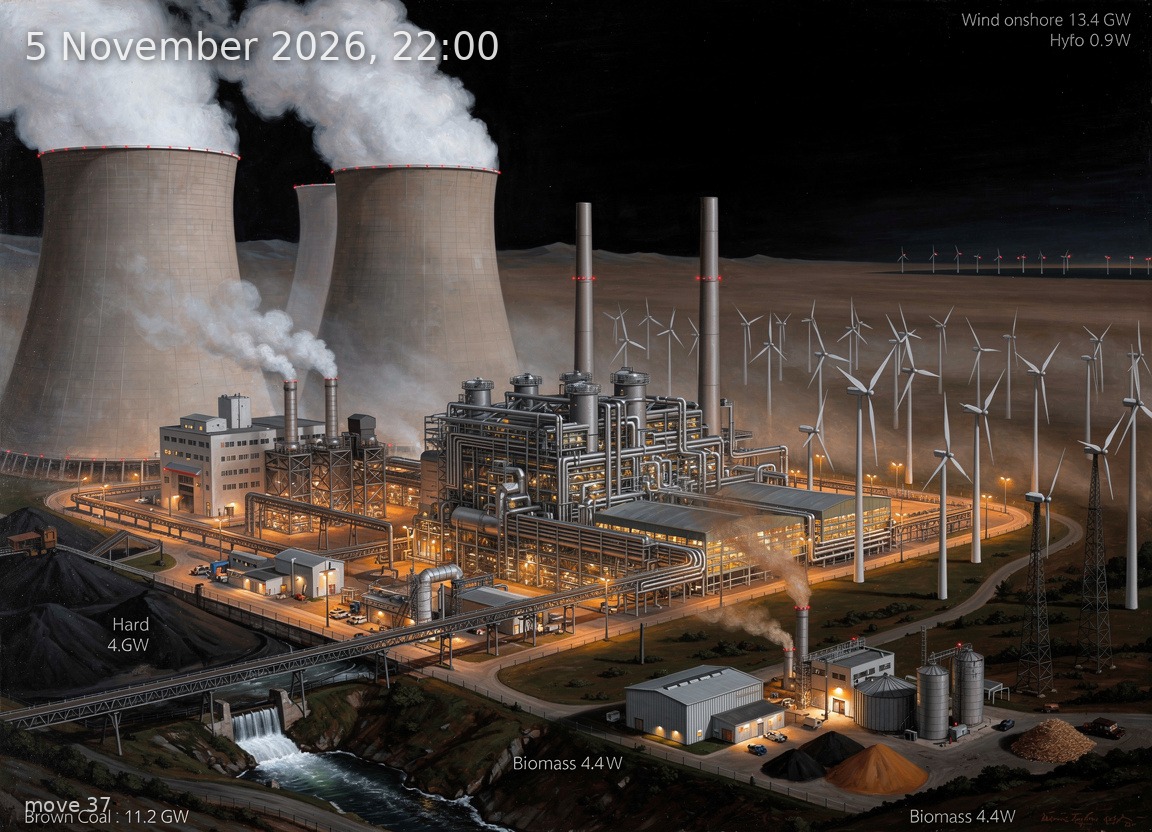
Gas, brown coal, and wind share a tight nocturnal grid as cold weather and zero solar push prices above 270 EUR/MWh.
Generation mix
Wind onshore 26%
Wind offshore 6%
Biomass 9%
Hydro 2%
Natural gas 28%
Hard coal 9%
Brown coal 22%
42%
Renewable share
16.3 GW
Wind (on + offshore)
0.0 GW
Solar
51.8 GW
Total generation
2.3 GW
Net import
273.2 EUR/MWh
Day-ahead price
3.4°C / 3 km/h
Temp / Wind speed
Open-Meteo, Kassel (51.3°N 9.5°E) · surface estimate from 100 m wind
0.0% / 0.0 W/m²
Cloud cover / Radiation
381
gCO₂/kWh
Image prompt
Natural gas 14.4 GW dominates the centre of the scene as a sprawling complex of combined-cycle gas turbine units with tall single exhaust stacks emitting pale heat haze, lit by banks of sodium-orange industrial floodlights. Brown coal 11.2 GW occupies the left third as massive hyperbolic cooling towers releasing thick white steam plumes that drift into the black sky, with conveyor belts carrying dark lignite visible at their base. Hard coal 4.6 GW appears as a smaller cluster of angular power station buildings with square chimneys and coal bunkers in the left-centre middle ground. Wind onshore 13.4 GW spans the right half of the composition as dozens of three-blade turbines on lattice and tubular towers stretching into the distance across low rolling hills, their red aviation warning lights blinking against the darkness. Wind offshore 2.9 GW is suggested by a distant row of turbines on the far-right horizon above a faintly visible dark sea line. Biomass 4.4 GW appears as a cluster of modest industrial buildings with short chimneys and wood-chip storage silos in the right-centre foreground. Hydro 0.9 GW is a small dam structure with illuminated spillway tucked into a valley in the far background. The sky is completely black with no twilight, no moon visible, a dense oppressive atmosphere hanging low — a faint brownish industrial haze presses down, conveying the extreme electricity price. The season is late autumn: bare deciduous trees with skeletal branches frame the foreground, frost glistens on dead grass, temperature near freezing. Light comes only from artificial sources — orange sodium lamps, white LED floods on the gas plant, red blinking turbine lights. Rendered as a highly detailed oil painting in the tradition of 19th-century German Romantic landscape painters such as Caspar David Friedrich, but depicting industrial infrastructure with meticulous engineering accuracy: visible turbine nacelles, three-blade rotors, aluminium-framed details, cooling tower parabolic curves, CCGT exhaust stacks. Rich dark palette of deep navy, burnt umber, ochre, and warm orange light against cold shadows. Atmospheric depth with layers of steam and haze receding into darkness. Visible brushwork, dramatic chiaroscuro. No text, no labels.