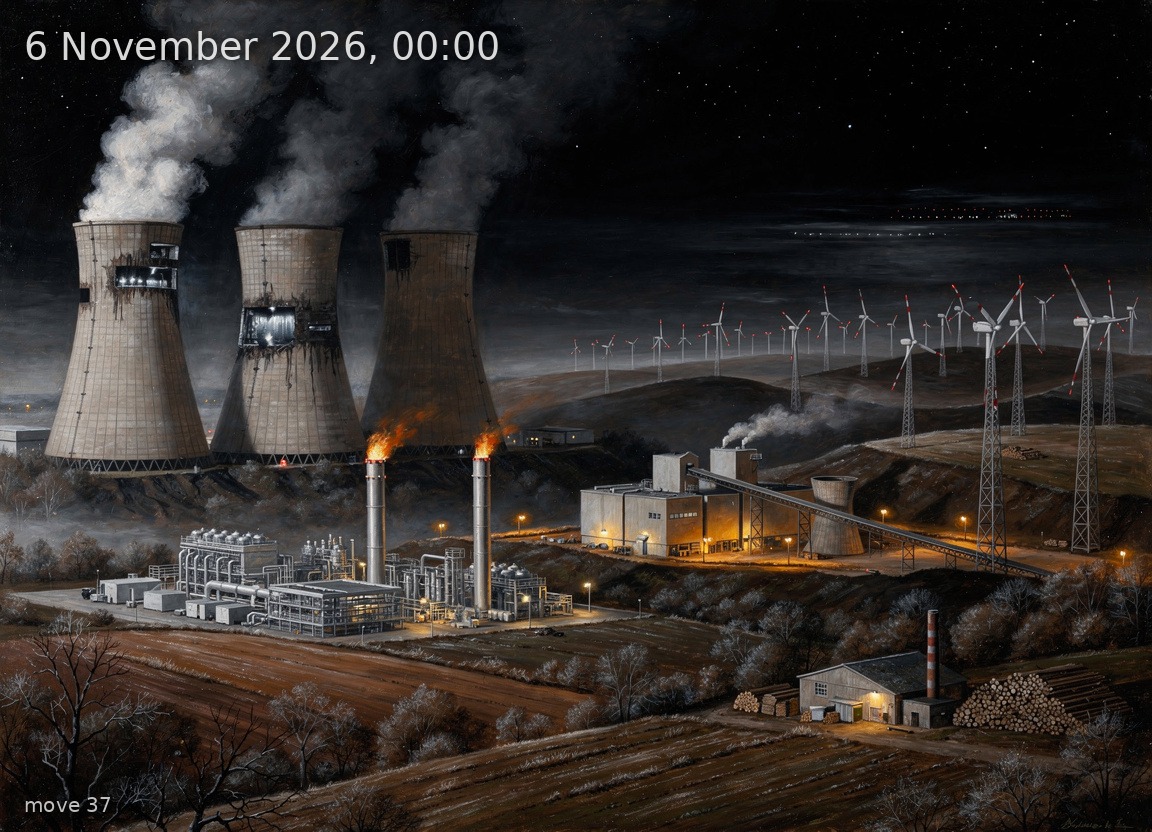
Gas, brown coal, and wind dominate midnight generation as cold temperatures drive high demand and elevated prices.
Generation mix
Wind onshore 24%
Wind offshore 5%
Biomass 9%
Hydro 2%
Natural gas 28%
Hard coal 10%
Brown coal 23%
40%
Renewable share
14.1 GW
Wind (on + offshore)
0.0 GW
Solar
48.6 GW
Total generation
0.3 GW
Net import
235.7 EUR/MWh
Day-ahead price
1.2°C / 4 km/h
Temp / Wind speed
Open-Meteo, Kassel (51.3°N 9.5°E) · surface estimate from 100 m wind
0.0% / 0.0 W/m²
Cloud cover / Radiation
396
gCO₂/kWh
Image prompt
Brown coal 11.0 GW dominates the left third of the scene as a massive lignite power station complex with four hyperbolic cooling towers emitting thick white-grey steam plumes into the black sky; natural gas 13.4 GW fills the centre-left as a sprawling array of compact CCGT units with tall single exhaust stacks and orange-lit gas flares reflected on polished metal surfaces; hard coal 4.9 GW appears centre-right as a pair of large boiler houses with conveyor belts and a single cooling tower, lit by amber sodium lamps; wind onshore 11.7 GW spans the right third as dozens of three-blade turbines on lattice and tubular towers, their red aviation warning lights blinking in rows receding toward the horizon; wind offshore 2.4 GW is suggested by a distant cluster of turbines on the far-right horizon with tiny red dots; biomass 4.3 GW appears as a modest wood-fired plant with a single chimney and stacked timber yard illuminated by floodlights in the mid-ground right; hydro 0.9 GW is a small dam structure with spillway lights barely visible at the far right edge. Time is midnight: the sky is completely black with faint cold stars visible through gaps in the steam plumes, no twilight, no sky glow. The atmosphere is oppressive and heavy, dense with industrial haze suggesting the high electricity price. Frost glistens on bare November ground and leafless trees. Temperature near freezing: breath-like mist rises from every warm surface. Central Germany rolling terrain with dormant brown fields. Sodium streetlights cast orange pools along an access road in the foreground. Style: highly detailed oil painting in the tradition of 19th-century German Romantic landscape painters such as Caspar David Friedrich — rich dark palette of deep navy, amber, burnt sienna, and ash grey, visible impasto brushwork, dramatic chiaroscuro, atmospheric depth with industrial sublime grandeur. Each energy technology rendered with meticulous engineering accuracy: turbine nacelles, three-blade rotors, aluminium-clad structures, reinforced concrete cooling towers with internal steam condensation visible. No text, no labels.