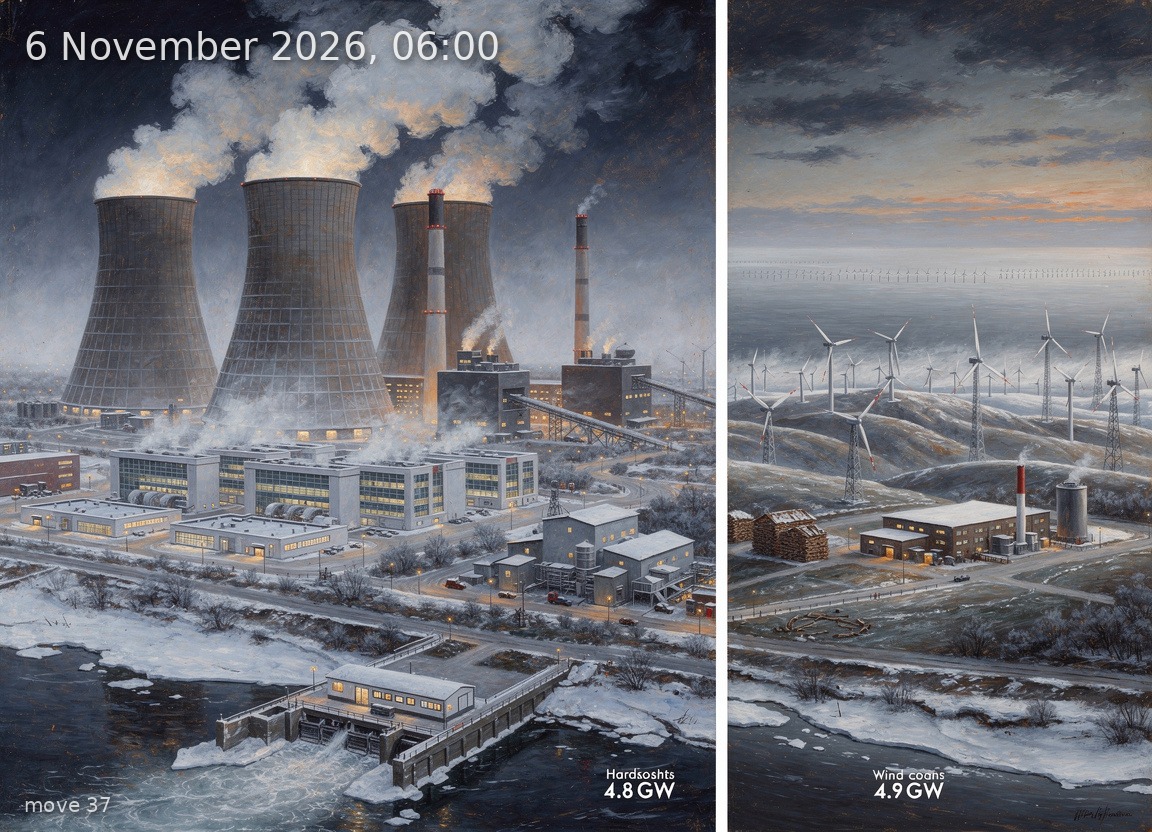
Gas, brown coal, and wind lead generation as freezing temperatures and zero solar drive 10 GW net imports.
Generation mix
Wind onshore 22%
Wind offshore 7%
Biomass 8%
Hydro 2%
Natural gas 27%
Hard coal 10%
Brown coal 23%
40%
Renewable share
14.1 GW
Wind (on + offshore)
0.0 GW
Solar
47.6 GW
Total generation
10.2 GW
Net import
286.8 EUR/MWh
Day-ahead price
-2.3°C / 4 km/h
Temp / Wind speed
Open-Meteo, Kassel (51.3°N 9.5°E) · surface estimate from 100 m wind
100.0% / 0.0 W/m²
Cloud cover / Radiation
397
gCO₂/kWh
Image prompt
Brown coal 10.9 GW dominates the left third of the scene as a massive lignite power complex with four hyperbolic cooling towers emitting thick white steam plumes into the freezing air; natural gas 12.8 GW fills the centre-left as a row of modern CCGT plants with tall single exhaust stacks venting heat shimmer; hard coal 4.9 GW appears centre-right as a smaller coal station with rectangular boiler houses and conveyor belts; wind onshore 10.6 GW spans the right third as dozens of three-blade turbines on lattice and tubular towers across rolling hills, their blades turning slowly in light wind; wind offshore 3.5 GW is suggested by distant turbines barely visible on the far-right horizon over a grey sea; biomass 4.0 GW appears as a modest wood-chip-fed plant with a single squat smokestack near the coal station; hydro 1.0 GW is a small run-of-river station at a frozen river in the foreground. Time is pre-dawn at 06:00 in early November: the sky is deep blue-grey with the faintest pale luminescence along the eastern horizon but no direct sunlight, no sunshine, no solar panels visible. Temperature is -2.3°C: frost coats bare deciduous trees, frozen puddles glint under sodium-yellow industrial floodlights illuminating the power stations, exhaled steam from the cooling towers is dense and voluminous in the frigid air. Overcast sky is heavy, oppressive, low-hanging clouds pressing down, reflecting the orange-sodium glow of the industrial complex below. The atmosphere is weighty and claustrophobic, conveying high energy prices and scarcity. No text, no labels. Style: highly detailed oil painting in the tradition of 19th-century German Romantic landscape painters — Caspar David Friedrich meets industrial sublime — rich dark blues, warm sodium oranges, cold frost whites, visible impasto brushwork, atmospheric depth with fog and steam layering the scene, meticulous engineering accuracy on turbine nacelles, cooling tower geometry, and gas turbine exhaust stacks.