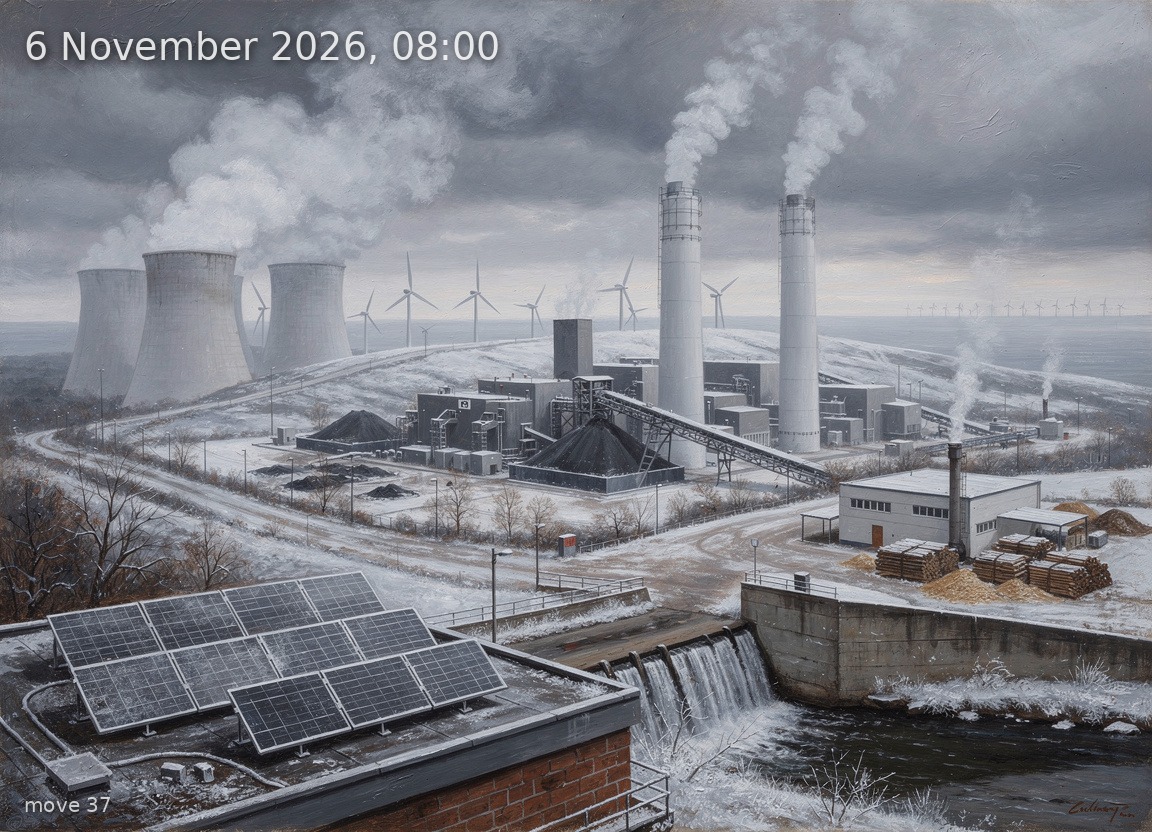
Cold, windless overcast morning forces heavy gas and coal dispatch; 12.1 GW net imports needed at 318.5 EUR/MWh.
Generation mix
Wind onshore 19%
Wind offshore 7%
Solar 11%
Biomass 8%
Hydro 2%
Natural gas 24%
Hard coal 9%
Brown coal 20%
47%
Renewable share
14.1 GW
Wind (on + offshore)
6.1 GW
Solar
53.7 GW
Total generation
12.1 GW
Net import
318.5 EUR/MWh
Day-ahead price
-2.2°C / 1 km/h
Temp / Wind speed
Open-Meteo, Kassel (51.3°N 9.5°E) · surface estimate from 100 m wind
100.0% / 0.0 W/m²
Cloud cover / Radiation
351
gCO₂/kWh
Image prompt
Natural gas 12.9 GW dominates the centre-right as a sprawling complex of CCGT units with tall single exhaust stacks emitting thick white plumes into frigid air; brown coal 11.0 GW occupies the left third as massive hyperbolic cooling towers with billowing steam columns rising into low cloud; wind onshore 10.4 GW appears as a receding line of three-blade turbines on a frozen ridge behind the power plants, their rotors nearly motionless in the still air; solar 6.1 GW is represented by frost-covered aluminium-framed crystalline silicon panels on a nearby rooftop catching no direct light under total overcast; hard coal 4.8 GW sits as a mid-sized coal plant with conveyor belts and a single rectangular stack between the gas and lignite complexes; biomass 4.1 GW appears as a compact wood-chip facility with a modest chimney and stacked timber at the far right; wind offshore 3.7 GW is suggested by faint turbine silhouettes on a grey distant horizon line; hydro 0.9 GW is a small dam spillway visible in the lower-right foreground. The sky is entirely overcast with heavy, low, oppressive pewter-grey clouds pressing down, no sun visible, no blue sky, full November daylight at 08:00 but deeply muted and flat. The landscape is a frozen central German plateau — bare deciduous trees with frost-white branches, brown dead grass dusted with rime ice, temperature visibly below zero with condensation plumes from every exhaust. The atmosphere feels heavy, costly, industrial. Rendered as a highly detailed oil painting in the tradition of 19th-century German Romantic landscape painters — Caspar David Friedrich meets industrial realism — with rich, sombre colour palette of greys, slate blues, burnt umber, and cold whites, visible impasto brushwork, atmospheric aerial perspective fading into mist, meticulous engineering detail on every turbine nacelle, cooling tower, and exhaust stack. No text, no labels.