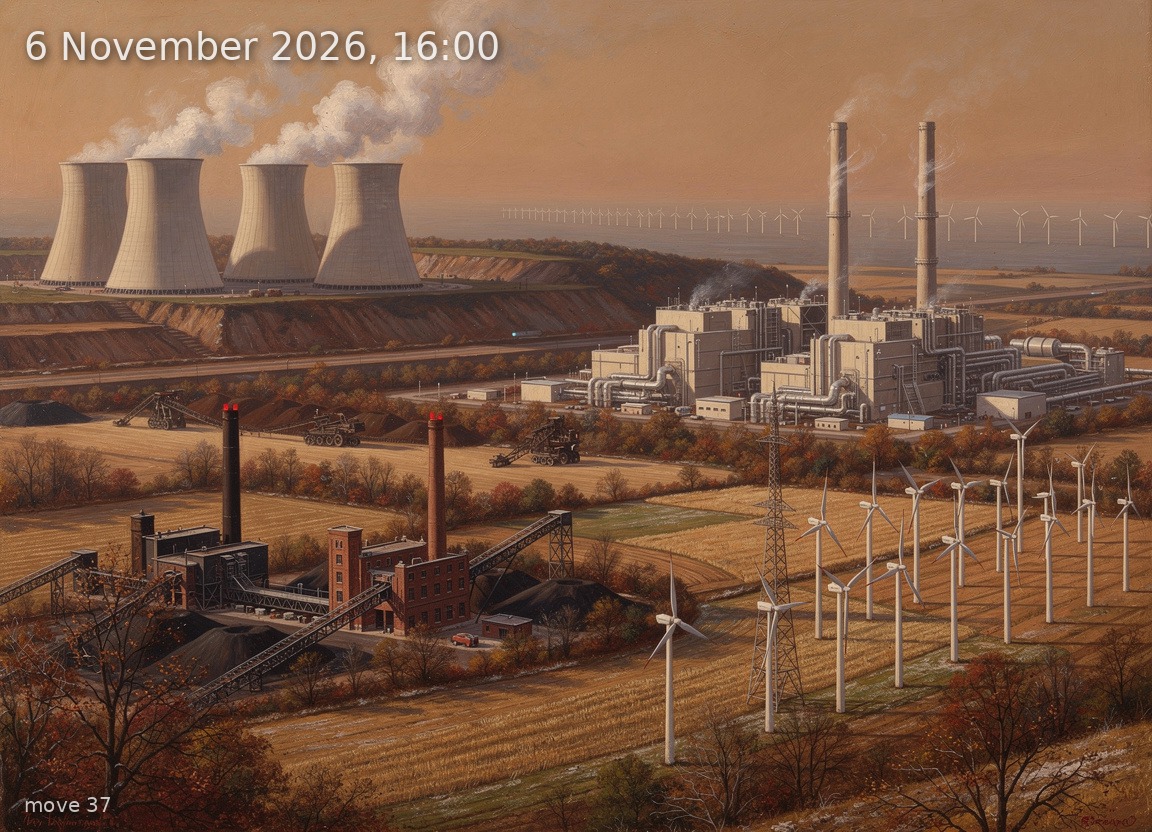
Gas, brown coal, and wind lead generation as a 13.6 GW import gap and tight supply drive prices to 331 EUR/MWh.
Generation mix
Wind onshore 21%
Wind offshore 7%
Solar 2%
Biomass 8%
Hydro 2%
Natural gas 28%
Hard coal 10%
Brown coal 21%
40%
Renewable share
14.0 GW
Wind (on + offshore)
1.1 GW
Solar
49.6 GW
Total generation
13.6 GW
Net import
331.0 EUR/MWh
Day-ahead price
8.1°C / 11 km/h
Temp / Wind speed
Open-Meteo, Kassel (51.3°N 9.5°E) · surface estimate from 100 m wind
0.0% / 66.0 W/m²
Cloud cover / Radiation
387
gCO₂/kWh
Image prompt
Natural gas 14.0 GW dominates the centre-right of the composition as a sprawling cluster of compact CCGT power plants with tall single exhaust stacks venting pale heat shimmer into the sky; brown coal 10.5 GW fills the left quarter with massive hyperbolic cooling towers releasing thick white steam plumes above open-pit lignite mines; hard coal 5.0 GW appears as a pair of dark industrial boiler houses with tall chimneys and coal conveyor belts in the left-centre; wind onshore 10.3 GW stretches across the right third as dozens of three-blade turbines on lattice and tubular towers across rolling autumn fields, blades turning at moderate speed; wind offshore 3.6 GW is visible as a row of turbines on the distant horizon line over a grey sea glimpsed through a gap in the terrain; biomass 4.1 GW appears as several mid-sized plants with wood-chip silos and modest stacks emitting thin grey smoke in the mid-ground; solar 1.1 GW is represented by a small field of aluminium-framed crystalline silicon panels catching the last weak rays at a low angle near the right foreground; hydro 0.9 GW is a small run-of-river weir with a concrete dam visible in a river valley in the far mid-ground. The time is 4 PM on November 6 — late-afternoon autumn daylight, the sun very low in the west casting long amber shadows, the sky completely clear with zero cloud cover but an oppressive, heavy amber-brown atmospheric haze suggesting expensive, strained conditions. Temperature is 8°C: bare deciduous trees with a few last brown leaves clinging, dry stubble fields, frost-tinged grass. The landscape is a wide German industrial-rural panorama. Style: highly detailed oil painting in the tradition of 19th-century German Romantic landscape masters — rich, saturated earth tones, dramatic chiaroscuro from the low sun, visible impasto brushwork, atmospheric depth with aerial perspective haze, meticulous engineering accuracy on every turbine nacelle, cooling tower flute, and exhaust stack. No text, no labels.