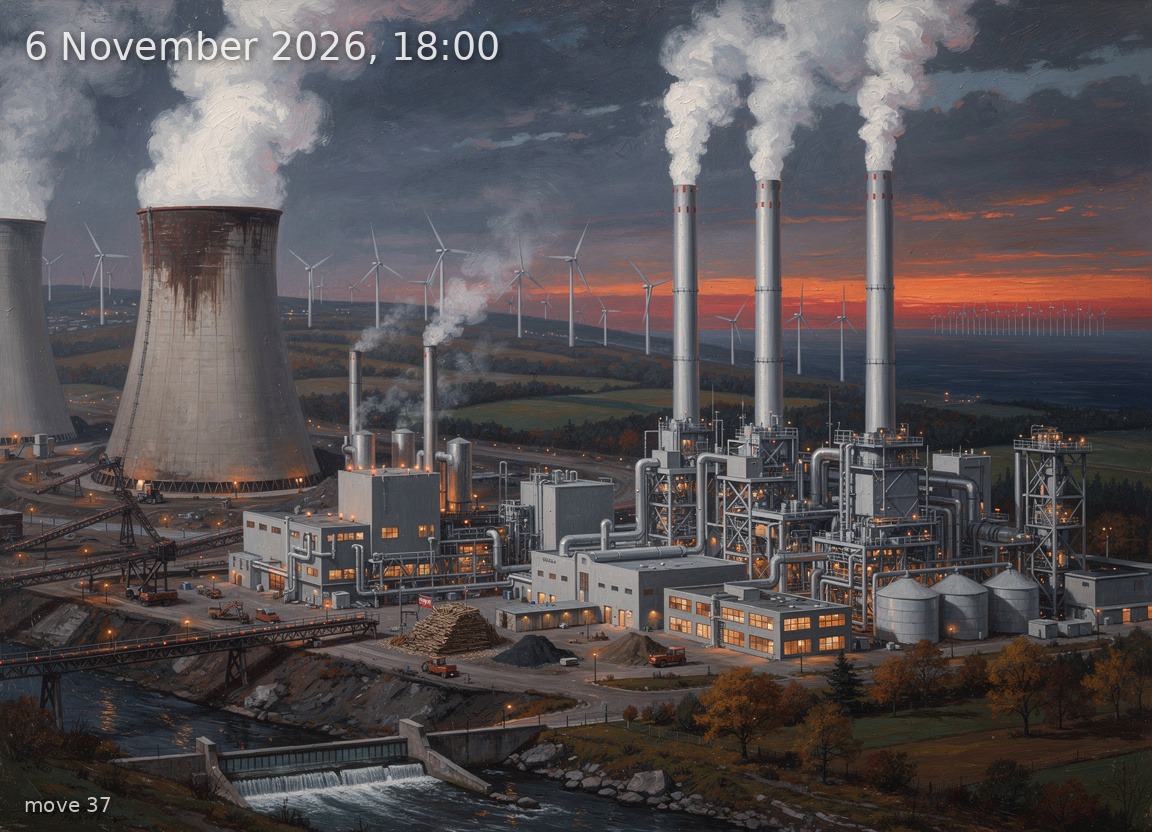
Gas, brown coal, and wind dominate as zero solar and cold evening peak demand drive prices above 357 EUR/MWh.
Generation mix
Wind onshore 26%
Wind offshore 7%
Biomass 8%
Hydro 2%
Natural gas 28%
Hard coal 9%
Brown coal 20%
43%
Renewable share
17.8 GW
Wind (on + offshore)
0.0 GW
Solar
53.9 GW
Total generation
11.4 GW
Net import
357.1 EUR/MWh
Day-ahead price
4.4°C / 5 km/h
Temp / Wind speed
Open-Meteo, Kassel (51.3°N 9.5°E) · surface estimate from 100 m wind
0.0% / 0.0 W/m²
Cloud cover / Radiation
371
gCO₂/kWh
Image prompt
Natural gas 15.2 GW dominates the centre-right of the scene as a sprawling complex of compact CCGT power plants with tall single exhaust stacks venting bright white plumes into the cold air; brown coal 10.8 GW fills the left quarter with massive hyperbolic cooling towers trailing immense columns of steam, adjacent strip-mine conveyors faintly visible; wind onshore 13.8 GW spans the distant background as dozens of three-blade turbines on lattice and tubular towers turning slowly in light wind across rolling hills; wind offshore 4.0 GW appears as a cluster of turbines on the far-right horizon above a dark sea; hard coal 4.9 GW is rendered as a gritty traditional power station with rectangular chimneys and coal bunkers in the mid-left; biomass 4.3 GW sits as a medium-sized wood-chip-fed CHP plant with a modest stack near the centre-left; hydro 0.9 GW is a small run-of-river weir with a low concrete dam in the lower foreground. Time is 18:00 in early November — dusk is nearly over, with only a thin band of deep orange-red light clinging to the lower western horizon, the sky above darkening rapidly to indigo and near-black overhead, first stars visible. The air temperature is 4.4°C: bare deciduous trees with skeletal branches, frost forming on brown grass, breath-like vapour around any human figures. Cloud cover is zero, revealing a crisp, clear sky transitioning to night. The atmosphere is heavy and oppressive, reflecting the extreme electricity price — a brooding, weighty mood pervades the scene, the industrial smoke and steam catching the last ember-coloured light from the horizon while sodium-orange streetlights flicker on around the plant perimeters. No solar panels anywhere. The landscape is flat central German terrain with patches of dormant farmland. Style: highly detailed oil painting in the tradition of 19th-century German Romantic landscape painters — rich, saturated colour palette of deep indigos, burnt oranges, and soot-greys, visible impasto brushwork, dramatic chiaroscuro, atmospheric perspective with haze from cooling tower plumes, meticulous engineering detail on every turbine nacelle, cooling tower, and exhaust stack. The painting conveys the sublime weight of industrial civilization against a vast, darkening autumn sky. No text, no labels.