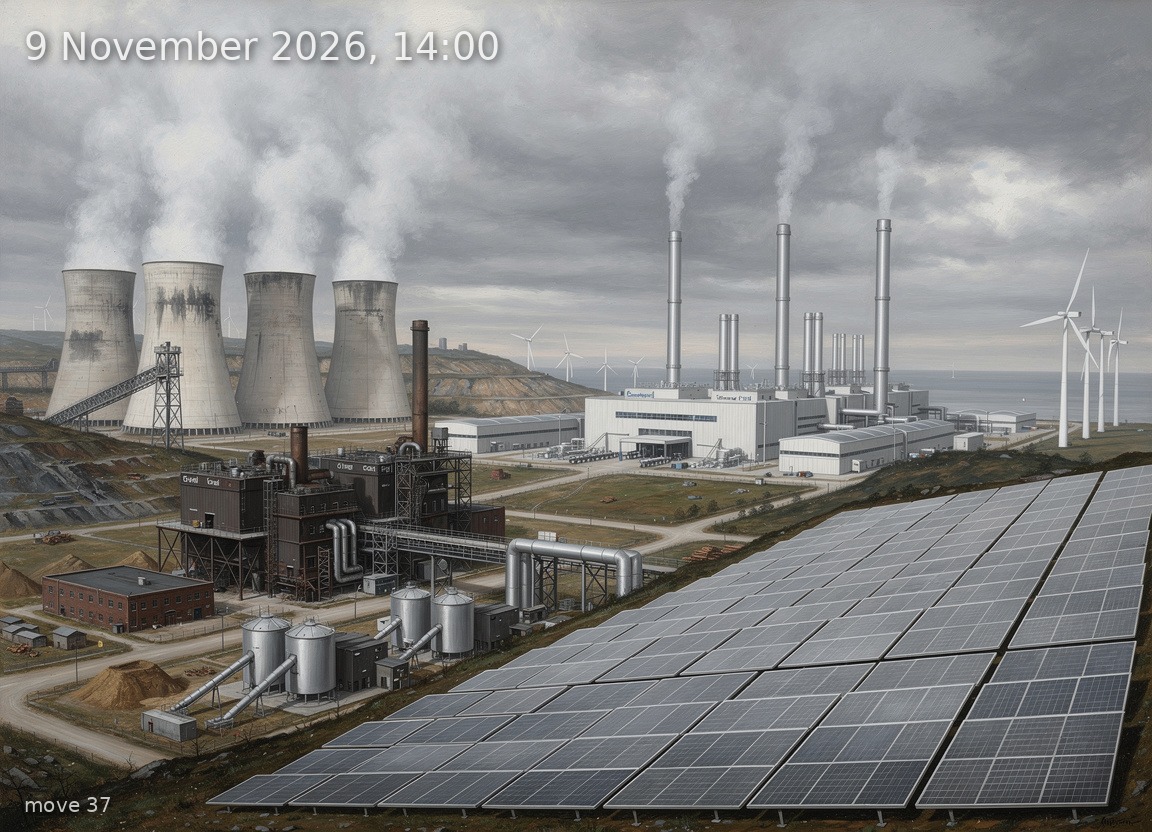
Gas, brown coal, and hard coal dominate as overcast skies and calm winds suppress renewables, driving 339 EUR/MWh prices.
Generation mix
Wind onshore 2%
Wind offshore 1%
Solar 18%
Biomass 8%
Hydro 2%
Natural gas 35%
Hard coal 10%
Brown coal 25%
30%
Renewable share
1.6 GW
Wind (on + offshore)
9.2 GW
Solar
52.2 GW
Total generation
11.0 GW
Net import
339.1 EUR/MWh
Day-ahead price
8.5°C / 7 km/h
Temp / Wind speed
Open-Meteo, Kassel (51.3°N 9.5°E) · surface estimate from 100 m wind
100.0% / 31.3 W/m²
Cloud cover / Radiation
450
gCO₂/kWh
Image prompt
Natural gas 18.1 GW dominates the center-right of the composition as a sprawling complex of modern combined-cycle gas turbine plants with tall slender exhaust stacks trailing white heat plumes. Brown coal 13.2 GW fills the left quarter with massive hyperbolic cooling towers — four or five of them — emitting thick columns of steam rising into the overcast sky, accompanied by lignite conveyor belts and open-pit mine edges in the far background. Hard coal 5.0 GW appears as a pair of dark industrial boiler houses with tall chimneys in the center-left middle ground. Solar 9.2 GW occupies a broad field in the right foreground — rows of aluminium-framed crystalline silicon photovoltaic panels stretching toward the horizon, their surfaces reflecting only flat grey light under heavy cloud. Biomass 4.2 GW is rendered as squat wood-chip-fed power stations with rounded storage silos and low stacks near the center foreground. Wind onshore 1.0 GW and wind offshore 0.6 GW appear as a sparse cluster of three-blade turbines on distant hills and a few barely visible offshore turbines on the far horizon, rotors nearly still. Hydro 0.8 GW is suggested by a small dam and reservoir visible in a valley to the far right. The sky is entirely overcast at 100% cloud cover — a uniform heavy blanket of grey stratus with no break or blue, lit by diffuse early-afternoon November daylight, flat and shadowless. The atmosphere is oppressive and dense, reflecting the extreme electricity price — a faint haze or industrial murk hangs between the viewer and the distant facilities. Temperature 8.5°C in November: bare deciduous trees, brown and dun grasslands, patches of frost on shadowed ground, muted autumn palette. Wind is almost absent — no motion in flags or vegetation. Rendered as a highly detailed oil painting in the tradition of 19th-century German Romantic landscape painters such as Caspar David Friedrich crossed with industrial realism — rich impasto brushwork, atmospheric depth through layered fog and haze, dramatic tonal contrasts between pale sky and dark industrial silhouettes, meticulous engineering accuracy on every cooling tower, turbine nacelle, PV module frame, and exhaust stack. No text, no labels.