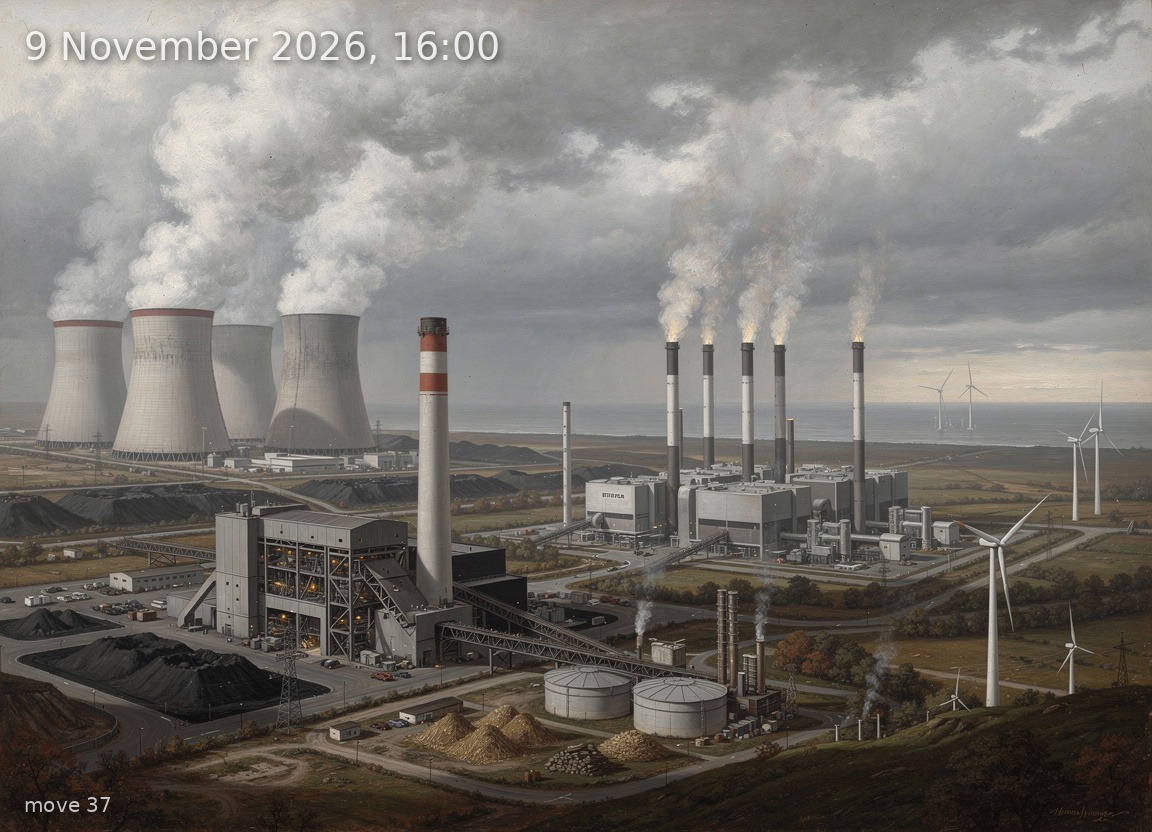
Gas, brown coal, and hard coal dominate as near-zero wind and solar force heavy imports and extreme prices.
Generation mix
Wind onshore 4%
Wind offshore 1%
Solar 1%
Biomass 9%
Hydro 2%
Natural gas 41%
Hard coal 11%
Brown coal 30%
18%
Renewable share
2.4 GW
Wind (on + offshore)
0.6 GW
Solar
44.2 GW
Total generation
22.1 GW
Net import
526.1 EUR/MWh
Day-ahead price
7.6°C / 4 km/h
Temp / Wind speed
Open-Meteo, Kassel (51.3°N 9.5°E) · surface estimate from 100 m wind
96.0% / 3.0 W/m²
Cloud cover / Radiation
529
gCO₂/kWh
Image prompt
Brown coal 13.1 GW dominates the left third of the scene as a sprawling lignite complex with four massive hyperbolic cooling towers emitting thick white steam plumes into the grey sky; natural gas 18.0 GW fills the centre-right as a dense cluster of modern CCGT power stations with tall slender exhaust stacks trailing heat shimmer and lighter vapour; hard coal 5.1 GW appears as a mid-ground industrial facility with a large boiler house, conveyor belts, and a single wide chimney; biomass 4.1 GW is rendered as a pair of smaller wood-chip-fueled plants with rounded storage silos and modest stacks near the centre-left; wind onshore 1.9 GW appears as a few barely turning three-blade turbines on a distant ridge to the far right, rotors nearly still in the calm air; wind offshore 0.5 GW is a faint silhouette of two turbines on a grey horizon line above a sliver of the North Sea; hydro 0.9 GW is suggested by a small dam and penstock visible in a valley in the far background; solar 0.6 GW appears only as dormant aluminium-framed crystalline PV panels on a rooftop in the foreground, dark and unreflective under the overcast. Time is 4 PM on a November afternoon in central Germany: the light is dim, grey-white, flat and diffuse, with 96% cloud cover forming a low oppressive blanket of stratus across the entire sky; the sun is invisible, direct radiation essentially zero. The atmosphere feels heavy, almost suffocating — a sense of enormous pressure and expense hangs in the air. Temperature is 7.6°C; bare deciduous trees with last brown leaves, damp ground, patches of stubble fields in autumnal brown. Transmission lines stretch across the scene toward the eastern horizon, suggesting the massive cross-border power flows. Style: highly detailed oil painting in the tradition of 19th-century German Romantic landscape painters — Caspar David Friedrich meets industrial sublime — rich muted earth tones, visible textured brushwork, deep atmospheric perspective, meticulous engineering detail on every turbine nacelle, cooling tower, and smokestack, dramatic chiaroscuro despite the overcast. No text, no labels.