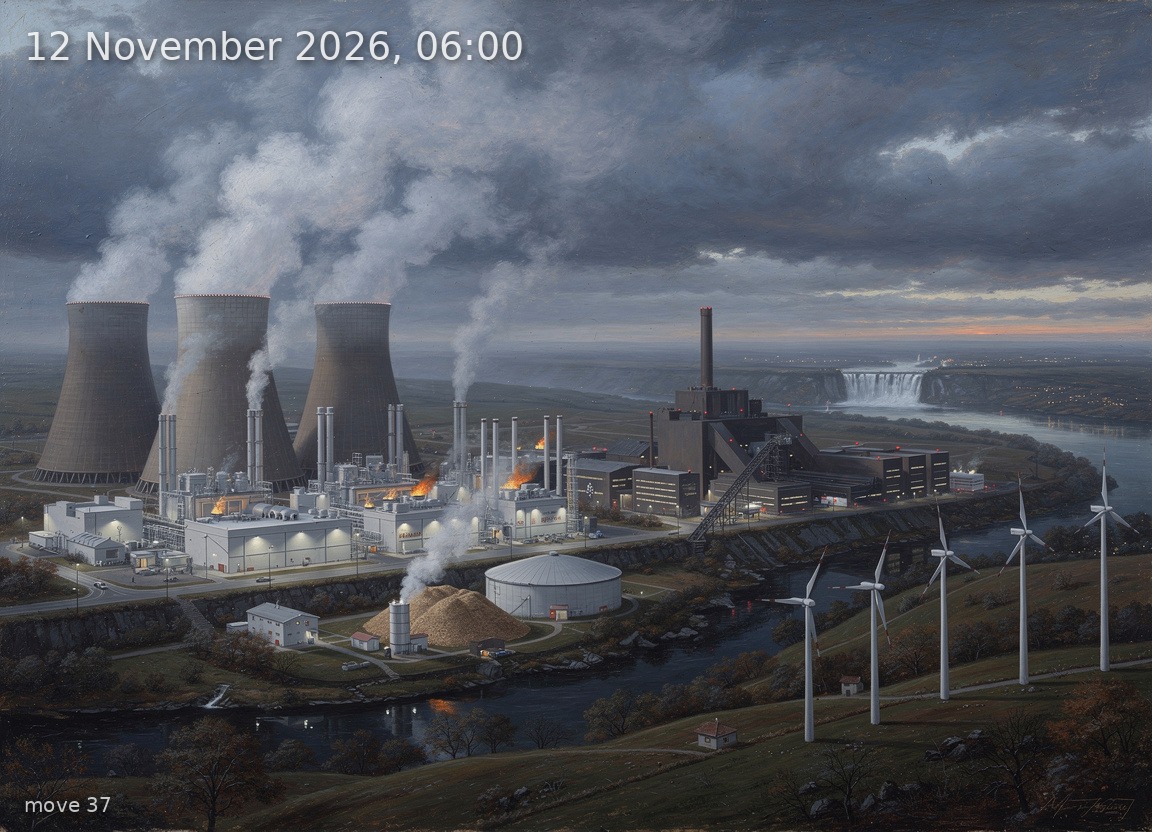
Lignite, gas, and coal dominate a dark, cold morning as high demand drives 11.5 GW of net imports.
Generation mix
Wind onshore 15%
Wind offshore 12%
Biomass 10%
Hydro 2%
Natural gas 24%
Hard coal 11%
Brown coal 25%
39%
Renewable share
12.5 GW
Wind (on + offshore)
0.0 GW
Solar
46.1 GW
Total generation
11.5 GW
Net import
211.9 EUR/MWh
Day-ahead price
5.8°C / 7 km/h
Temp / Wind speed
Open-Meteo, Kassel (51.3°N 9.5°E) · surface estimate from 100 m wind
100.0% / 0.0 W/m²
Cloud cover / Radiation
412
gCO₂/kWh
Image prompt
Brown coal 11.7 GW dominates the left quarter as a massive lignite power station complex with four hyperbolic cooling towers emitting thick white steam plumes into the dark sky; natural gas 11.2 GW fills the centre-left as a row of modern CCGT plants with tall slender exhaust stacks and glowing orange gas flares; hard coal 5.2 GW appears centre-right as a blocky coal-fired station with conveyor belts and a single large smokestack; wind onshore 7.1 GW occupies the right third as a line of three-blade turbines on ridgelines with slowly turning rotors; wind offshore 5.4 GW is suggested in the far-right background as turbines rising from a grey sea horizon; biomass 4.4 GW appears as a modest wood-chip-fed plant with a rounded silo and low steam vent near the centre; hydro 1.0 GW is a small dam structure visible in a valley in the far background. Time is dawn at 06:00 in November: the sky is deep blue-grey with the faintest pale pre-dawn glow along the eastern horizon, no direct sunlight, no sun visible. No solar panels anywhere — zero solar generation. The atmosphere is heavy and oppressive, reflecting the 211.9 EUR/MWh price: low thick clouds press down on the landscape. Temperature is near 6°C — bare deciduous trees, frost on brown grass, breath-visible cold. Sodium streetlights glow amber along an access road. The industrial facilities are lit with harsh white work lights. Cooling tower steam billows massively upward and spreads across the overcast ceiling. Style: highly detailed oil painting in the tradition of 19th-century German Romantic landscape painters — Caspar David Friedrich meets industrial sublime — rich colour palette of deep indigo, slate grey, warm amber from artificial lights, visible impasto brushwork, atmospheric depth and aerial perspective. Each technology rendered with meticulous engineering accuracy: turbine nacelles with three-blade rotors on lattice or tubular towers, lignite hyperbolic cooling towers with correct parabolic geometry, CCGT units with heat recovery steam generators. The scene conveys the weight of a nation's morning demand pressing on fossil infrastructure under a sunless sky. No text, no labels.