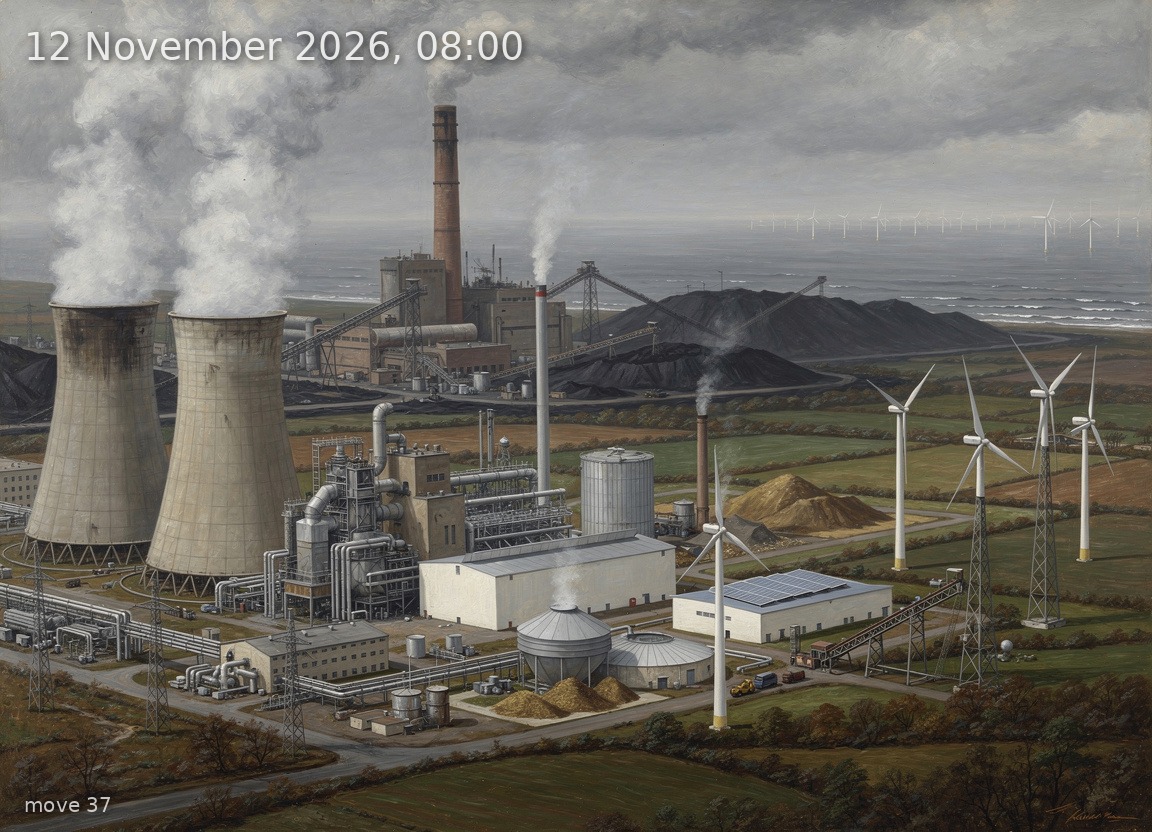
Brown coal, gas, and wind anchor a 47.8 GW supply against 65.3 GW demand, requiring ~17.5 GW net imports under full overcast.
Generation mix
Wind onshore 16%
Wind offshore 12%
Solar 3%
Biomass 9%
Hydro 2%
Natural gas 23%
Hard coal 10%
Brown coal 24%
43%
Renewable share
13.6 GW
Wind (on + offshore)
1.6 GW
Solar
47.8 GW
Total generation
17.4 GW
Net import
244.8 EUR/MWh
Day-ahead price
5.0°C / 13 km/h
Temp / Wind speed
Open-Meteo, Kassel (51.3°N 9.5°E) · surface estimate from 100 m wind
100.0% / 0.0 W/m²
Cloud cover / Radiation
382
gCO₂/kWh
Image prompt
Brown coal 11.3 GW dominates the left third of the scene as a massive lignite power station complex with four hyperbolic cooling towers emitting thick white-grey steam plumes rising into the overcast; natural gas 11.0 GW fills the centre-left as a cluster of modern CCGT plants with tall slender exhaust stacks and low rectangular turbine halls, their flues trailing translucent heat shimmer; wind onshore 7.7 GW spans the centre-right as dozens of three-blade turbines on lattice and tubular steel towers arrayed across rolling farmland, blades turning in moderate wind; wind offshore 5.9 GW appears in the far right distance across a grey North Sea horizon, rows of white offshore turbines barely visible through haze; hard coal 4.9 GW sits behind the lignite station as a smaller conventional coal plant with a single tall brick chimney and conveyor belts feeding from a dark coal heap; biomass 4.4 GW is rendered as a mid-ground industrial wood-chip plant with a rounded silo and short stack emitting pale smoke; solar 1.6 GW appears as a small field of aluminium-framed crystalline silicon panels in the mid-ground, their surfaces dull and reflectionless under the total cloud cover, producing minimal output; hydro 1.0 GW is a concrete run-of-river weir with a low powerhouse visible along a grey river in the foreground. Time of day: 08:00 November morning, full daylight but entirely diffuse — the sky is a uniform iron-grey ceiling of 100% stratus cloud with no sun visible, no shadows, flat cold light. Temperature 5 °C: bare deciduous trees, brown stubble fields, patches of frost on grass. The atmosphere feels heavy and oppressive, reflecting the extreme electricity price — a thick, brooding, suffocating overcast presses down on the industrial panorama. Style: highly detailed oil painting in the tradition of 19th-century German Romantic landscape art — rich, sombre colour palette of slate greys, ochres, umber browns, and muted greens, visible impasto brushwork, atmospheric aerial perspective with distant turbines fading into haze, meticulous engineering detail on every turbine nacelle, cooling tower, and exhaust stack. No text, no labels.