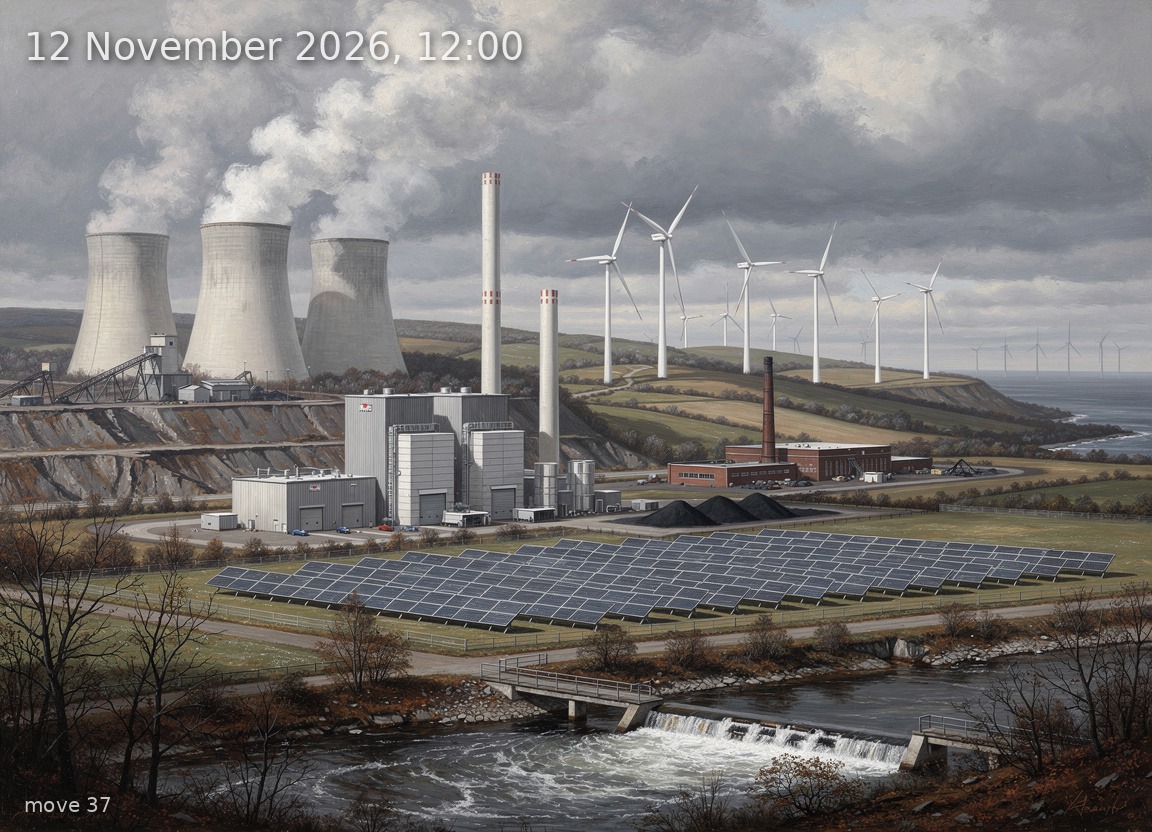
Wind, gas, and brown coal anchor a tight grid importing 7.7 GW under heavy overcast at elevated prices.
Generation mix
Wind onshore 22%
Wind offshore 10%
Solar 17%
Hydro 2%
Natural gas 22%
Hard coal 8%
Brown coal 20%
50%
Renewable share
18.4 GW
Wind (on + offshore)
9.8 GW
Solar
58.1 GW
Total generation
7.7 GW
Net import
184.1 EUR/MWh
Day-ahead price
5.4°C / 5 km/h
Temp / Wind speed
Open-Meteo, Kassel (51.3°N 9.5°E) · surface estimate from 100 m wind
91.0% / 21.8 W/m²
Cloud cover / Radiation
328
gCO₂/kWh
Image prompt
Wind onshore 12.8 GW spans the right third of the scene as dozens of tall three-blade turbines with white tubular towers and nacelles receding across low rolling hills; wind offshore 5.6 GW appears as a distant row of larger turbines on the far-right horizon above a slate-grey North Sea sliver. Brown coal 11.4 GW dominates the left quarter as a cluster of massive hyperbolic cooling towers with thick white-grey steam plumes merging into the overcast, alongside a conveyor-fed lignite bunker and broad open-pit mine terraces. Natural gas 12.8 GW fills the centre-left as two modern CCGT power plants with tall slender exhaust stacks emitting thin heat shimmer, their compact turbine halls rendered with corrugated steel cladding. Solar 9.8 GW occupies the centre foreground as a large field of aluminium-framed crystalline silicon PV panels tilted southward, their surfaces reflecting only dull grey sky with no sun glare. Hard coal 4.5 GW sits behind the gas plants as a single large facility with a prominent brick chimney and coal storage yard. Hydro 1.1 GW is a small run-of-river weir with foaming water visible in the near foreground along a river cutting through the scene. The sky is heavily overcast at 91% cloud cover, a uniform blanket of low stratus in tones of pewter and ash — full midday daylight diffused to a flat, shadowless brightness. The atmosphere feels heavy and oppressive, conveying the high electricity price. Temperature is 5.4 °C: bare deciduous trees with dark wet bark, brown fallen leaves on damp ground, patches of frost lingering in shadows, pale dormant grass. Wind is light at 4.8 km/h — turbine blades rotate slowly, steam plumes rise mostly vertically before drifting gently. The landscape is central German: gentle terrain, mixed farmland and industrial zones. Rendered as a highly detailed oil painting in the tradition of 19th-century German Romantic landscape painters — Caspar David Friedrich meets industrial realism — with rich layered colour, visible impasto brushwork, atmospheric depth and haze, meticulous engineering detail on every structure, dramatic tonal composition. No text, no labels, no human figures prominent.