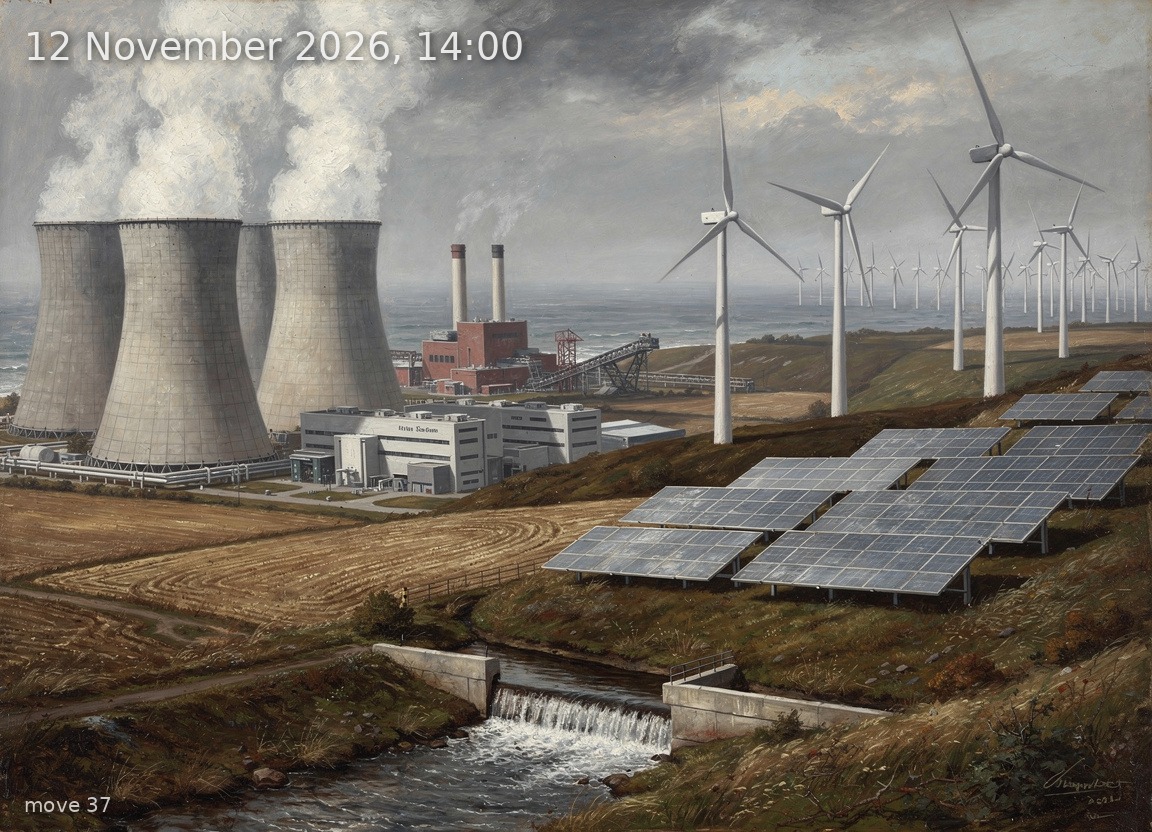
Wind leads at 23 GW alongside 16 GW coal and 12 GW gas as tight supply-demand balance lifts prices.
Generation mix
Wind onshore 30%
Wind offshore 10%
Solar 10%
Hydro 2%
Natural gas 20%
Hard coal 7%
Brown coal 21%
52%
Renewable share
22.9 GW
Wind (on + offshore)
6.0 GW
Solar
57.9 GW
Total generation
5.3 GW
Net import
182.5 EUR/MWh
Day-ahead price
7.2°C / 10 km/h
Temp / Wind speed
Open-Meteo, Kassel (51.3°N 9.5°E) · surface estimate from 100 m wind
61.0% / 94.5 W/m²
Cloud cover / Radiation
324
gCO₂/kWh
Image prompt
Wind onshore 17.3 GW dominates the right half of the composition as dozens of tall three-blade turbines with white tubular towers stretching across rolling, late-autumn farmland with brown stubble fields; wind offshore 5.7 GW appears in the distant right background as a cluster of turbines on a grey-blue North Sea horizon. Brown coal 12.0 GW occupies the left foreground as a massive lignite power station with four hyperbolic concrete cooling towers emitting thick white steam plumes rising into the overcast. Natural gas 11.7 GW fills the centre-left as two modern CCGT plants with slender exhaust stacks and compact turbine halls, thin heat shimmer visible above each stack. Solar 6.0 GW appears in the centre-right middle ground as several rows of aluminium-framed crystalline silicon PV panels on a gentle hillside, catching weak diffused light. Hard coal 4.3 GW sits behind the lignite station as a smaller coal plant with a single tall smokestack and conveyor belt structure. Hydro 1.1 GW is a small concrete run-of-river weir with modest spillway visible in a river cutting through the foreground valley. Time of day: early-to-mid afternoon in November, daylight but subdued—a flat, milky-grey sky at 61% cloud cover with patches of watery sunlight breaking through, direct radiation low, casting soft diffuse shadows. Temperature 7°C: bare deciduous trees with a few last brown-gold leaves clinging, damp earth tones, frost remnants in shaded hollows. Wind speed moderate: turbine blades caught mid-rotation with slight motion blur, grass bending gently. Atmosphere feels heavy, pressured, slightly oppressive—reflecting the high electricity price—with a low grey ceiling of stratocumulus and muted colour palette. Style: highly detailed oil painting in the tradition of Caspar David Friedrich and Carl Blechen, rich but restrained autumnal palette of umber, slate grey, pale gold, and steel blue, visible impasto brushwork in the clouds and steam plumes, atmospheric perspective with hazy industrial background fading into mist, meticulous engineering accuracy on every turbine nacelle, cooling tower profile, and PV module frame. No text, no labels.